❤️ Heart Rate Zone Training Calculator
Calculate your personalized 5 heart rate training zones using the Karvonen method for optimal cardio results
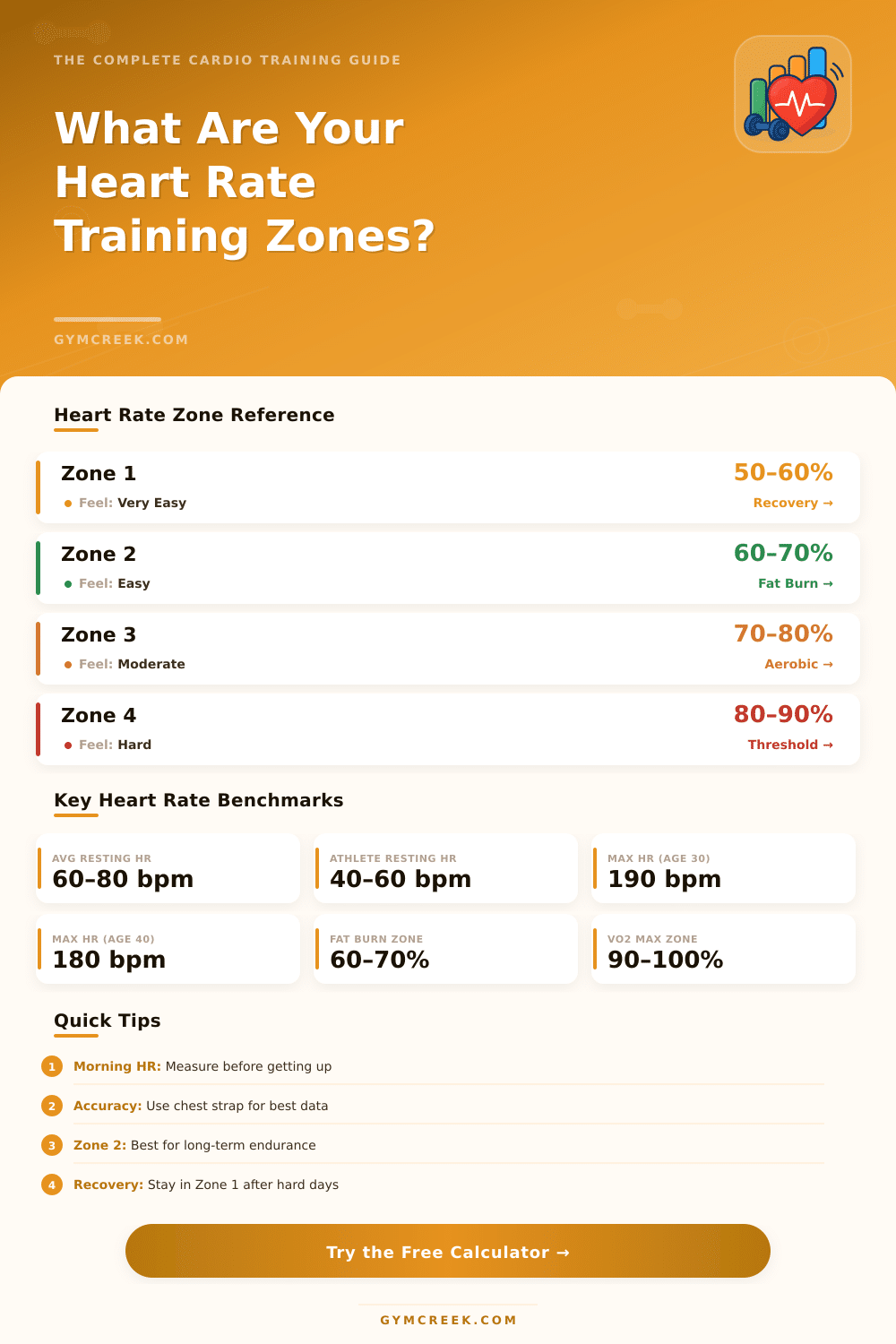
| Zone | Name | % Max HR | % HR Reserve (Karvonen) | Effort Feel | Primary Benefit | Typical Duration |
|---|---|---|---|---|---|---|
| Zone 1 | Active Recovery | 50–60% | 30–40% | Very Easy | Recovery, warm-up | Unlimited |
| Zone 2 | Fat Burning / Base | 60–70% | 40–55% | Easy – Comfortable | Fat oxidation, aerobic base | 45–180 min |
| Zone 3 | Aerobic / Tempo | 70–80% | 55–70% | Moderate – Somewhat Hard | VO2 max, cardiovascular | 30–60 min |
| Zone 4 | Lactate Threshold | 80–90% | 70–85% | Hard – Very Hard | Speed, lactate clearance | 10–30 min |
| Zone 5 | VO2 Max / Anaerobic | 90–100% | 85–100% | Maximum Effort | Peak performance, power | 1–8 min |
| Fitness Category | Male RHR (bpm) | Female RHR (bpm) | Typical Profile |
|---|---|---|---|
| Excellent (Athlete) | 40–50 | 44–54 | Elite / competitive sports |
| Very Good | 51–58 | 55–61 | Regular intense training |
| Good | 59–65 | 62–67 | Active 3–4x / week |
| Above Average | 66–70 | 68–72 | Light regular exercise |
| Average | 71–75 | 73–76 | Moderate activity |
| Below Average | 76–82 | 77–84 | Occasional activity |
| Poor | 83+ | 85+ | Sedentary lifestyle |
| Training Goal | Zone 1 | Zone 2 | Zone 3 | Zone 4 | Zone 5 |
|---|---|---|---|---|---|
| Weight Loss | 10% | 60% | 20% | 8% | 2% |
| Endurance Base | 15% | 65% | 12% | 6% | 2% |
| General Fitness | 10% | 50% | 25% | 12% | 3% |
| HIIT / Speed | 10% | 30% | 20% | 25% | 15% |
| Marathon / Race | 10% | 55% | 15% | 15% | 5% |
| Cardiac Rehab | 30% | 55% | 15% | 0% | 0% |
Heart Rate Zone simply are ranges of pulses per minute, that show how hard your body works during exercise or just during everyday activities. One counts them as percentages of your highest heart rate, so the fastest rhythm, that your heart can reach in one minute. There are five such zones, numbered from 1 to 5, and at higher levels of your pulse you reach a higher zone.
The traditional way to estimate your maximum heart rate is fairly easy: one takes 220 and subtract that by your age. Some women prefer to start from 226 instead. When you have that number, you can count your exercise zones, multiplying the maximum by various percentages.
What Are Heart Rate Zones
Even so, for real accuracy, better use your truly measured maximum rate than depend only on age-based guesses for your resting pulse.
Zone 1 sits between 50 and 60 percentages of your maximum. Here happens recovery, when you warm up or cool down, or simply move in the day, imagine walking or house chores. Zone 2 reaches around 60 to 70 percentages and works well for burning fat and building endurance.
Practical advice here: try talking while you move. When chatter folws naturally, you probably find yourself in Zone 2 or even lower.
In Zone 3 starts stronger intensity. Exercise hear helps to increase the blood flow through your heart and muscles. Also lactic acid starts to build at that level.
Lower zones like 1 and 2 depend mostly on fat with a bit of glucose, but when you enter Zones 3 and upward, your oxygen-using system reaches its limit, and the sugar-burning system kicks in.
Zone 5 is the hardest of the Training zones and needs long recovery after it. So one should not pass too much time here. Newcomers in exercise or inactive folks could not safely reach Zones 4 and 5, but as your oxygen Training grows, you can pass that limit.
Here the main point: your zones are personal. They adjust according to your current fitness, age and genes. A good exercise program combines sessions from all five zones.
Work in Zone 2 to build solid oxygen base helps your body handle more severe challenges and rest more quickly. Keeping a stable pulse in those zones truly strengthens your heart for long efforts.
For basics, aim for the lower part of the intended zone (around 50 percentages), and slowly raise it, which works well. Heart Rate Zone helps clear the trouble of different levels, which makes it easier to reach your weeklyTraining goals. Both the force of exercise and its length matter, especially if you aim for things like weight loss, muscle growth or run preparation.