Weight Loss Timeline Calculator
Set a realistic calorie deficit, protect lean mass, and map your path to a healthier goal date with practical timeline planning.
Timeline Snapshot
Calories, pace, macros, and target weight are estimated from your current size, activity, and lean mass assumptions.
| Phase | Deficit | Weekly loss | Best for |
|---|---|---|---|
| Mini-cut | 20-25% | 1.0-1.5% | Short push, fast trim, strict recovery focus |
| Steady cut | 15-20% | 0.5-1.0% | Most physiques, balanced performance, muscle retention |
| Slow cut | 10-15% | 0.25-0.5% | Already lean lifters, longer dieting windows, higher training load |
| Diet break | 0-10% | 0-0.25% | Recovery, adherence reset, maintenance rehearsal |
| Activity level | Multiplier | Typical pattern | Cut note |
|---|---|---|---|
| Sedentary | 1.20 | Desk job, low steps | Use conservative cuts first |
| Lightly active | 1.375 | Some walking, 2-3 lifts | Standard deficit works well |
| Moderately active | 1.55 | Most training schedules | Good balance of speed and recovery |
| Very active | 1.725-1.90 | High steps, frequent sessions | Protect carbs around training |
| Situation | Protein | Fat floor | Carb fill |
|---|---|---|---|
| Higher body fat | 2.0 g/kg LBM | 0.6 g/kg LBM | Fill the rest |
| Mid-lean cut | 2.2 g/kg LBM | 0.7 g/kg LBM | Prioritize training days |
| Very lean cut | 2.4 g/kg LBM | 0.7-0.8 g/kg | Conserve performance |
| Mini-cut | 2.4 g/kg LBM | 0.7-0.9 g/kg | Keep carbs around lifts |
| Profile | Suggested pace | Protein cue | Notes |
|---|---|---|---|
| Desk worker | 15% | 2.0-2.2 g/kg LBM | Use step count to set realistic maintenance |
| Runner | 10-15% | 2.2 g/kg LBM | Watch recovery and keep carbs higher |
| Strength athlete | 10-20% | 2.2-2.4 g/kg LBM | Use a slower cut near heavy blocks |
| Lean finisher | 10% | 2.4 g/kg LBM | Small deficits preserve fullness better |
| Formula | Inputs | Output | Use |
|---|---|---|---|
| Mifflin-St Jeor | Weight, height, age, sex | BMR estimate | Best when body fat is unknown |
| Katch-McArdle | Lean body mass | BMR estimate | Best when body fat is known |
| Maintenance | BMR x activity | TDEE | Starting point for the cut |
| Target weight | Lean mass + target BF | Goal scale weight | Helps define the finish line |
A weight loss timeline often includes faster scale changes in the first 4 to 6 weeks, then slower fat loss and possible plateaus as the body adapts. This is totally normal. No two people are exactly alike, so everyone’s weight loss timeline may be different.
Sustainable weight loss can be quite a bumpy ride and there is no one-size-fits-all solution.
How Fast You Can Lose Weight Safely
Weight loss occurs in two stages. The first stage is fast weight loss, where the body sheds water, glycogen, and some muscle. The second stage is slow weight loss, where fat loss becomes the main focus after glycogen stores are depleted.
In the first few days, it is common for the scale to drop several pounds. The important thing to remember is that this is water weight coming off, not body fat. The rates of loss fall off quickly, and that weight will likely return when the diet ends.
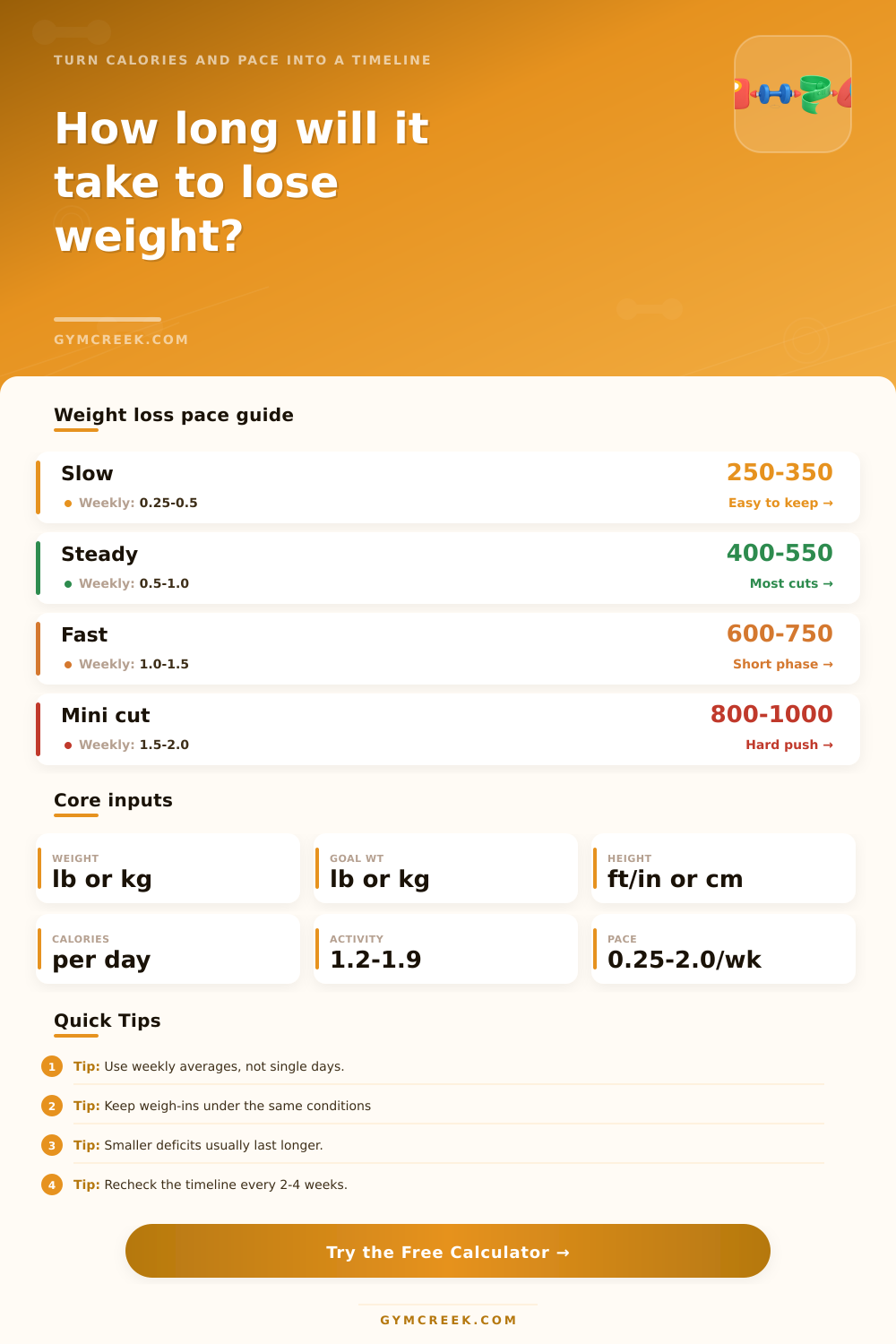
A safe and realistic weight loss goal is 1 to 2 pounds per week. The recommended pace for active weight loss is 0.5 to 2 pounds per week, which works out to an average daily deficit of 250 to 1000 calories. A 500 calorie deficit per day typically produces about 1 pound per week of loss.
Losing weight faster than 6 pounds per month on the high end risks increased muscle loss and loose skin. Targeting about 4 pounds per month is a better aproach. For sustained and healthy weight loss, limiting it to 4.5 pounds per month is a good idea.
More aggressive weight loss is not recommended because of loss of lean body mass. Realistic rates of fat loss for women with casual adherence amount to roughly 0.5 to 1 percent of bodyweight per week.
A healthy and realistic timeline to lose 20 to 25 pounds is about 3 to 6 months with steady diet and exercise. A simple formula works like this: take current weight minus target weight, then divide by weekly loss rate to get the number of weeks. For example, losing 20 pounds at 1 pound per week equals 20 weeks.
At 2 pounds per week, that puts it at 10 weeks if done as quickly as possible.
In the first 1 to 4 weeks, the scale may drop 2 to 4 pounds, mostly from water weight and initial fat loss. Starting a new exercise routine can actually cause water retention too. New gym activity alone can cause several pounds of water weight gain.
The lower the weight gets, the longer it tends to take. Weight loss often slows to smaller amounts per month toward the end.
Factors like medication, typical diet, and amount of weekly exercise all affect the timeline. Tracking calories, weight, and waist measurements for two weeks and then adjusting calories from that data is a smart starting point. Weighing in once a week is a good way to monitor progress overtime.