Muscle Mass Calculator
Estimate muscle mass from direct body fat, Navy tape measurements, or a blended method so you can compare body composition and track change cleanly.
| Formula | Inputs | Use | Output |
|---|---|---|---|
| Deurenberg | BMI, age, sex | No BF input | Fallback BF |
| US Navy | Waist, neck, hip | Tape mode | BF estimate |
| Lean mass | Weight and BF | Body comp | FFM |
| Muscle share | FFM, training | Final estimate | Muscle mass |
| Tier | Men | Women | Notes |
|---|---|---|---|
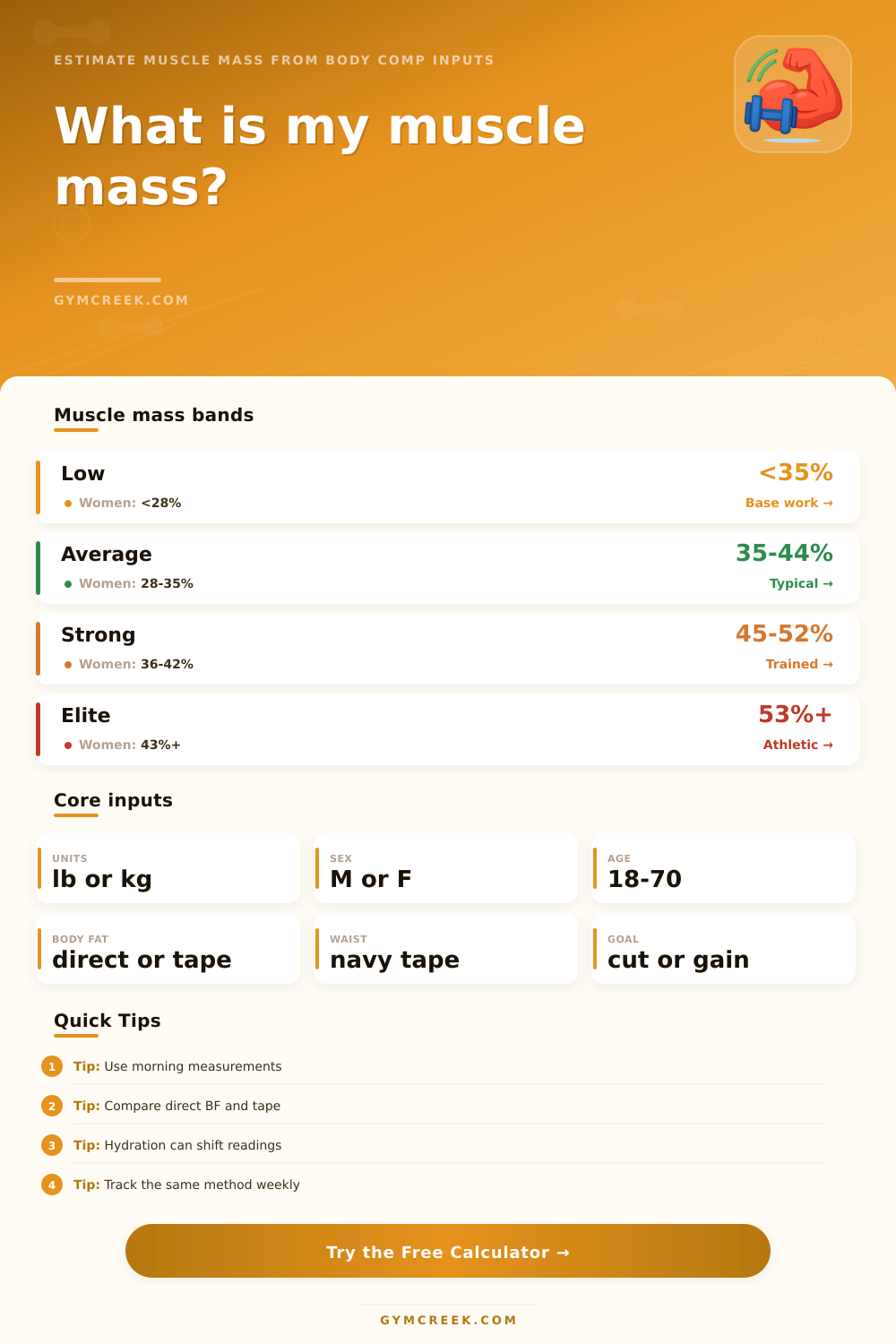
| Low | <35% | <28% | Base work |
| Average | 35-44% | 28-35% | Typical build |
| Strong | 45-52% | 36-42% | Trained look |
| Elite | 53%+ | 43%+ | Athletic level |
| Tier | Men BF % | Women BF % | Muscle cue |
|---|---|---|---|
| Essential | 2-5 | 10-13 | Very lean |
| Athletic | 6-13 | 14-20 | Higher share |
| Fit | 14-17 | 21-24 | Middle ground |
| Average | 18-24 | 25-31 | Build base |
| Profile | BF | Muscle share | Read |
|---|---|---|---|
| Desk worker | 18-25% | 35-43% | Build base |
| Beginner lift | 15-22% | 34-41% | Steady gains |
| Strength female | 18-28% | 32-44% | Keep lean mass |
| Masters athlete | 12-20% | 38-50% | Recover well |
Muscle mass refers to the weight and size of the smooth muscle tissue in the body. It is part of lean body mass, which also includes skin, bones, water, and organs. Building muscles and burning body fat often go together, although they are not the same thing.
Simply put, muscle mass measures the weight of muscles in kilos or pounds.
What Muscle Mass Is and How to Build It
Skeletal muscles make up about 30% to 40% of total body mass. They are the muscles that attach to bones and allow many movements and functions. Skeletal muscle refers especially to muscles that are attached to the skeleton and are responsible for voluntary movements.
General muscle mass covers all muscle tissues, including smooth and cardiac muscles. In everyday fitness talk there is no real difference between “muscle mass” and skeletal muscle.
Men usually have more skeletal muscle than women, both in absolute terms and relative to body mass. In addition, men have a bigger percentage of muscle in the upper body than women.
Maintaining good muscle mass matters for overall health and quality of life. It goes beyond just looks or athletic performance. Muscles are commonly called the engine of the body because they burn fat and calories.
More muscle mass helps to reduce body fat, strengthen the immune system, improve energy and reduce stress. Having more muscle also burns more calories during exercise and rest.
To build muscles, use compound exercises like bench press, squats, deadlifts, and military presses. A progressive program that starts at 50-60% of your one rep maximum and goes to 80-90% for few reps will bild strength and muscles. Muscle growth happens when muscles spend more time under tension.
Raise the heaviest weight that you can while you hit the intended reps. Bodybuilding programs usually recommend 8-12 reps, while strength programs favor 1-5.
Nutrition is likewise important. To add muscle, eating at a calorie surplus matters for experienced lifters. Protein should reach 0.8-1 gram per pound of lean body mass.
Protein is essential because exercise creates micro-tears in muscles, which the body fixes using amino acids from protein. Gaining muscle on a calorie deficit is only really possible for beginners with enough body fat.
Muscle gains are unfortunately slow over time. In the first year of regular training, most people get 0.5-2 pounds of muscle. Changing training methods helps keep exercises fresh and fun instead of repeating the same routine for months.
Genetics play a big part in how easily you build muscle. Body recomposition, which turns fat into muscle, is a long process that requires attention to nutrition, training programs andlifestyle choices.