FFMI Calculator
Estimate fat-free mass index, adjusted FFMI, lean mass, and goal weight from body fat, height, and body weight.
Calculation Breakdown
Goal Snapshot
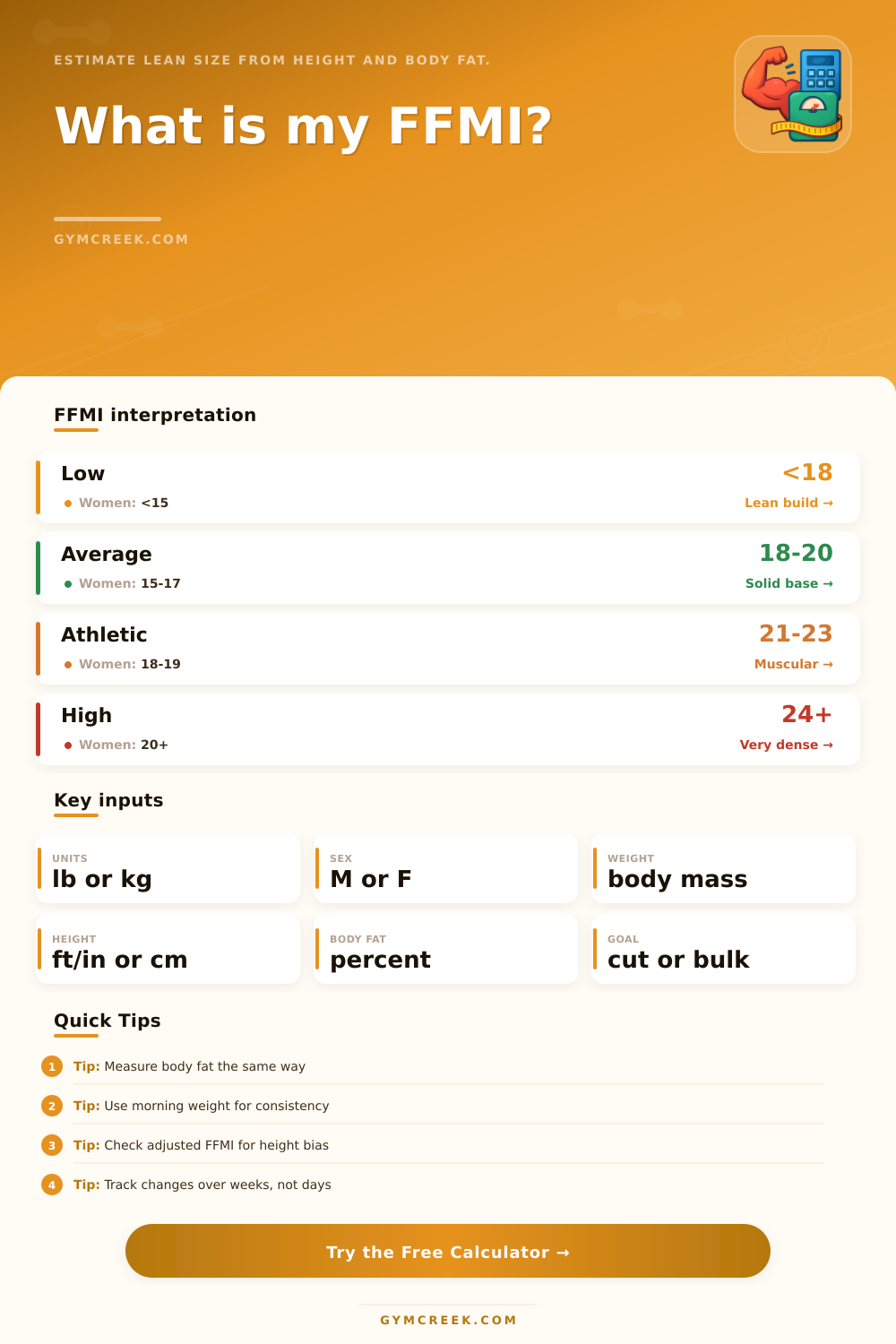
Standard Ranges
| Band | Adjusted FFMI | Look | Notes |
|---|---|---|---|
| Low | < 18.0 M / < 15.0 F | Lean or small | Often beginner or endurance focused |
| Average | 18.0 to 20.9 M / 15.0 to 17.9 F | Balanced base | Easy to maintain and improve |
| Athletic | 21.0 to 22.9 M / 18.0 to 19.9 F | Muscular | Common for strong lifters and field athletes |
| Advanced | 23.0+ M / 20.0+ F | Very dense | Big frame, long training age, or exceptional genetics |
Common Scenarios
| Scenario | Snapshot | Expected FFMI | Takeaway |
|---|---|---|---|
| Lean lifter | 5 ft 9 in, 160 lb, 10% | About 20.5 | Solid baseline strength build |
| Strong natural | 5 ft 11 in, 190 lb, 12% | About 22.9 | Upper natural range for many people |
| Female athlete | 5 ft 6 in, 145 lb, 18% | About 18.4 | Performance focused and visibly fit |
| Dense bulk | 6 ft 1 in, 230 lb, 18% | About 22.8 | Size comes with more total mass |
Formula Reference
| Formula | Equation | Use | Why it matters |
|---|---|---|---|
| Lean mass | Weight x (1 - BF%) | Fat-free tissue | Core number behind FFMI |
| FFMI | Lean mass / height^2 | Size relative to height | Compares physiques fairly |
| Adjusted FFMI | FFMI + 6.1 x (1.8 - H) | Height correction | Reduces short vs tall bias |
| Goal weight | Goal lean mass / (1 - target BF) | Target planning | Shows the scale weight needed |
Use the same body fat method every time so your FFMI trend stays meaningful.
Compare adjusted FFMI first, then check the lean mass and target weight outputs.
This calculator provides estimates only. Body fat methods vary, so treat the result as a comparison tool rather than a diagnosis or exact lab measurement.
FFMI stands for Fat-Free Mass Index. It measures lean body mass relative to height. Think of it like BMI but it actually considers body composition, so it is a better measure for muscularity.
BMI only looks at the total weight, while FFMI focuses on how much muscle mass someone has at a given height.
What is FFMI?
The formula is very easy. You take the lean mass in kilos and divide it by the square of the height in metres. Lean mass is the total weight without the fat.
It covers muscles, bones, organs and water; so everything that is not fat. FFMI belongs to the group of body indexes, together with the well known BMI.
Researchers created it in the 1990s to control the muscular growth of bodybuilders and estimate if some use steroids. Bodybuilders use this index to compare themselves with others. It also helps estimate the muscular potential and find where you lack.
For the general population, normal FFMI is around 16 for women and 19 for men. Values of 22 are clearly above the average and probably cannot be reached without weightlifting. Above 23 without good genitcs or steroids is said to be almost impossible.
FFMI under 19 shows little muscle, 19 to 20 is normal amount, 21 to 24 is above average mass, and above 25 shows chemically improved muscularity through anabolic steroids.
The said natural limit of 25 is a common talking point. But the raw data do not fully support a hard limit at 25. That number was found after a bit arbitrary correction.
Some natural outliers reached 26, although almost no one arrives there. A natural FFMI of 26 puts you in the most exclusive genetic group. The current natural Olympia classic champion had FFMI of only 24.46 on show day after a refeed of carbohydrates.
One point to recall: FFMI works best with low body fat percentage, around 10% or less. The used fat measure commonly errs, especially on simple scales. Use various ways to estimate the fat and average them for a better result.
Even a good scale only alters FFMI by some tenths.
There is a normalized version of FFMI that corrects for height, because the original was calculated for men of 1.80 m. The normalized value gives a more accurate picture. During training for muscle and fatloss, increase of FFMI shows success.