🏋 Sumo to Conventional Deadlift Calculator
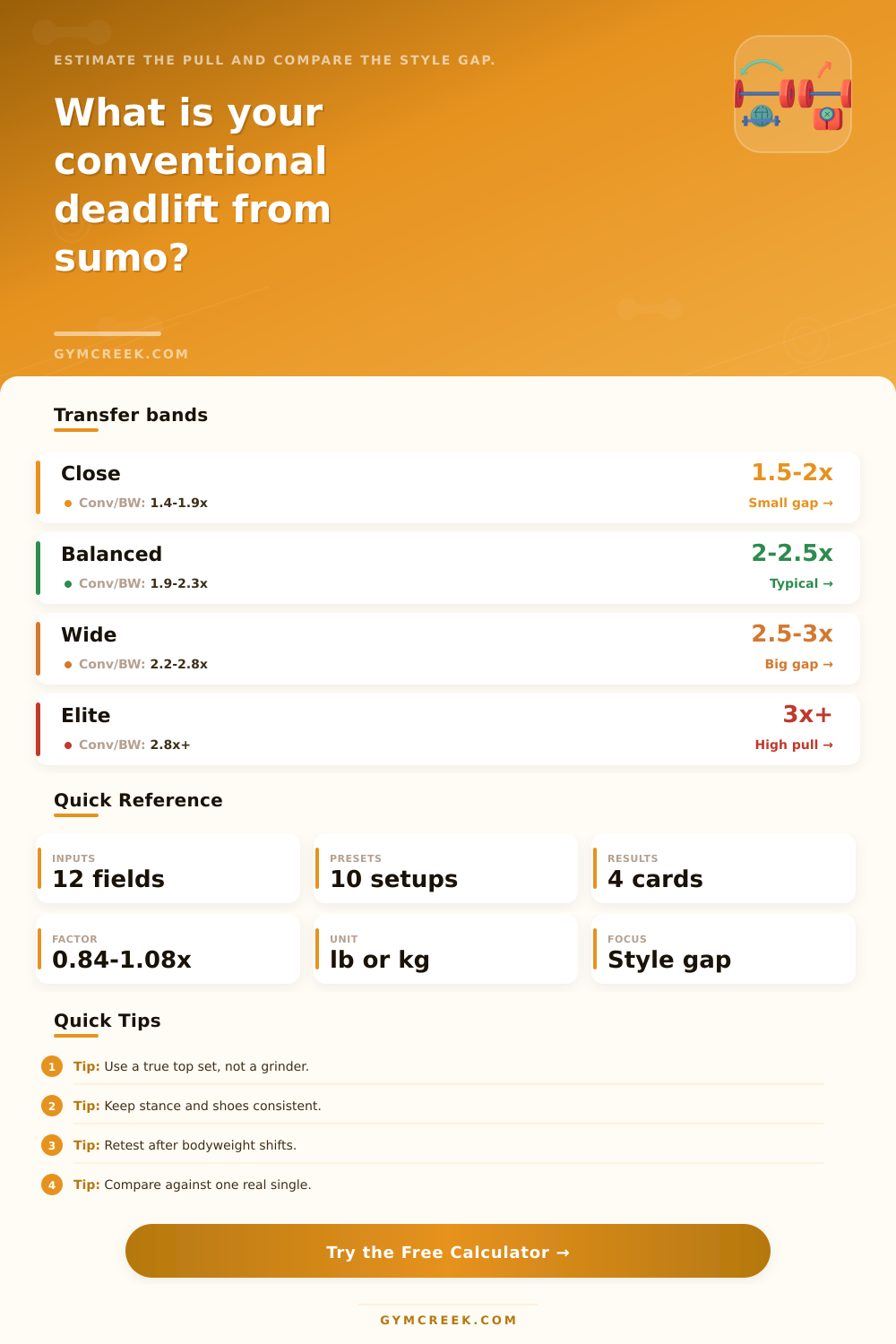
Estimate your conventional pull from a sumo top set, then compare the gap, ratio, and training target across real gym scenarios.
💪 Preset Pull Profiles
These presets mix body types, training ages, stance choices, and set quality so you can see how the sumo-to-conventional transfer shifts in practice.
📝 Athlete Inputs
Calculation Breakdown
📊 Fitness Metrics Grid
📖 Reference Tables
| Reps | Approx % | Use it for | Note |
|---|---|---|---|
| 1 | 100% | True single | Best signal |
| 3 | 93% | Heavy triple | Very stable |
| 5 | 86% | Strength set | Common range |
| 8 | 79% | Top work set | More fatigue |
| Band | Factor | Gap | Meaning |
|---|---|---|---|
| Conv edge | 1.00-1.08x | Small | Direct puller |
| Balanced | 0.96-0.99x | Moderate | Most lifters |
| Sumo edge | 0.92-0.95x | Clear | Wide stance |
| Big gap | 0.84-0.91x | Large | Very sumo |
| Input | Higher factor | Lower factor | Effect |
|---|---|---|---|
| Stance | Narrow | Very wide | Changes gap |
| Mobility | Stiff | Very mobile | Shifts bias |
| Experience | Specialist | Novice | Raises skill |
| Height | Shorter | Taller | ROM changes |
| Profile | Preset feel | Expected factor | Note |
|---|---|---|---|
| Novice bridge | Standard | 0.95-0.99x | Small sample |
| Meet prep | Tight | 0.97-1.02x | Closer test |
| Tall puller | Long lever | 0.90-0.96x | More gap |
| Strongman off | Brute force | 0.94-1.01x | Mixed carry |
💬 Practical Tips
⚠ Disclaimer
The sumo deadlift is a type of the barbell deadlift that powerlifters commonly use. During the sumo deadlift, the lifter takes a wide stance and grips the bar between the legs. The main difference of the sumo deadlift from the conventional version is the foot position of the lifter.
It copies the stance of a sumo wrestler with legs very spread and arms reaching inside between them
What is the Sumo Deadlift?
That lift trains the whole body, but it stresses most the quads, glutes, hamstrings and adductors. Compared to the conventional deadlift, the sumo version puts much more stress on the hips, glutes and hamstrings, which helps more in sports. The quads get a stronger stimulas in sumo, while conventional is harder on the spinal erectors.
Both kinds, mostly, work the same muscles.
Because of the sumo position, that gives more leg-push, you can lift heavy weights more easily without hurting the lower back. It is a fully valid deadlift with full range of motion. However the sumo has a bit shorter range, and for muscle growth long range is better.
The foot position and motion of the plate during sumo can change or quickly ease the weight in a deadlift attempt. Finding the right mix of intention, plan and process requires hundreds of repetitions, practice, analysis and correction. New sumo lifters benefit from resetting every repetition and using fast sets to set the technique.
A higher starting hip-position can be useful. A good test and helpful exercise is the sumo deadlift until knee height, just the first part followed by a slow move back to the floor.
Which lift is more difficult depends on body proportions. Length of limbs, quad dominance, flexibility and weight class all affect the best stance. People with long arms and legs but short torso commonly do better with conventional, while folks with long torso and short limbs do well with sumo.
Change to sumo helps against balance problems or back pain from conventional lifting. But it is much more technical.
It ranks among the most discussed exercises in the gym. Maybe sumo is a bit easier to lift, but that does not make it a cheat lift. For bodybuilding it is a variation with stronger use of the glute medius, that leaves the lower back less tired.
Bodybuilders should check which lift best hits the muscles they want. The sumo deadlift also trains the hip-hinge move and is special because of its skill to build fullbody strength.