🏋 Squat Weight Calculator
Estimate your 1 Rep Max, training zones & strength level from any set
Use a weight you can lift for 1–10 reps to failure — estimates become less accurate above 10 reps. Rest at least 2 full rest days before testing a true max. Always squat to parallel or below for a valid lift. Have a spotter present for heavy sets.
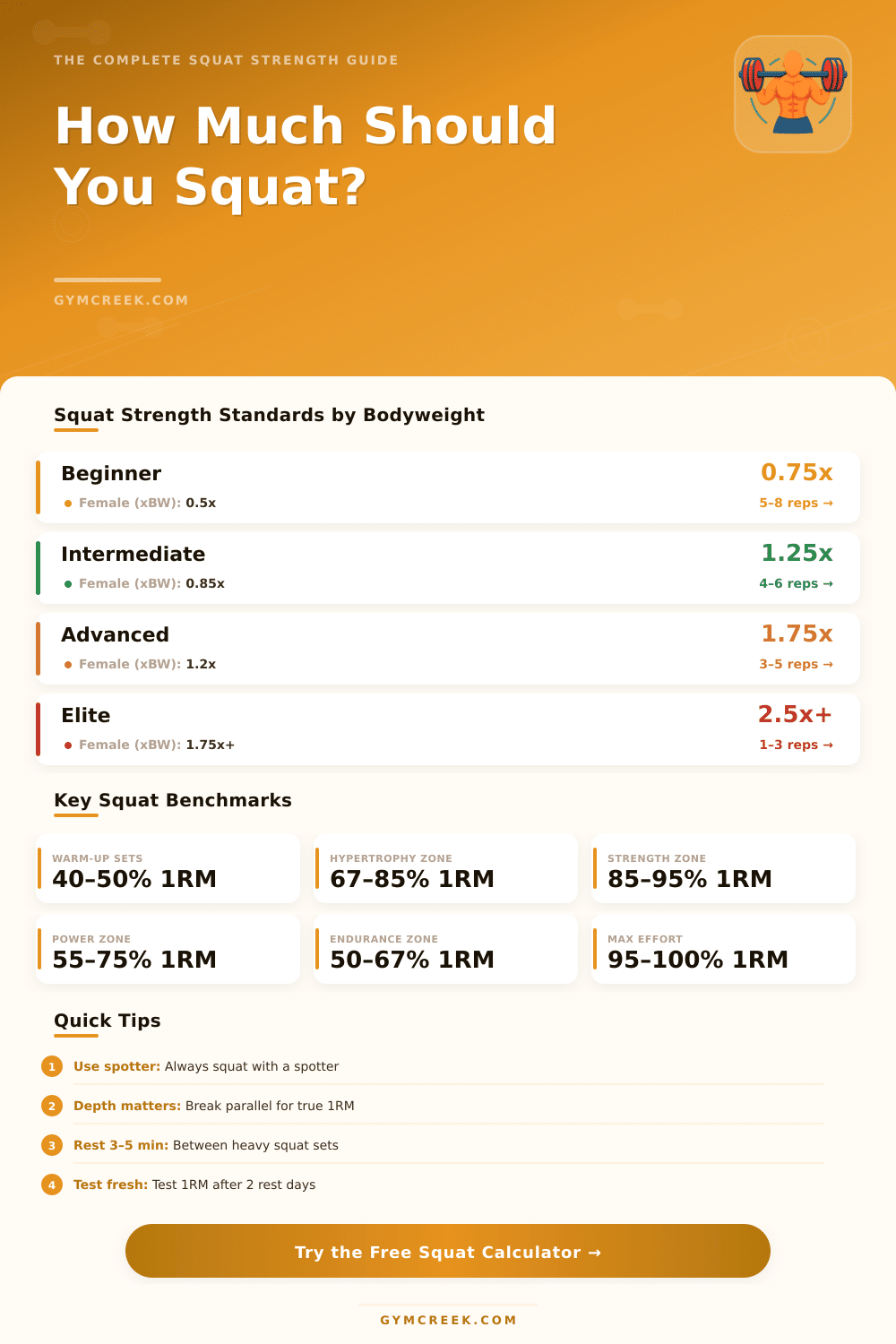
| Level | Male (x BW) | Female (x BW) | Male Example* | Female Example* | Training Focus |
|---|---|---|---|---|---|
| Untrained | < 0.75x | < 0.5x | < 131 lbs | < 88 lbs | Technique & consistency |
| Beginner | 0.75x – 1.0x | 0.5x – 0.75x | 131–175 lbs | 88–131 lbs | Linear progression |
| Intermediate | 1.0x – 1.5x | 0.75x – 1.0x | 175–263 lbs | 131–175 lbs | Periodized programming |
| Advanced | 1.5x – 2.0x | 1.0x – 1.5x | 263–350 lbs | 175–263 lbs | Advanced periodization |
| Elite | 2.0x – 2.5x | 1.5x – 2.0x | 350–438 lbs | 263–350 lbs | Sport-specific peaking |
| World Class | > 2.5x | > 2.0x | > 438 lbs | > 350 lbs | Competitive powerlifting |
*Example based on 175 lb male / 175 lb female bodyweight
| Zone | % of 1RM | Rep Range | Sets | Rest Period | Goal |
|---|---|---|---|---|---|
| Warm-Up | 40–50% | 10–15 | 2–3 | 60–90 sec | Activate & prime CNS |
| Endurance | 50–67% | 12–20 | 3–4 | 60 sec | Muscular endurance |
| Hypertrophy | 67–80% | 8–12 | 3–5 | 60–90 sec | Muscle size growth |
| Strength | 80–90% | 4–6 | 3–5 | 3–5 min | Max force production |
| Peaking | 90–95% | 2–3 | 3–5 | 4–6 min | Competition prep |
| Max Effort | 95–100% | 1 | 1–3 | 5–10 min | True 1RM testing |
| Reps | % of 1RM (Epley) | % of 1RM (Brzycki) | Typical Use |
|---|---|---|---|
| 1 RM | 100% | 100% | Max strength test |
| 2 RM | 97% | 97% | Near-max strength |
| 3 RM | 94% | 94% | Peaking / competition |
| 5 RM | 89% | 88% | Strength training |
| 6 RM | 86% | 85% | Strength / hypertrophy |
| 8 RM | 81% | 80% | Hypertrophy |
| 10 RM | 75% | 75% | Hypertrophy / endurance |
| 12 RM | 70% | 69% | Muscle endurance |
| 15 RM | 64% | 63% | Endurance / metabolic |
⏳ Time your rest periods. For strength-focused sets, rest 3–5 minutes between working sets. Insufficient rest artificially reduces performance and skews your 1RM estimate downward.
📏 Squat depth matters. A full squat (hip crease below the knee) is a different lift from a half squat. Always use consistent depth when testing — and note which standard you used.
📅 Retest every 4–8 weeks. As you progress, your 1RM will increase. Recalculate regularly to keep your training zones accurate and progressive.
DISCLOSURE: This post may contain affiliate links, meaning when you click the links and make a purchase, I receive a commission. As an Amazon Associate I earn from qualifying purchases.

The Weight for Squat are one of those themes that can seem hard to understand at first. For male newcomers, a good start level is around 141 pounds for one single repetition at maximum, which is quite good compared to the average crowd. Weights with barbell always include the mass of the bar itself which usually weighs 20 kg.
Or 44 pounds. This fact commonly surprises many newcomers.
Squat Weight Guide for Beginners
Average folk of male sex manage to raise Squat at around 265 pounds, while women on average reach 154 pounds. Males usually move from the base level at 0.75 times the body mass until middle at 1.5 times and to advanced at 2.25 times the body mass. Squat at 1.5 times the body Weight is really good target mark.
To explain, that means that one raises 1.5 times his own body Weight in metal above the body itself. Like this, folk weighing 150 pounds should be able to do Squat at 225 pounds.
To meet the standards of Squat, the thighs must go under the level of the floor. This is the right spot.
Exercising with body Weight alone Squat, that one also calls bodyweight Squat, form a good start. Later, one passes to version with extra mass, when the move already feels natural. Fixed position of the feet, wear the Weight spreads equally, forms the base for good body Squat.
The simplest way to add mass is to carry two dumbbells beside the body. Start with light weights and slowly grow them to help fast increase of the force. Squat can be hard, even so they should not cause pain.
A good program for newcomers is made up of 3 series of 5 repetitions, three times a week, with adding of around 5 pounds each time. When the adding of Weight in each session stops because of difficulty or form that starts dropping, one takes back some Weight and focuses on right movement control and full range. Later, one again builds the load upward.
Body Squat are possible without any extra Weight, what makes them great for those that recently exercise. One can adapt them to versions with mass by use of resistance band, dumbbell, kettlebell, barbell in back or front position or even cable device.
Goblet Squat work well, when one stands with feet broad as the hips and keeps a heavy dumbbell or kettlebell before the chest. The elbows turn down. With chest kept up proud and core tight, one slowly goes down into Squat by pushing the hips back and down, as if sitting on a chair.
When it feels too easy, one grows the mass or pauses one or two seconds at the bottom to add challenge.
During any Squat, the tension of the core and belly muscles helps to steady the spine. Chest stays up and stiff, head a bit raised, Weight lays on the heels while you push the hips toward the back wall; all this helps for good form. Doing Squat at home without Weight is more good than not doing them at all, but work with mass gives much better results for the whole lower body and the belly area.
Big moves with barbell, like the back Squat, allow bigger loads than most other exercises, because the Weight plates stack on the barbell and thenatural multi-joint moves pull more muscles.