Russian Deadlift Program Calculator
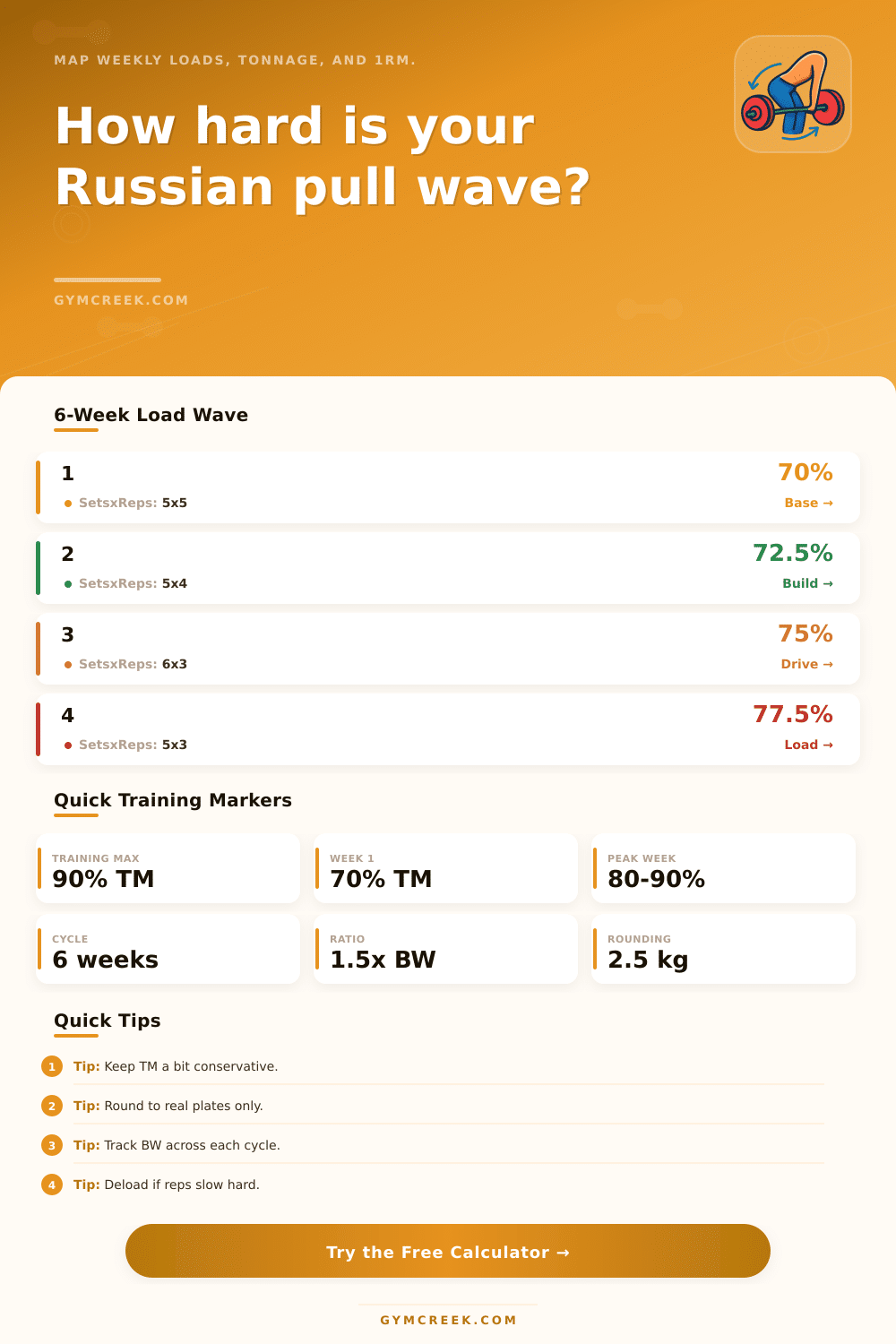
Build a Russian-style pull wave with training maxes, weekly percentage jumps, tonnage, and a projected end-cycle deadlift.
🏋 Russian Program Presets
🔧 Program Inputs
Russian deadlift wave snapshot
Enter values to see the weekly load wave, tonnage, and projected end-cycle pull.
📊Fitness Metrics Grid
📑Reference Tables
Cycle preview
Each row shows the selected week, the percentage of training max, the rounded load, and the weekly tonnage.
| Week | %TM | Load | Weekly tonnage |
|---|---|---|---|
| Enter values to preview the wave. | |||
Variation factors
Different deadlift variations change leverage, stress, and how aggressively the wave should be treated.
| Variation | Factor | Main effect | Use case |
|---|---|---|---|
| Conventional | 1.00 | Baseline pull | Standard wave |
| Sumo | 0.96 | Shorter range | Hips and speed |
| Deficit | 1.04 | More range | Off-the-floor |
| Block pull | 0.90 | Less range | Lockout overload |
Strength ratio standards
Use these bodyweight ratios as a quick context check when you compare one cycle to another.
| Ratio | Male band | Female band | Note |
|---|---|---|---|
| 1.25x | Novice | Novice | Start point |
| 1.50x | Club | Club | Solid base |
| 2.00x | Advanced | Advanced | Strong pull |
| 2.50x | Elite | Elite | High output |
Formula reference
The calculator uses simple percentage waves so the inputs stay easy to audit and repeat next cycle.
| Metric | Formula | Output | Why it matters |
|---|---|---|---|
| Training max | 1RM x TM% | Program base | Safer wave load |
| Week load | TM x %TM | Rounded bar load | Weekly prescription |
| Weekly tonnage | Load x reps x sets x sessions | Volume per week | Track fatigue |
| Projected gain | Cycle tonnage x factors | End-cycle 1RM | Estimate progress |
💡Practical Tips
Keep the training max honest so the wave stays recoverable.
Use the same plates and bar every cycle for cleaner comparisons.
The Russian deadlift is simply another name for Romanian deadlift or RDL. This exercise works the whole body and is very liked. It works well for home training because you need some dumbbells.
Compared to the classical deadlift, it is simpler to learn and strains less the lower back
What is the Romanian (Russian) Deadlift?
The main difference of the traditional deadlift is the start position of the move. At the RDL you lower the bar from the center of the thigh until under the knee and repeatedly upward. The classical version starts from the floor with straight arms, bent hips and straight back.
The RDL starts from up and never reaches the ground.
Rather than in the usual deadlift variations, the RDL underlines the lowering phase of the move. That helps to grow the muscles, improve their control and stability. To well execute the Russian deadlift, start with correct form and technique.
It is a deadlift with slightly bent knees, that genuinely works the hamstrings and glutes. Perfect for strengthening the back muscles.
RDLs very well train the hamstrings. This move well helps the classical deadlifts, strengthening hamstrings together with the whole body from top until bottom. Romanian deadlift is more easily done correctly than the traditional.
For beginners in deadlift, it is possible to start with this, with the bar on a rack.
RDLs work as light days for traditional deadlifts, usually with half until two-thirds of the weight according to the number of reps. Occasionally you call good mornings also Russian deadlifts, which can confuse. At the RDL it is chiefly hip hinge with little bend.
The traditional deadlift requires both hip and knees fully.
Deadlifts and Romanian deadlifts train the whole body. Glutes, hamstrings and back erectors form the main force of the body. Here exactly the exercises, that many fear because of back pain, but that indeed help the back feel better.
For stability, as single leg deadlifts, dumbbells or kettlebells operate well instead of a barbell. It is not need to overload stability with heavy weights progressively. You can do that with reps instead.