🏋️ One Rep Max Calculator with RPE
Estimate your 1RM using weight lifted, reps, and Rate of Perceived Exertion (RPE)
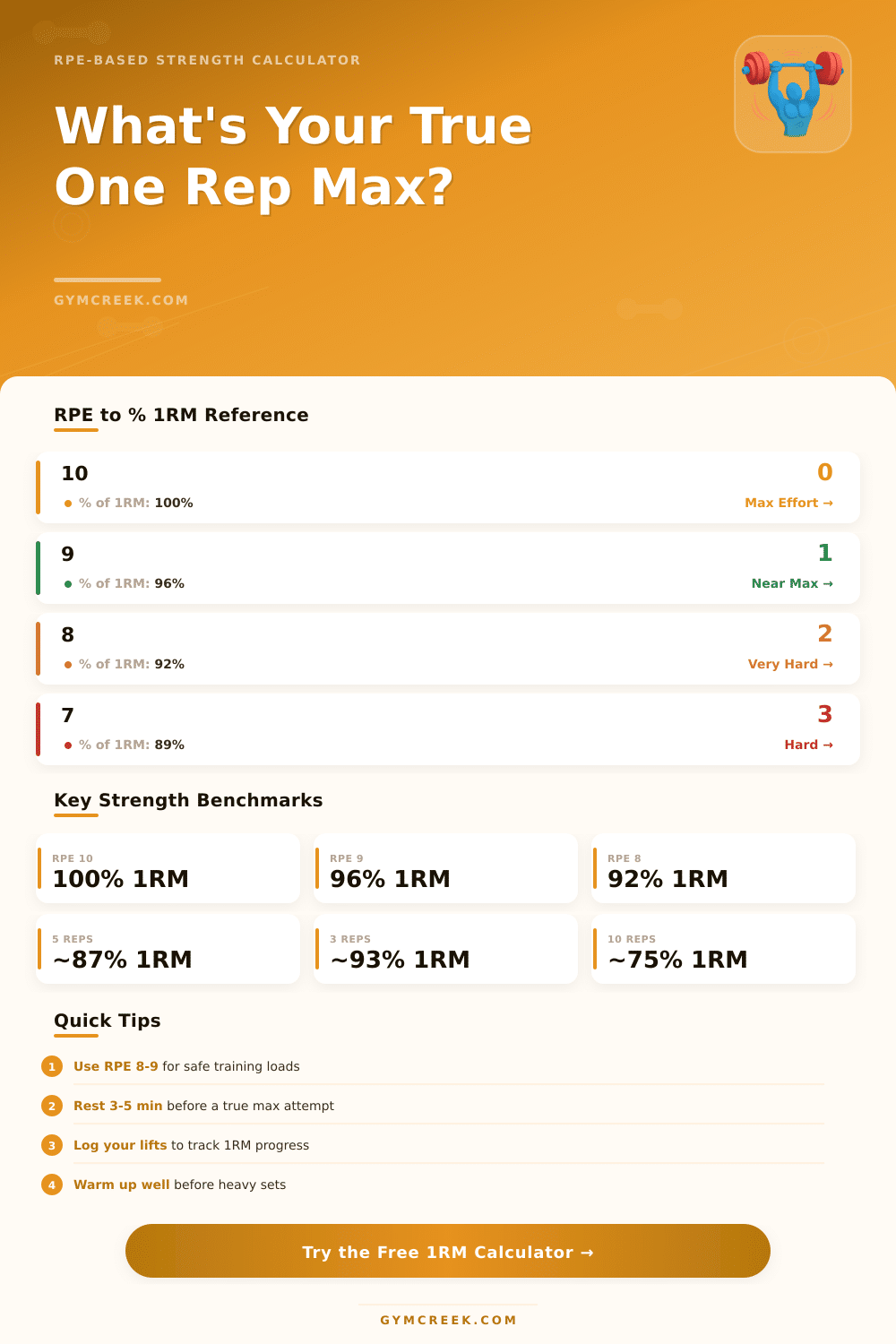
| RPE | Reps in Reserve | 1 Rep | 2 Reps | 3 Reps | 5 Reps | 8 Reps | 10 Reps |
|---|---|---|---|---|---|---|---|
| 10 | 0 | 100% | 97% | 94% | 89% | 82% | 77% |
| 9.5 | 0–1 | 98% | 95% | 92% | 87% | 80% | 75% |
| 9 | 1 | 96% | 93% | 90% | 85% | 78% | 73% |
| 8.5 | 1–2 | 94% | 91% | 88% | 83% | 76% | 71% |
| 8 | 2 | 92% | 89% | 86% | 81% | 74% | 69% |
| 7.5 | 2–3 | 90% | 87% | 84% | 79% | 72% | 67% |
| 7 | 3 | 88% | 85% | 82% | 77% | 70% | 65% |
| 6.5 | 3–4 | 86% | 83% | 80% | 75% | 68% | 63% |
| 6 | 4 | 84% | 81% | 78% | 73% | 66% | 61% |
| Reps (@ RPE 10) | % of 1RM | Training Zone | Primary Adaptation |
|---|---|---|---|
| 1 rep | 100% | Max Strength | Neural efficiency, peak force |
| 2–3 reps | 93–97% | Near-Max Strength | Strength, neural drive |
| 4–5 reps | 87–92% | Strength | Strength + some hypertrophy |
| 6–8 reps | 80–87% | Strength-Hypertrophy | Balanced strength & size |
| 9–12 reps | 70–80% | Hypertrophy | Muscle size (primary zone) |
| 13–15 reps | 65–70% | Hypertrophy-Endurance | Size + muscular endurance |
| 15–20 reps | 55–65% | Muscular Endurance | Endurance, metabolic stress |
| 20+ reps | <55% | Endurance | Metabolic conditioning |
| Exercise | Beginner | Intermediate | Advanced | Elite |
|---|---|---|---|---|
| Back Squat | 0.75x BW | 1.25x BW | 1.75x BW | 2.5x BW+ |
| Bench Press | 0.5x BW | 1.0x BW | 1.5x BW | 2.0x BW+ |
| Deadlift | 1.0x BW | 1.5x BW | 2.25x BW | 3.0x BW+ |
| Overhead Press | 0.35x BW | 0.65x BW | 1.0x BW | 1.35x BW+ |
| Barbell Row | 0.5x BW | 0.9x BW | 1.35x BW | 1.75x BW+ |
| Formula | Equation | Best For | Accuracy Note |
|---|---|---|---|
| Epley | w × (1 + r/30) | General use, >1 rep | Most widely used |
| Brzycki | w × 36 / (37 - r) | 1–10 reps | Accurate at low reps |
| Lander | 100w / (101.3 - 2.67123 × r) | General use | Research-validated |
| Lombardi | w × r^0.10 | Higher rep ranges | Less common |
| O'Conner | w × (1 + 0.025 × r) | Conservative estimate | Underestimates slightly |
| Mayhew | 100w / (52.2 + 41.9 × e^(-0.055 × r)) | Research setting | Good for 6–20 reps |
One Rep Max, usually written as 1RM, shows the biggest weight that a person can lift for one single repetition of any exercise while one keeps right form. It marks the heaviest load that one can complete for only one rep. That counts for every kind of movement, whether it is about deadlifts bench press, squats or any other exercise.
DISCLOSURE: This post may contain affiliate links, meaning when you click the links and make a purchase, I receive a commission. As an Amazon Associate I earn from qualifying purchases.

The word “maxing out” simply describes the gym way of pushing yourself to attempt a One Rep Max. It differs from just simply lifting a heavy single rep. A true One Rep Max uses everything from the physical and mental energy of a person to finish the lift. Any doubt hurts the result.
One Rep Max: What It Means and How to Test It
Any excuse like “I felt tired” or “I could have done more”. Everything that you manage to get in that last single rep becomes the new max.
One Rep Max usually applies to big, multi-joint barbell movements like deadlifts, bench press and squats, instead of more basic exercises like bicep curls. Squats use more muscles than curls and the maxes can change daily based on sleep and rest after prior workouts.
Testing a real max needs prep work. Working with lighter loads and fewer reps during some days to a week before really helps to ensure that the body rests well. One calls that deloading.
A good warm-up includes five to ten reps at fifty percent of the planned max, then three to five reps at seventy percent and one to two reps at eighty-two to ninety percent. A pause of two to five minutes before teh main set gives time to refill energy in the muscles. Testing a real One Rep Max will leave a person feeling drained for at least some days after that.
Even so not everyone needs to test a real max. Many calculators for One Rep Max are online. Those tools guess the top weight based on the amount of reps done with a lighter load. For best results, one uses a weight that one can lift for won to ten times.
Some calculators use formulas like Brzycki and Epley. The Wendler formula multiplies the lifted weight by the reps times 0.0333, then adds the lifted weight to reach the predicted max.
Knowing the One Rep Max matters because many training programs need you to work at percentages of it. A program maybe needs sets at seventy percent or ninety percent of the 1RM. Building strength from a five-rep max transfers well to One Rep Max. Training for strength really needs reps of six or less, rest periods of three to five minutes and weights around eighty-two percent of the 1RM.
It feels great tosee that max number grow over time.