🏋 Bench Press Percentile Calculator
Find out how your bench press compares to others your age, gender & bodyweight
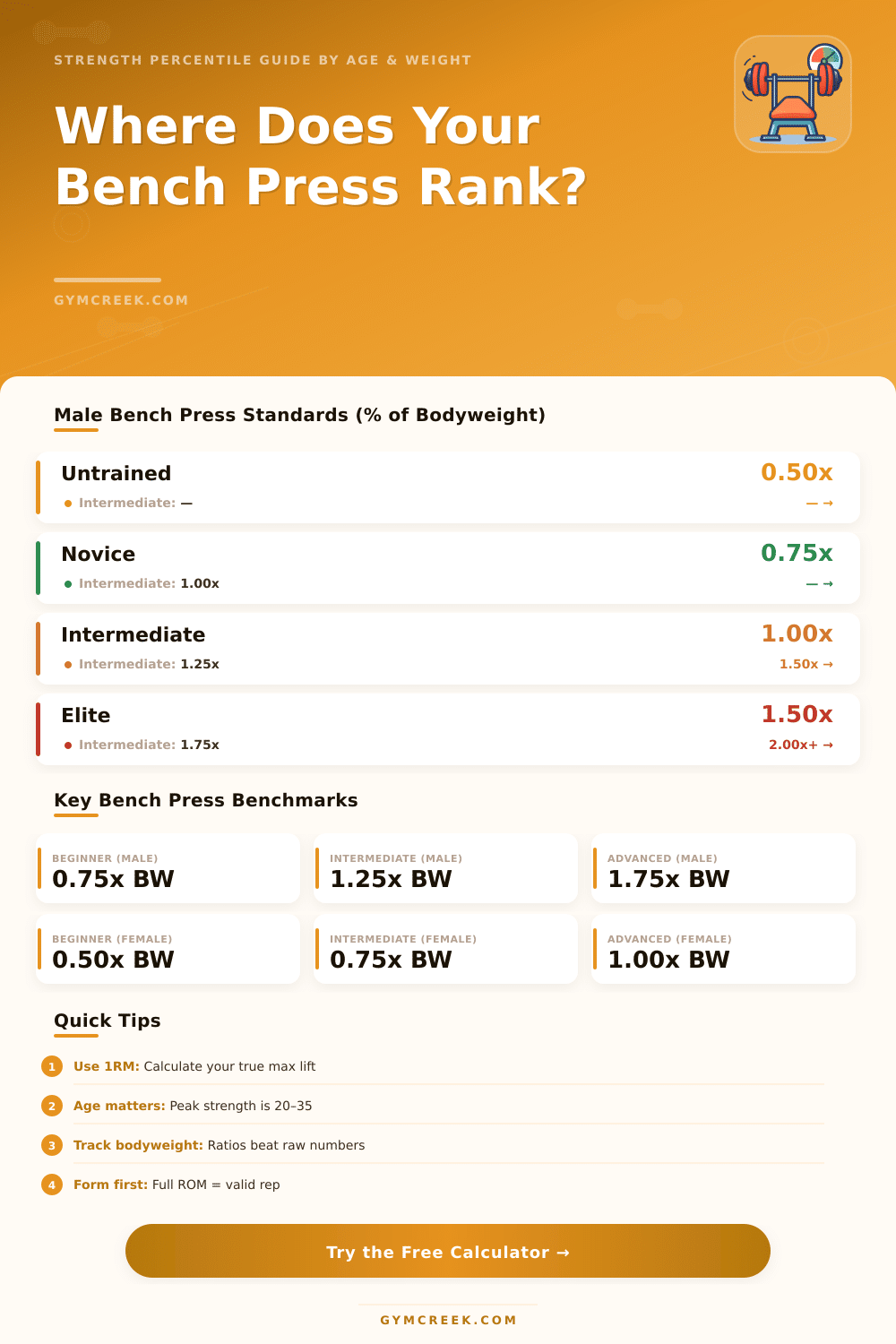
| Age Group | Untrained (<25th) | Beginner (25th) | Intermediate (50th) | Advanced (75th) | Elite (90th+) |
|---|---|---|---|---|---|
| 14–17 | <0.60x | 0.60x | 0.85x | 1.10x | 1.35x+ |
| 18–25 | <0.75x | 0.75x | 1.10x | 1.40x | 1.75x+ |
| 26–35 | <0.80x | 0.80x | 1.15x | 1.45x | 1.80x+ |
| 36–45 | <0.75x | 0.75x | 1.05x | 1.35x | 1.65x+ |
| 46–55 | <0.65x | 0.65x | 0.95x | 1.20x | 1.50x+ |
| 56–65 | <0.55x | 0.55x | 0.80x | 1.05x | 1.30x+ |
| 65+ | <0.45x | 0.45x | 0.65x | 0.90x | 1.10x+ |
| Age Group | Untrained (<25th) | Beginner (25th) | Intermediate (50th) | Advanced (75th) | Elite (90th+) |
|---|---|---|---|---|---|
| 14–17 | <0.30x | 0.30x | 0.50x | 0.70x | 0.90x+ |
| 18–25 | <0.40x | 0.40x | 0.65x | 0.85x | 1.05x+ |
| 26–35 | <0.45x | 0.45x | 0.70x | 0.90x | 1.10x+ |
| 36–45 | <0.40x | 0.40x | 0.65x | 0.85x | 1.00x+ |
| 46–55 | <0.35x | 0.35x | 0.55x | 0.75x | 0.90x+ |
| 56–65 | <0.28x | 0.28x | 0.48x | 0.65x | 0.80x+ |
| 65+ | <0.22x | 0.22x | 0.40x | 0.55x | 0.70x+ |
| Reps | % of 1RM | Example (135 lbs) | Example (185 lbs) | Example (225 lbs) |
|---|---|---|---|---|
| 1 | 100% | 135 lbs | 185 lbs | 225 lbs |
| 2 | 97% | 139 lbs | 191 lbs | 232 lbs |
| 3 | 94% | 144 lbs | 197 lbs | 239 lbs |
| 4 | 92% | 147 lbs | 201 lbs | 245 lbs |
| 5 | 89% | 152 lbs | 208 lbs | 253 lbs |
| 6 | 86% | 157 lbs | 215 lbs | 262 lbs |
| 8 | 81% | 167 lbs | 228 lbs | 278 lbs |
| 10 | 75% | 180 lbs | 247 lbs | 300 lbs |
| 12 | 70% | 193 lbs | 264 lbs | 321 lbs |
| 15 | 65% | 208 lbs | 285 lbs | 346 lbs |
Full range of motion counts: A valid bench press rep means the bar touches your chest and arms fully lock out at the top. Partial reps will inflate your number.
No belt or board: For standard percentile comparison, use a flat barbell bench press without board pressing or bouncing the bar off your chest.
1RM vs. rep max: If you've never maxed out, use your heaviest set and number of clean reps — the calculator will estimate your 1RM using the Epley formula.
The bench press exercise remain one of the most popular measure of upper body strength. Regardless of where you train, whether at a commercial gym, a powerlifting club, or even at home, it is always valuable to compare your bench press strength to others.
A bench press percentile calculator can provide insight into your strength based on your age, gender, and body weight.


Strength alone does not exist in a vacuum. Many individuals will find that their strength is impressive relative to their expectations but relatively less impressive when compared with others in a general population.
Factors such as age, gender, and body weight can have significant influence on strength levels. Understanding these factors allow for the setting of realistic goals or the tracking of genuine accomplishment.

What Is a Bench Press Percentile Calculator?
A bench press percentile calculator will calculate the percentage of the general population that can lift a specific amount of weight relative to your body weight. For instance, if an individual who weighs 180 pounds can perform a bench press of 225 pounds, they may find themselves in the 65th percentile for men in their thirties with their body weight.
This indicate that they can lift more than two-thirds of other men in their age group with the same body weight.
Bench press percentile calculators draw from research study of strength. Data from numerous weightlifting athletes of all ages and strength levels allow for calculations to determine where an individual’s strength level relative to others in the population.
Factors that are consider include age, body weight, and the decades of an individual’s life. An individual who can lift 225 pounds at the age of 22 is not comparable with an individual of the same lifting strength at the age of 52. An individual who weighs 150 pounds who can lift 225 pounds is not comparable with an individual of the same lifting strength who weighs 250 pounds.
Formula like the Epley equation allow individuals to calculate the one-repetition maximum, or 1RM, that an individual can lift. Most individuals do not regularly perform their 1RM exercises due to the risks involved. Instead, they perform sets of five or eight repetitions of the bench press exercise. The bench press calculator will use these set to calculate the percentile rankings of an individual’s strength.
Beyond determining an individual’s strength relative to others in the population, these calculators can help determine an individual’s training potential. An individual who is ranked in the 85th percentile for strength who has only been training for two years indicate a significant genetic response to strength training compared to others who have trained for the same length of time.
An individual who is in the 40th percentile for strength who has trained for five years may benefit from a review of their training techniques or methods. Individual relative strength to body weight is also calculate by percentile bench press calculators.
An individual’s ability to bench press their body weight have different implications based off their body weight. A lightweight weightlifter may have to compete with others who have lower bench press strengths than the individual in question compared to an individual who weighs more than the individual in question.

Age is another factor that many bench press calculators consider. An individual’s strength will naturaly decline as their testosterone level decrease and their body weakens with time. An individual who rates in the 30th percentile for strength at the age of 25 may have a 60th percentile ranking with their body at the age of 55. Understanding these natural declines in strength allow for individuals to adjust their training methods to avoid becoming discouraged throughout the years.
Gender difference in strength are another factor that strength calculators consider. Men have more muscle in their upper bodies and, therefore, possess significantly more strength than women. Yet, relative to their initial strength levels, women have a greater response to weightlifting than men. A quality bench press percentile calculator will account for these physiological difference.

An individual’s experience with weightlifting should also be considered. An individual who is just beginning to lift weights may have a 70th percentile for strength after six month of training. However, an individual who has trained for years may have the same percentile rankings. These percentile rankings can help an individual determine whether they need to make change to their training regimen.
As with all data collected, individuals can compare their results to their previous results using these calculators. While the percentile rankings provide a great overview of an individual’s strength, it is recommended to use these calculators in conjunction with other performance metric to provide a more accurate picture of an individual’s physical accomplishment. Bench press strength does not encompass overall physical strength or athleticism.
Yet, it remains a critical tool in an individual’s training journey. Regardless of where you are in your strength training journey, whether you are just beginning or focusing on more advanced bench press techniques, understanding your percentile rankings relative to others with similar characteristics can provide you with valuable insight into your training journey.