❤️ Heart Rate Zone Calculator
Calculate your Garmin-compatible training zones based on age, resting HR & max HR
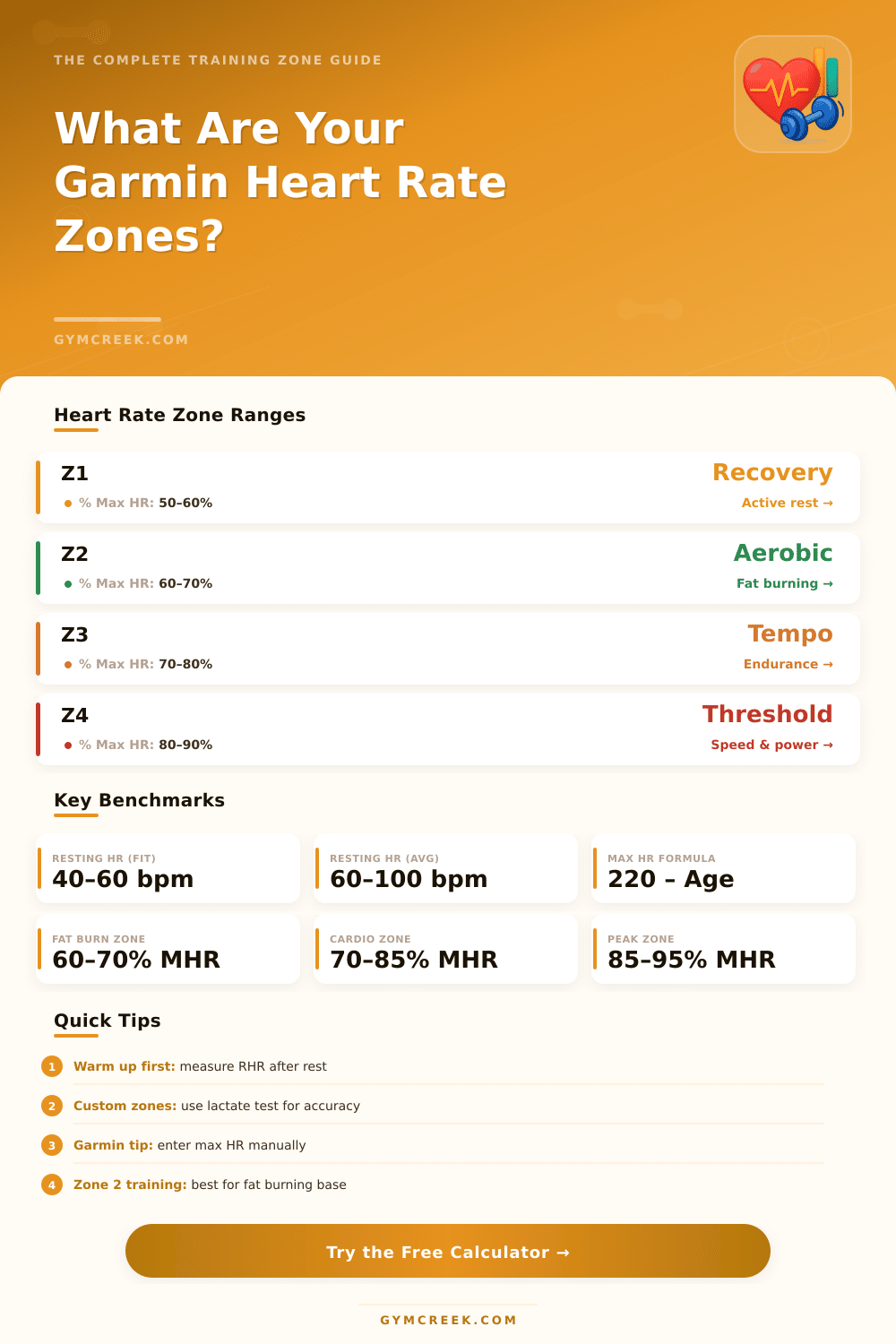
| Zone | Name | % Max HR | Garmin Label | Primary Benefit | Feel |
|---|---|---|---|---|---|
| Zone 1 | Recovery | 50–60% | Light Activity | Active recovery, warm-up | Very easy, can sing |
| Zone 2 | Aerobic Base | 60–70% | Easy | Fat metabolism, base fitness | Easy, full sentences |
| Zone 3 | Aerobic / Tempo | 70–80% | Aerobic | Cardiovascular fitness | Moderate, short phrases |
| Zone 4 | Lactate Threshold | 80–90% | Threshold | Speed, lactate clearance | Hard, few words |
| Zone 5 | VO2 Max / Peak | 90–100% | Maximum | Max performance, anaerobic | Max effort, no talking |
| Training Goal | Zone 1–2 | Zone 3 | Zone 4–5 |
|---|---|---|---|
| Fat Loss | 60–70% | 20–25% | 5–15% |
| General Health | 50–60% | 25–30% | 10–20% |
| Endurance Base | 70–80% | 10–15% | 5–15% |
| 5K / 10K Racing | 50–60% | 15–20% | 20–30% |
| Marathon Training | 65–75% | 10–15% | 10–20% |
| HIIT / Performance | 30–40% | 15–25% | 35–50% |
| Formula | Equation | Best For | Accuracy |
|---|---|---|---|
| Standard (Fox) | 220 – Age | General population | 녅 10–12 bpm |
| Tanaka | 208 – (0.7 × Age) | Older adults | 녅 8–10 bpm |
| Gulati (Women) | 206 – (0.88 × Age) | Women specifically | 녅 7–9 bpm |
| Lactate Test | Lab / Field test | Athletes | Most accurate |
| Karvonen (HRR) | (MHR – RHR) × % + RHR | Personalized zones | High (uses RHR) |
Heart rate zones are made up of ranges of beats per minute that match the level of effort that you feel when you push yourselves exercising. You count them based on your maximum heart rate, that is the highest speed that your heart truly reaches when you give everything you have. Those zones help you understand how much effort your body puts out, whether this happens during planned training or simply while you move through the days.
DISCLOSURE: This post may contain affiliate links, meaning when you click the links and make a purchase, I receive a commission. As an Amazon Associate I earn from qualifying purchases.

There are five separate zones each of them pointing to a different level of effort. Zone 1 involves 50% to 60% of your maximum heart rate. It stays fairly easy; you can chat freely without heavy sweating.
Easy Guide to Heart Rate Zones
Here happen warm-ups, cooldowns and easy rest periods. Zone 2 sits between 60% and 70%, and truly it ranks among the most useful if you want to burn fat while you build your endurance. If you spend training time in zone 2, you build a stronger aerobic base, which allows your heart to adapt better to harder efforts later.
Zone 3 brings everything from low to middle intensity. Here your blood flow improves in the heart and in the muscles. And yes, here starts also the buildup of lactic acid.
Zone 5 forms the highest level, after it you need longer rest, since the majority of folks aviod too many training hours here.
A fast way to estimate your maximum Heart Rate Zone is to take 220 and subtract your age. So if you are 30 years old, that gives about 190. After you have that number, you find every zone by multiplying it by the right percentage.
There is also the Karvonen formula, that requires a bit more effort, you subtract the resting heart rate from the maximum, multiply by the wanted percentage, then you add the resting rate again. Using your real values instead of only age-based guesses usually results in more accurate training zones.
Heart rate training shows great benefit. A person that is usually at home could not safely reach zones 4 and 5, but as aerobic fitness improves, that ability grows. For beginners, aim for the bottom limit of your target zone, say around 50%, and slowly climb, that makes much more sense.
The most commonly aimed for zone sits somewhere between 55% and 85% of the maximum heart rate. Middle intensity usually reaches 50% to 70%. While you work at 60% to 75%, you find that sweet balance, wear everything feels challenging but not extreme.
A simple way to check your heart rate during training? Find your pulse at the wrist, count the beats during ten seconds, and multiply that by six.
For endurance sports like running, cycling and triathlons, around 80% of your training should happen in zones 1 and 2, while the remaining 20% spreads through zones 3 to 5. Different sports need different zones, because factors like weight-bearing versus non-heavy activity play a role. The talk test works well also, if you can talk freely, you probably find yourself in zone 2 or below.
Your body uses different fuels in every zone, where zones 1 to 2 depend a lot on fat, whilehigher zones lean more toward stored energy.