Cycling Saddle Height Calculator
Start with the classic LeMond inseam rule, then layer in crank length, cleat placement, pedal stack changes, flexibility, and discipline so the number feels closer to a real fit, not a forum guess.
📌Real Presets
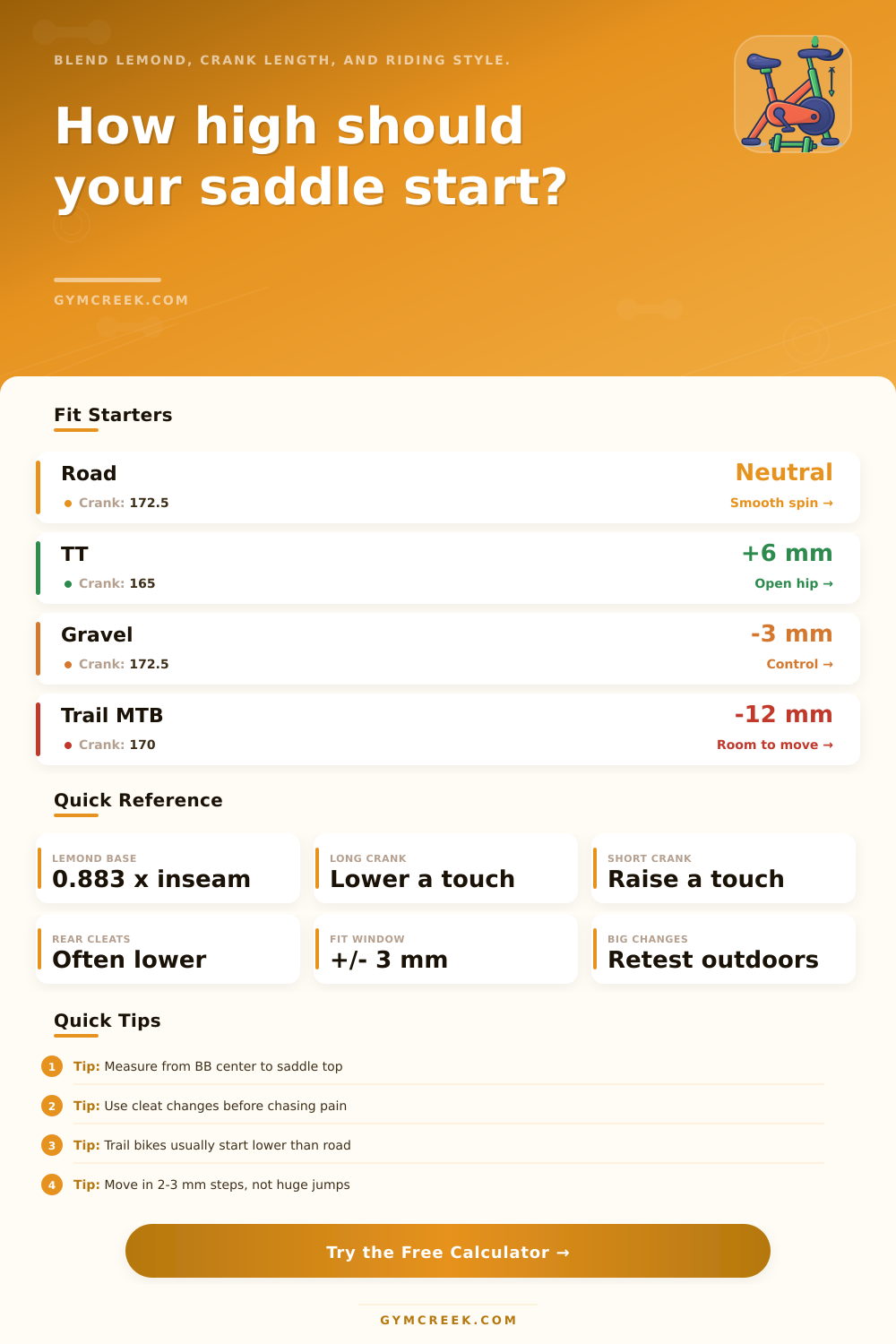
Each preset loads a believable inseam, crank, and riding brief so you can see how road, gravel, TT, and MTB positions drift away from the same pure LeMond start point.
⚙Fit Inputs
Adjusted saddle height target
Enter your measurements to compare LeMond against a more tailored fit number.
📊Fit Metrics
📑Reference Tables
| Discipline | Bias | Why | Typical feel |
|---|---|---|---|
| Road endurance | 0 mm | Neutral LeMond start | All-day spin |
| TT / tri | +6 mm | Shorter cranks and open hip angle | Steady aero |
| Gravel all-road | -3 mm | Extra control on rougher surfaces | Loose but efficient |
| Trail MTB | -12 mm | More room for body movement | Technical stability |
| Crank | Bias | Reference | Read |
|---|---|---|---|
| 165 mm | +7.5 mm | vs 172.5 | Raise slightly |
| 170 mm | +2.5 mm | vs 172.5 | Near neutral |
| 172.5 mm | 0 mm | Baseline | Standard road |
| 175 mm | -2.5 mm | vs 172.5 | Lower slightly |
| Change | Bias | Reason | Reminder |
|---|---|---|---|
| Taller stack | Lower same amount | Foot sits higher | Retest saddle tilt |
| Shorter stack | Raise same amount | Foot sits lower | Watch toe point |
| Forward cleat | +2 mm | More ankle reach | Usually firmer feel |
| Rearward cleat | -3 mm | Less plantar flex | Often calmer on climbs |
| Inseam | LeMond start | Common bikes | Note |
|---|---|---|---|
| 740 mm | 653 mm | Smaller road frames | Check crank overlap |
| 780 mm | 689 mm | Mid-size gravel bikes | Often easy to fine-tune |
| 820 mm | 724 mm | Typical adult road fits | Good neutral benchmark |
| 860 mm | 759 mm | Taller riders | Long cranks matter more |
💡Fit Tips
Saddle heights is the measurement from the bicycle saddle to the pedals. The saddle height can significant impact how a person pedals on a bicycle. Setting the saddle height incorrectly can cause discomfort in the knee or hips of the bicyclist.
Setting the saddle height incorrectly can also make it difficult for a person to generate the power necessary to ride the bicycle efficient. To find the starting height for the bicycle saddle, measure the inseam of the bicyclist. The inseam are the distance from the crotch to the floor of the persons shoe when standing barefoot against a wall.
How to Set Your Bike Seat Height
To calculate the target height for the bicycle saddle, use mathematical formula based off the inseam measurement. For example, one formula, the LeMond method, calculate the distance from the bottom bracket to the saddle by multiplying the inseam length by 0.88. This formula aims to allow the bicyclist to extend their leg when cycling without straining the knees.
Several variable may impact the saddle height of a cyclist. For example, the length of the crank arms will change the height of the bicycle’s pedals when viewed from the side of the bicycle. Using longer crank arms will raise the height of the bicycle’s pedals.
Using shorter crank arms will lower the height of the bicycle’s pedals. The position of the cleat on the bicycle shoe can change the height of the bicycle’s pedals when viewed from the front of the bicycle. Placing the cleats towards the front of the shoe will raise the height of the bicycles pedals.
The type of cycling that a person do will change the saddle height that that person uses. For example, road cyclists may use taller saddle heights to gain more pedaling power. Gravel cyclists may use lower saddle heights to increase there stability on uneven terrains.
Mountain bikers use lower saddle heights so that they can move their bodies more easy when descending mountains on their bicycles. The weight of the bicycle and its accessories may also impact the saddle height that a person use when cycling. For example, a person who rides with bikepacking accessories on their bicycle may need to adjust the height of the bicycle saddle to maintain control of the bicycle.
Make adjustment to the height of the bicycle saddle in small increments. Do not adjust the height of the bicycle saddle drastic. Instead, make adjustments of only two or three millimeter at a time.
Test these adjustments on flat roads that is familiar to the cyclist. If the cyclist feel like their hips are twisting when they are cycling, the height of the bicycle saddle is likely too low. If the cyclist feels any pain in the front of the knee while cycling, the height of the saddle may be too high.
A persons flexibility may impact the height of the saddle. For example, a person with tight hamstrings may have to adjust the height of their saddle to avoid discomfort and pain in their lower back. A person who is flexible may be able to ride with a different saddle height then a person with tight muscle.
Because all humans are physically different than each other, there is no way to calculate the perfect height for the bicycle saddle for each individual. Only by riding the bicycle at different speeds and with different intensities can a person determine the perfect height for their bicycle saddle. Remember that the height of the bicycle saddle impact the power with which a person can pedal the bicycle.
By making small adjustments to the height of the bicycle saddle, a person will be able to find the most comforty position while cycling on a bicycle.