The Navy Physical Readiness Test, or PRT, was created to assess the physical readiness of sailor. The Navy Physical Readiness Test consist of three different types of tests to measure a sailor’s physical readiness. The first event measure a sailors cardiovascular fitness, which require the sailor to run, swim, bike, or row a certain distance or for a certain amount of time.
The second event measure a sailors muscular endurance, which require the sailor to perform either push-ups or a plank hold. Finally, the third event measures a sailors core stability, which require the sailor to perform as many curl-ups as possible. Each of these test uses different standards to assess the physical readiness of sailors according to there age and gender.
How the Navy Physical Readiness Test Works
This standard takes into consideration that the physical capabilities of sailors differs with age. The overall score on the Navy Physical Readiness Test is derived from the lowest score of the three individual events. For instance, if a sailor score well on the cardiovascular and muscular endurance events but scores poorly on the core stability event, that sailor will receive an overall score based upon the score from the core stability event.
Therefore, sailors must have good physical fitness in each of the three category in order to achieve a high score on the Navy Physical Readiness Test. As a result, sailors should always work to maintain there ability to score well in each of the three events. Sailors of different ages and gender have different standards for passing each of the Navy Physical Readiness Test events.
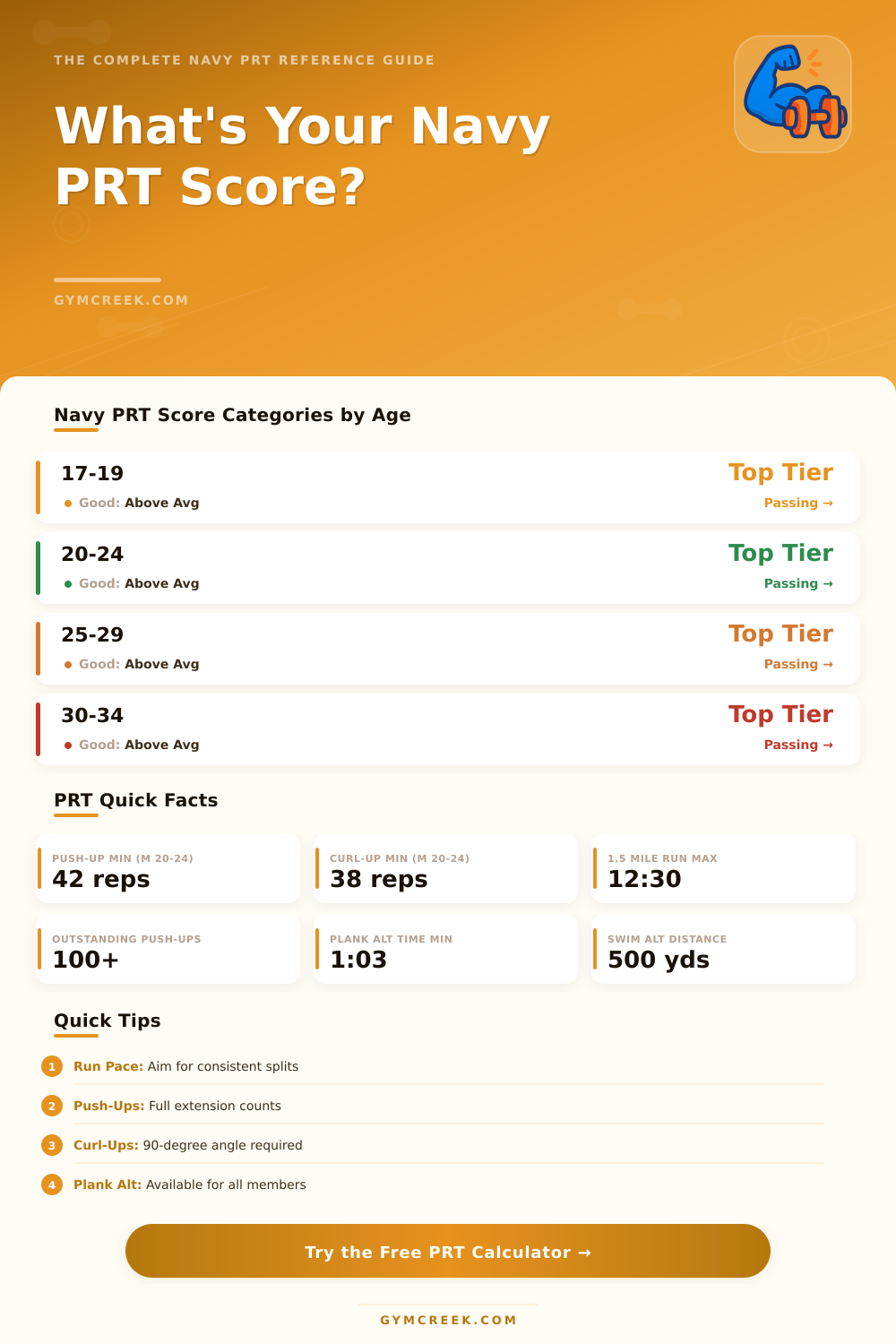
For instance, a male in his early twenties must run a distance of under 9:10 minutes to receive an outstanding rating on the Navy Physical Readiness Test, but will receive only a satisfactory rating if he takes 12:30 minutes to run that distance. In contrast, a female in her early twenties will receive an outstanding score for a run time of 10:20 minutes, but will only receive a satisfactory score if she takes 14:30 minutes to run that distance. These times ensure that sailors have the physical strength and endurance to move while performing physical task with heavy gear.
Additionally, sailors with shoulder injuries may be exempt from performing push-ups and must instead perform a plank hold instead. Plank holds are an isometric exercise that all group of sailors can perform, regardless of gender. Many sailors fail to reach higher categories within the Navy Physical Readiness Test because of there lack of understanding of how specific improvements to individual physical events can improve an individual’s Navy Physical Readiness Test score.
For instance, a male between the ages of 20 and 24 must perform at least 35 push-ups to receive a good Navy Physical Readiness Test score; however, if he can perform 42 push-ups in the same amount of time, he can earn an excellent rating. Therefore, individuals of all age can use tools to input there age and the scores for each of the Navy Physical Readiness Test events to determine how there score may change. Additionally, if a person chooses to complete a plank hold instead of push-ups, these type of tools allow individuals to view if there score on that event will improve there category within the Navy Physical Readiness Test.
There are requirements of proper form for each of the Navy Physical Readiness Test events. For push-ups, sailors must perform a full extension of there arms. Any deviation from full extension of the sailors arms will result in the sailor’s repetitions not counting.
Additionally, sailors must perform a 90-degree bend in there elbows for curl-ups. Any angle other than a 90-degree angle will result in the sailor’s repetitions not counting for that event. Finally, sailors must maintain even pacing for there run events; sprinting at the start of the run can lead to sailors becoming too tired to finish the run.
To improve there running scores, sailors can incorporate interval training into there training routine; performing interval training on a track will help sailors to develop there lactate threshold. This developed lactate threshold will allow sailors to clear lactic acid from there body at a faster rate. Age can impact the score that sailors receive during the Navy Physical Readiness Test.
For instance, young sailors between the ages of 17 and 19 must perform 87 push-ups to earn an outstanding score; however, sailors between the ages of 40 and 44 only need to perform 68 push-ups to earn the same outstanding score. These different requirements are based off the fact that the physical recovery rate of sailors slow with age. The Navy holds the Navy Physical Readiness Test semi-annually for sailors to ensure that all sailors maintain a habit of regular physical fitness.
Additionally, if a sailor scores below a satisfactory level on any given Navy Physical Readiness Test, he or she will receive a probationary rating for that category; a probationary score may result in the sailor being provided with a remedial exercise plan to improve his or her score. Sailors may be impacted by various environmental factor and there physical health. For instance, high temperature will impact sailors running times; for each degree that the temperature increases above 80 degrees Fahrenheit, sailors will have a 10 to 20 second increase in there running time.
Additionally, the wind can impact sailors bike score. Furthermore, if sailors are dehydrated, there scores will drop 5% during performance of the Navy Physical Readiness Test; proper hydration is, therefore, essential to performing well on this test. Additionally, sailors should incorporate nutritional change into there diets; eating carbohydrates before running events will provide energy for sailors to perform the required distance, and eating protein after performing the push-up events will provide the sailors with the proper nutrients to recover after the event.
Finally, sailors with joint issue may opt out of performing push-ups and may instead perform a 12K bike ride or a 2000m row; these alternate events have there own scoring scale and test different aspects of physical fitness for these sailors.