Power Clean Vertical Jump Calculator
Estimate jump height from your clean, compare transfer bands, and reverse-check the clean needed for a target vertical.
📌Presets
Each preset loads a realistic athlete profile and refreshes the transfer estimate before you tweak anything.
⚙Clean Inputs
Power clean jump snapshot
Enter your clean, bodyweight, and jump goal to see the estimated carryover.
📊Transfer Metrics
📑Reference Tables
| Ratio | Jump | Band | Read |
|---|---|---|---|
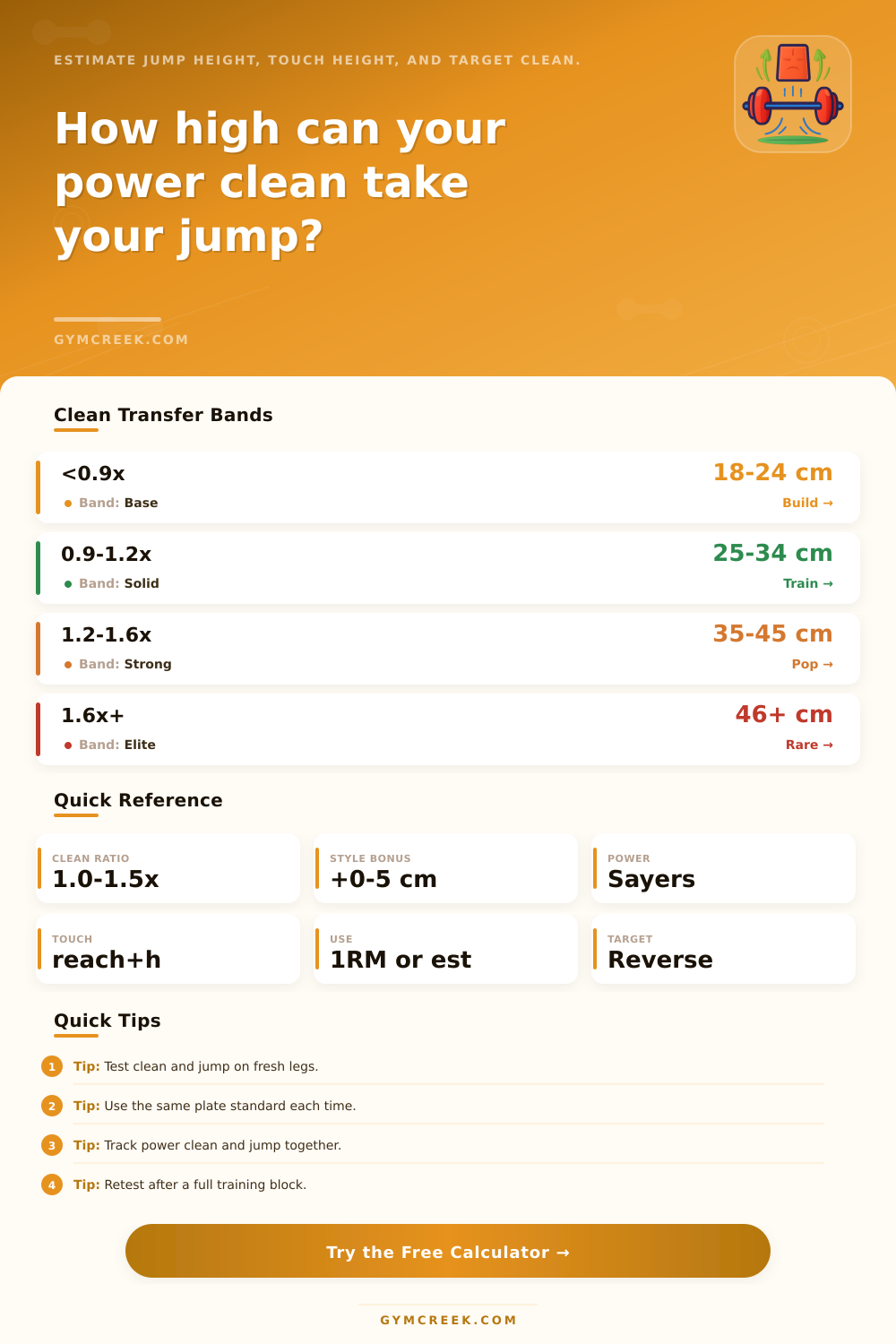
| <0.9x | 18-24 cm | Base | Build |
| 0.9-1.2x | 25-34 cm | Solid | Train |
| 1.2-1.6x | 35-45 cm | Strong | Pop |
| 1.6x+ | 46+ cm | Elite | Rare |
| Clean type | Bonus | Use | Read |
|---|---|---|---|
| Power | 0.0 cm | Base | Fast |
| Hang power | +1.4 cm | Explode | Pop |
| Hang | +0.6 cm | Speed | Flow |
| Blocks | +0.9 cm | Shorter | Sharp |
| Style | Bonus | Band | Use |
|---|---|---|---|
| Standing | +0.0 cm | Pure | Test |
| CMJ | +2.8 cm | Common | Train |
| Approach | +5.4 cm | Sport | Game |
| Reactive | +3.6 cm | Quick | Fast |
| Formula | Input | Output | Use |
|---|---|---|---|
| Ratio | Clean/BW | Jump cm | Main |
| g t^2 / 8 | Jump | Height | Touch |
| Sayers | Jump+BW | Power | Index |
| Inverse | Target | Clean kg | Goal |
💡Tips
The power clean exercises will help a person to improve there jump height if the exercise increase the explosive movement that the individual must perform for jumping. The relationship between the power clean and the jump height can be calculated through a ratio. To calculate this ratio, an individual divide the weight that they performed their power cleans by their body weight.
The resulting number will allow an individual to calculate there jump height; the more higher the ratio, the more higher the individual’s jump height will be. If the individual increase the ratio of the weight of their power cleans to their body weight, the individual will experience an increase in their jump height. The power clean exercise are beneficial for athletic performances due to the type of muscle that are required to perform the exercise.
How Power Cleans Improve Jump Height
Athletes often select the power clean exercise for the ability of the exercise to develop the fast twitch muscle fibers that are required for jumping. An individual might have high squat weights, but their vertical jump might not be high. Squatting develops strength in the muscles, but the power clean develop the speed of those muscles.
Because the power clean mimics the jumping movement by the bodys muscles, it is a better indicator of an individual’s jumping ability than the squat exercise. An individual can use the power clean to categorize an individual’s strength and jumping performance abilities. If an individual’s power clean ratio is under 0.9 times their body weight, they are in the “build” category for jumping abilities; their jumps will be between 18 and 24 centimeters.
If an individual’s power clean ratio is between 0.9 and 1.2 times their body weight, they are in the “solid” category; their jumps will be between 25 and 34 centimeters. If an individual’s power clean ratio is between 1.2 and 1.6 times their body weight, they are in the “strong” category; their jumps will be between 35 and 45 centimeters. Finally, if an individual’s power clean ratio is 1.6 times their body weight or more, they are in the “elite” category; their jumps will be 46 centimeters or more.
These categories is based off data from force plates and combine the results of jumping performance to relate the power clean to jumping performance. In order to obtain accurate data from performing the power clean and jumping exercises, they must be performed under specific conditions. The power clean and jump tests should be performed when the individual’s legs is fresh; testing when fatigued will result in inaccurate data.
Additionally, the same height of the weight plates should be used for each test. Finally, an individual should compare the jump height that they calculates from the power clean tests to the individual’s actual jump height; if the calculated jump height is much higher then the actual jump height, the individual may have technical errors in their power clean or have poor ankle stiffness. Based off the sport that an individual participate in, they may require different types of jumping abilities, and different types of power clean exercises can develop those jumps.
Basketball players, for example, must jump from an approach start; to develop these jumping starts, basketball players benefit from perform hang cleans. Volleyball players must jump from a standing start to develop touch height, which is the total of an individual’s standing reach and their jump height; to develop this jumping start, volleyball players should perform power cleans to develop explosive starts. Football players, however, jump from a standing start to develop vertical jump; standing vertical jumps require an “no-step” explosion; football players should perform power cleans to develop these explosion jump.
Another way to develop a jumping ability is to use reverse planning to the desired jump height goals for the individual. If an individual want to jump a certain height, they can calculate the required weight of the bar for the power clean to develop that jump height. For instance, if an individual desires to reach the jump height of an elite player, they can calculate the amount of kilogram that they must add to their power clean to reach that ratio.
Additionally, to track the success of the individual’s performance of the power cleans and jumps, those metric should be tracked every month. By comparing the jump height calculated by the power clean to the individual’s actual jump height, an individual can track there success in transferring the power generated from the power clean into jumping performance. If the calculated jump height is increasing, the power clean is successfuly transfer to jump performance.