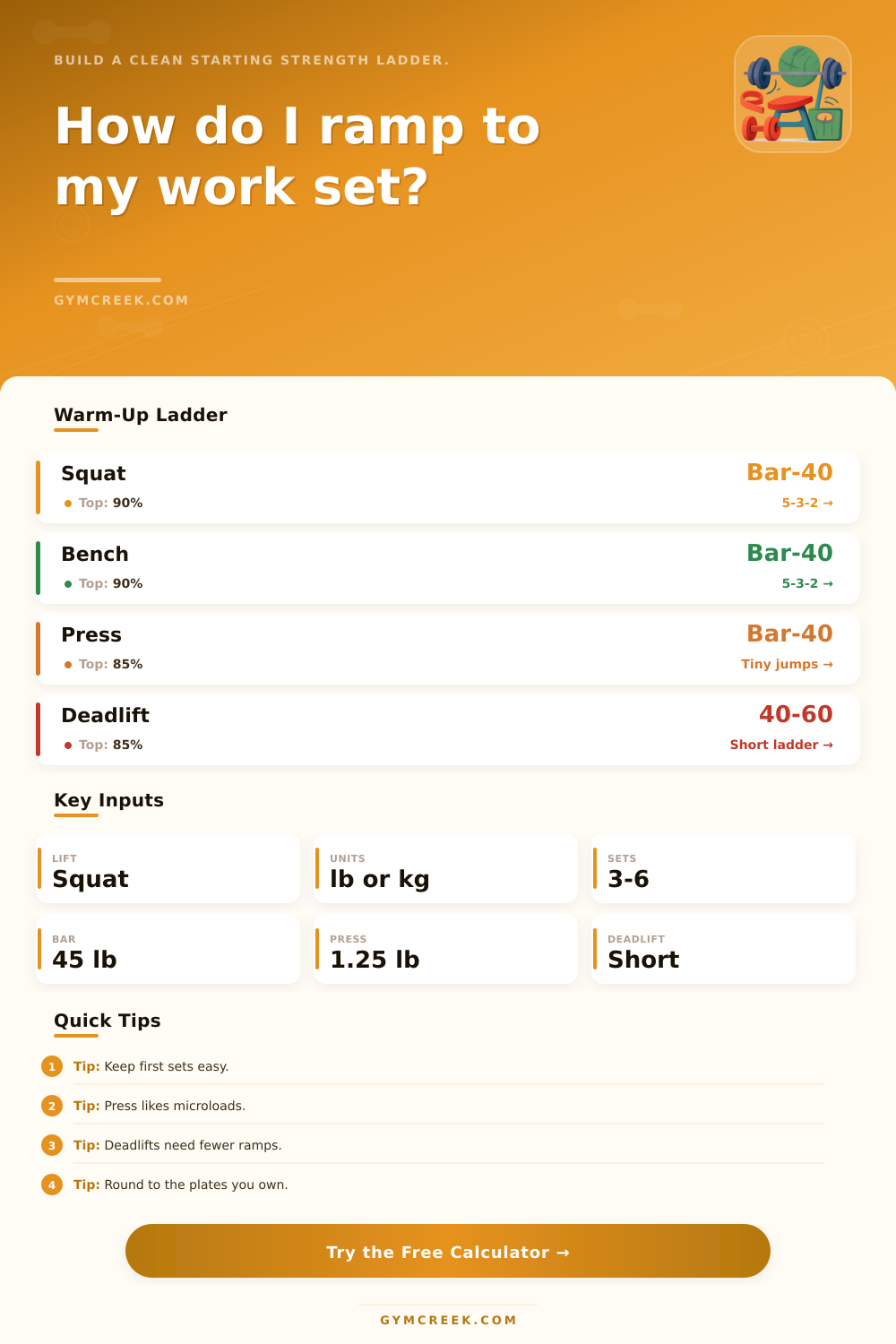
Starting Strength Warm-Up Calculator
Build exact barbell ramp-up sets for squat, bench, press, and deadlift with plate math, rep cues, and lift-specific Starting Strength pacing.
📌Warm-Up Presets
Each preset loads a realistic Starting Strength setup and recalculates the full ramp table, plate pairs, and warm-up tonnage instantly.
⚙Warm-Up Inputs
Starting Strength snapshot
Choose a lift and calculate the full warm-up ladder.
| Set | % | Load | Reps | Plate Pairs |
|---|
📊Warm-Up Benchmarks
📖Reference Tables
| Lift | Default Ladder | Reps | Use When |
|---|---|---|---|
| Squat | Bar-40-60-80-90 | 5-5-3-2-1 | Most novice days |
| Bench | Bar-40-60-80-90 | 5-5-3-2-1 | Stable upper body |
| Press | Bar-40-55-70-85 | 5-5-3-2-1 | Microload focus |
| Deadlift | 40-60-75-85 | 5-3-2-1 | Shorter ramp only |
| Plate | Per Side | Total Jump | Best Use |
|---|---|---|---|
| 2.5 lb | 2.5 lb | 5 lb | Big lifts |
| 1.25 lb | 1.25 lb | 2.5 lb | Press work |
| 1.25 kg | 1.25 kg | 2.5 kg | Metric base |
| 0.5 kg | 0.5 kg | 1 kg | Microload step |
| Set Role | Squat / Bench | Press | Deadlift |
|---|---|---|---|
| Set 1 | Bar or 40% | Bar or 40% | 40% |
| Set 2 | 60% | 55% | 60% |
| Set 3 | 80% | 70% | 75% |
| Set 4 | 90% | 85% | 85% |
| Signal | Change | Why | Action |
|---|---|---|---|
| Bar speed slow | Trim next jump | Fatigue is high | Use smaller plates |
| Work feels light | Hold pattern | Keep tempo stable | Do not rush |
| Press stalls | Add microload | Upper-body progress | Use 1.25 lb pairs |
| Deadlift heavy | Shorten ladder | Pulling is costly | Skip the extra set |
💬Warm-Up Tips
A proper warm-up is essential to your strength training routine because a warm-up prepare the nervous system and a warm-up prepares the body for heavy weights. If you dont warm up before your sets, it is possible that your working sets will suffer due to your hips or the way that you brace the ground not being ready for the weight that you will perform. A warm-up isnt busywork; however, it is a tool that will allow you to hit your top set while you are fresh.
The best way to warm up is with a progressive ladder approach to warm up, which means that you will gradually increase the weight that you use for your warm-up so that your working sets will not be a shock to your bodys. The warm-up will begin with a light load. For instance, you can start with an empty barbell or a load that is approximately 40% of the weight you will use for your working sets.
How to Warm Up Before Lifting Weights
Perform five easy reps with this load. Focus on your bar speed and the tightness of your bar during these first five reps. After these first five reps, increase the load to 60% of your working sets.
Perform three reps with this weight. Once you reach 80% and 90% of your working sets, perform single reps to warm up with these percentages. This specific warm-up has allowed your body to scale the effort that you will exert with your working sets.
Your working sets will feel like an extension of your warm-up. The specific warm-up will depend on the exercise that you will be performing. For instance, squats and bench presses will use a countdown to five sets, starting at an empty bar or 40% load.
Overhead presses will use smaller increments to ensure that the muscle used in pressing the bar overhead do not fatigue during the warm-up to 85% of your maximum overhead press. Deadlifts will also have a shorter warm-up because deadlifts work the back and grip strength more than other exercises. Warm-ups for deadlifts will skip the sets using the empty bar to allow the muscles to avoid fatigue before performing heavy deadlift sets.
Calculating the weight that you will use for your warm-up is a difficult task. However, there are specific tools and rules for the math behind your warm-up sets. The total bar weight that you use will factor into your warm-up calculations.
The weight of the specific training plates that you own will also impact your warm-up calculations. For instance, if you can squat 225 pounds, you must calculate the number of 45-pound plates and 25-pound plates that you need to reach that number. Tools will make it easier for you to calculate these warm-up increments so that you can focus on performing the sets that you design for yourself.
When performing overhead presses, use 1.25-pound plates to ensure that your strength does not stall during your sets. For squats, use 5- to 10-pound increments per side. During your warm-up, you must take care of your rest periods.
For instance, if you are performing a warm-up with a lighter load, rest periods should last no more than 90 seconds. However, if the warm-up uses more considerable loads, warm-up rests should last two minutes each. These time increments will allow your warm-up to remain effective while your body stay warmed up and ready for strength training.
Also, pay close attention to your bar speed during your warm-up. Bar speed during the warm-up is an indicator of the way that your body will perform during your sets. When you have slow bar speed during a warm-up at 60% of your working sets, it could indicate that you need to change your load for your next set or perform additional repetitions to warm up your body for the session.
There are some mistakes that people commit when performing their warm-up. For instance, many people attempt to rush their warm-up. Some people will completely skip the sets with the lightest loads or the empty bar because they believe that performing a warm-up steals some of the volume that their working sets will generate.
The weight used for a warm-up are so light that they will not affect the volume that they will generate during their working sets. Additionally, people will load the bar to 70% of their working sets for warm-up without regard to form. Such sloppy warm-up routines will affect their lifts and the form that they use when lifting the weight.
If you use a 35-pound barbell but do not own a 45-pound barbell, you will have to adjust every calculation for your warm-up by 10 pounds. By following a warm-up routine, you can turn the guesswork into a ritual. This warm-up ritual will allow you to know exactly which training plate to use for your sets and how many repetitions to perform.