Fatigue Index Calculator
Measure sprint decay, compare the best and worst efforts, and see how protocol choice changes the fatigue picture for repeated power tests.
📌Preset Test Profiles
⚙Calculator Inputs
Fatigue index snapshot
Enter a valid power series to see raw fatigue, adjusted fatigue, and the repeatability gap.
Interval Power Series
| Stage | Watts | % Peak | Comment |
|---|
📊Fatigue Metrics
📑Reference Tables
Fatigue index bands
Raw index ranges are the simplest way to read a repeated sprint test.
| Band | FI | Meaning | Cue |
|---|---|---|---|
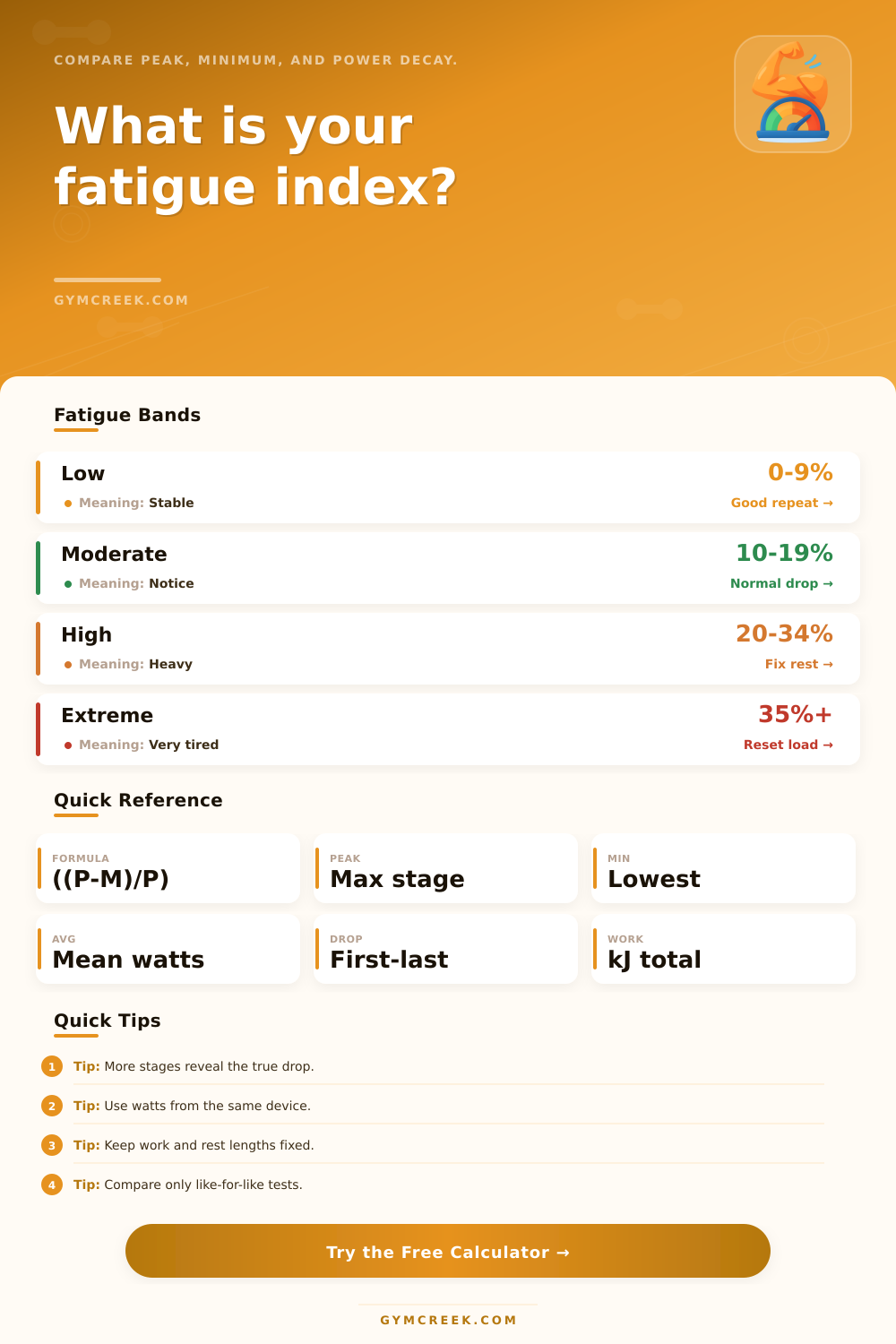
| Low | 0-9% | Stable | Good repeat |
| Moderate | 10-19% | Notice | Normal drop |
| High | 20-34% | Heavy | Fix rest |
| Extreme | 35%+ | Very tired | Reset load |
Protocol map
Use a protocol that matches the sport or test you are trying to analyze.
| Protocol | Work | Rest | Best use |
|---|---|---|---|
| Wingate | 30 s | 60-120 s | Baseline test |
| Assault | 20-30 s | 60-90 s | Bike repeat |
| Row erg | 30 s | 60-90 s | Indoor repeat |
| Track | 10-20 s | 90-180 s | Sprint repeat |
Power benchmark cues
Compare the relative peak and the average power to spot useful trends.
| Profile | Peak | Avg | Note |
|---|---|---|---|
| Fresh | High | Strong | Low drop |
| Trained | Good | Solid | Normal |
| Winded | Fair | Lower | Notice |
| Depleted | Low | Weak | Large drop |
Formula reference
These are the core equations behind the calculator outputs.
| Metric | Formula | Output | Use |
|---|---|---|---|
| Fatigue index | (Peak-Min)/Peak | % | Main score |
| Repeatability | Min/Peak | % | Stability |
| Relative peak | Peak/BW | W/kg | Compare size |
| Work output | Avg x sec | kJ | Session load |
💡Practical Tips
Load the same machine, slope, or erg.
More rest usually lowers the index.
Track the first and last rep together.
Use the adjusted score for tired days.
The fatigue indices is a mathematical term that help to calculate the decrease in power that an individual experience when they performs a series of sprints, for instance. Because the individual will experience a decrease in there power output as they become fatigued, the fatigue index can help to determine whether an athlete’s recovery periods is sufficient, or if their training program need to be changed to decrease the number of power drop-offs that occurs during their efforts. Additionally, the fatigue index can help an individual to understand how much power an athlete lose between there initial efforts and their final efforts.
Taking the peak power output of an athlete of an exercise divided by the minimum power output divided by the peak power output, and multiplied by 100, a person calculates the fatigue index. For instance, if an athlete produce 1000 watts of power during there first sprint, but only 615 watts during their sixth sprint effort, their power output has dropped significantly. Thus, the fatigue index can be used to calculate this drop-off in power output, and provide information regarding the athlete’s fatigue resistance, their ability to maintain their power output during a series of repetition.
Fatigue Index: What It Is and How to Use It
The protocol that an athlete use to fatigue will impact the fatigue index for that athlete. For instance, performing sprints of short distances on a track will fatigue the fast twitch muscle fibers of an athlete different than performing sprints of the same distance but of longer duration on a rowing machine. Additionally, the interval of rest that an athlete takes between repetitions will also impact the fatigue index; longer periods of rest will allow an athlete to reload there phosphocreatine stores, indicating a lower fatigue index.
An athlete’s context during the performance of the test will also impact the fatigue index; an athlete fresh out of a competition will experience different results than an athlete who are already winded. The fatigue index can be categorized into different range of percentages. For instance, a fatigue index between 0% and 9% indicate that the athlete’s power output is stable, which is desirable for athletes that must perform there efforts at a consistent rate.
A fatigue index between 10% and 19% is considered to be normal for athletes of various disciplines. A fatigue index between 20% and 34% indicate that the athlete is experiencing heavy fatigue, indicating that there rest periods or the number of efforts that they perform can be adjusted. Finally, a fatigue index of 35% or higher indicate that the athlete is experiencing extreme fatigue, indicating that there training program needs to be reset.
Based off the fatigue index of an athlete, adjustments can be made to an athlete’s training program. For instance, if the fatigue index is very high for an athlete, it may be that more rest periods should be provided to the athlete. Additionally, if an athlete experiences high fatigue indices over several training weeks, it may be that their training volume need to be reduced.
Furthermore, the fatigue index can be used to track the adaptation of an athlete to there training program. For instance, if the fatigue index decreases over several training weeks, it is likely that the athlete is adapting to there training program; however, if the fatigue index increase over time, it may be that the athlete is overreaching or not recovering from there training efforts. In order to accurately use the fatigue index to track an athlete’s improvements in relation to there training, it is essential that the athlete use the same equipment for all fatigue index measurements.
Additionally, the same calibration of the equipment should be used, as well as the same number of repetitions. Should the athlete incorporate a different device or a different number of repetitions, the fatigue index will not be a reliable indication of the athlete’s fatigue. Finally, the fatigue index should also account for environmental factor, such as the temperature of the area in which the athlete perform there tests, or the altitude at which the athlete lives or trains.
The fatigue index is a tool for providing feedback to an athlete and a coach to adjust an athlete’s training program, but is not a form of punishment for an athlete. Instead, the measurement of the fatigue index can help to indicate how much power an athlete can output during there efforts, and what adjustments can be made to improve that output. Thus, the fatigue index can help coaches to ensure that there training program are effective, and that there athletes have sufficient periods of recovery to perform there trained efforts.