Cycling Climbing Power Calculator
Map climb watts, steady speed, watts per kilogram, and summit time from the hill, the rider, and the bike setup.
📌Presets
Each preset loads a real climb setup and updates the solve mode before you calculate.
⚙Climb Inputs
Cycling climbing power snapshot
Enter climb data and the calculator will solve the steady-state hill effort.
📊Fitness Metrics Grid
📑Reference Tables
| Grade | Feel | Bias | Use |
|---|---|---|---|
| 1-3% | Long drag | Aero matters | Tempo |
| 4-6% | Mixed | Mass rises | Threshold |
| 7-10% | Steep | Gravity wins | Climb pace |
| 11%+ | Sharp | Weight only | Attack |
| W/kg | Band | Climb feel | Use |
|---|---|---|---|
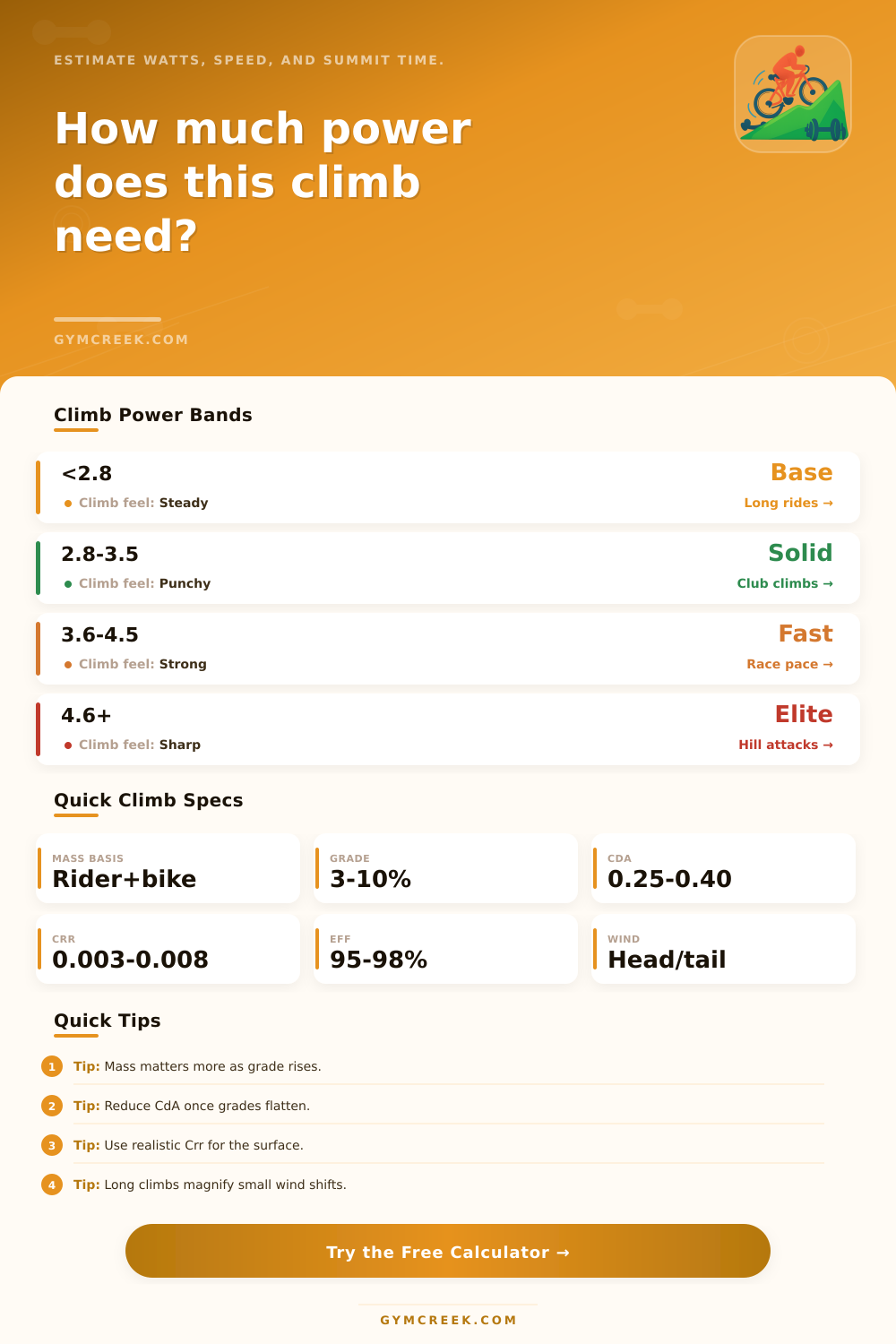
| <2.8 | Base | Steady | Long rides |
| 2.8-3.5 | Solid | Punchy | Club climbs |
| 3.6-4.5 | Fast | Strong | Race pace |
| 4.6+ | Elite | Sharp | Hill attacks |
| Position | CdA | Crr | When |
|---|---|---|---|
| Upright | 0.45+ | .005+ | Easy spin |
| Hoods | 0.32-0.38 | .0035-.005 | Club pace |
| Seated | 0.30-0.34 | .003-.0045 | Steeper ramps |
| Aero | 0.25-0.30 | .003-.004 | Shallow grades |
| Scenario | Distance | Grade | Focus |
|---|---|---|---|
| HC climb | 8-18 km | 6-9% | Settled pace |
| Short rise | 1-4 km | 8-12% | Surge control |
| Gravel pass | 5-12 km | 4-8% | Traction |
| Ramp test | 2-6 km | 10%+ | Repeatable |
💡Tips
Climbing a hill involve a number of physical forces. These physical forces has an impact on the power that a person must produce in order to ride the bicycle up the hill. The main physical forces that act upon a rider who are climbing a hill are gravity, aerodynamic drag, and rolling resistance.
Gravity is a force that acts upon the total mass of the rider and the bicycles. Aerodynamic drag is an force that the resistance of the air creates. Rolling resistance is the force created by the friction of the tires in contact with the ground, and rolling resistance can change based off the texture of the road upon which the bicycle is riding.
What Makes Climbing a Hill Hard
The grade of the hill will change which of these physical forces are the most important for the rider. On hills with shallow gradient, such as gradients between 1% and 3%, the speed at which the rider will travel will be higher, making aerodynamic drag more important then other physical forces. On hills with steeper gradients, such as gradients that are 7% or more, the speed at which the rider will travel will be less, making gravity the most important physical force for the rider to overcome.
Gravity is a physical force that relates to the total mass of the rider, the bicycle, and any other equipment. Thus, the total mass of these variables will have an impact upon the amount of energy require to ride up the hill. If a rider can reduce the total mass of the rider and the bicycle, then the rider will require less power to overcome gravity.
One metric that can be utilized to measure a rider’s climbing ability is the metric of watts per kilogram. Watts per kilogram is a measurement of the power of a rider relative to the mass of the rider. Thus, if a rider has a low measurement of watts per kilogram, that rider may experience difficulty in maintaining high speed on hills with steep gradients.
If a rider has a high wattage per kilogram, the rider can maintain a more higher speed on a steep climb. For instance, a rider with a wattage of 3.6 watts per kilogram can climb more effective than a rider with 2.8 watts per kilogram. Additionally, the metric VAM (vertical ascent meters per hour) can be used to show how many meters of vertical elevation the rider can climb in one hour.
Pacing is an important aspect of climbing, as error in pacing can lead to premature fatigue. Many cycling apps allow a person to use power presets to plan a climb, as these preset can simulate alpine climbs or gravel climbs. Additionally, the drivetrain that transmit the power from the rider to the wheel isnt 100% efficient; the drivetrain may have an efficiency of between 95% and 98%.
Thus, friction in the drivetrain will lose some watts of power. Finally, environmental factor such as air density and wind can impact the climb. The air density decrease at higher altitudes, as well as the wind may blow in a way that increases the drag that the cyclist must overcome.
A rider can improve their climbs by understanding each of the force that consume the riders power. On steep pitch of a climb, the majority of the riders power is consumed fighting the force of gravity. However, on pitches that are much shallower than steep pitches, the majority of the power is consumed fighting air resistance.
Thus, a rider can adjust their tire pressure to minimize rolling resistance on different type of riding surfaces. A rider can also adjust their riding position to minimize either aerodynamic drag or maximize riding comfort. By understanding how each of these factors impact a climb, a rider can manage their power more effective during their ride.