Refeed Day Calculator
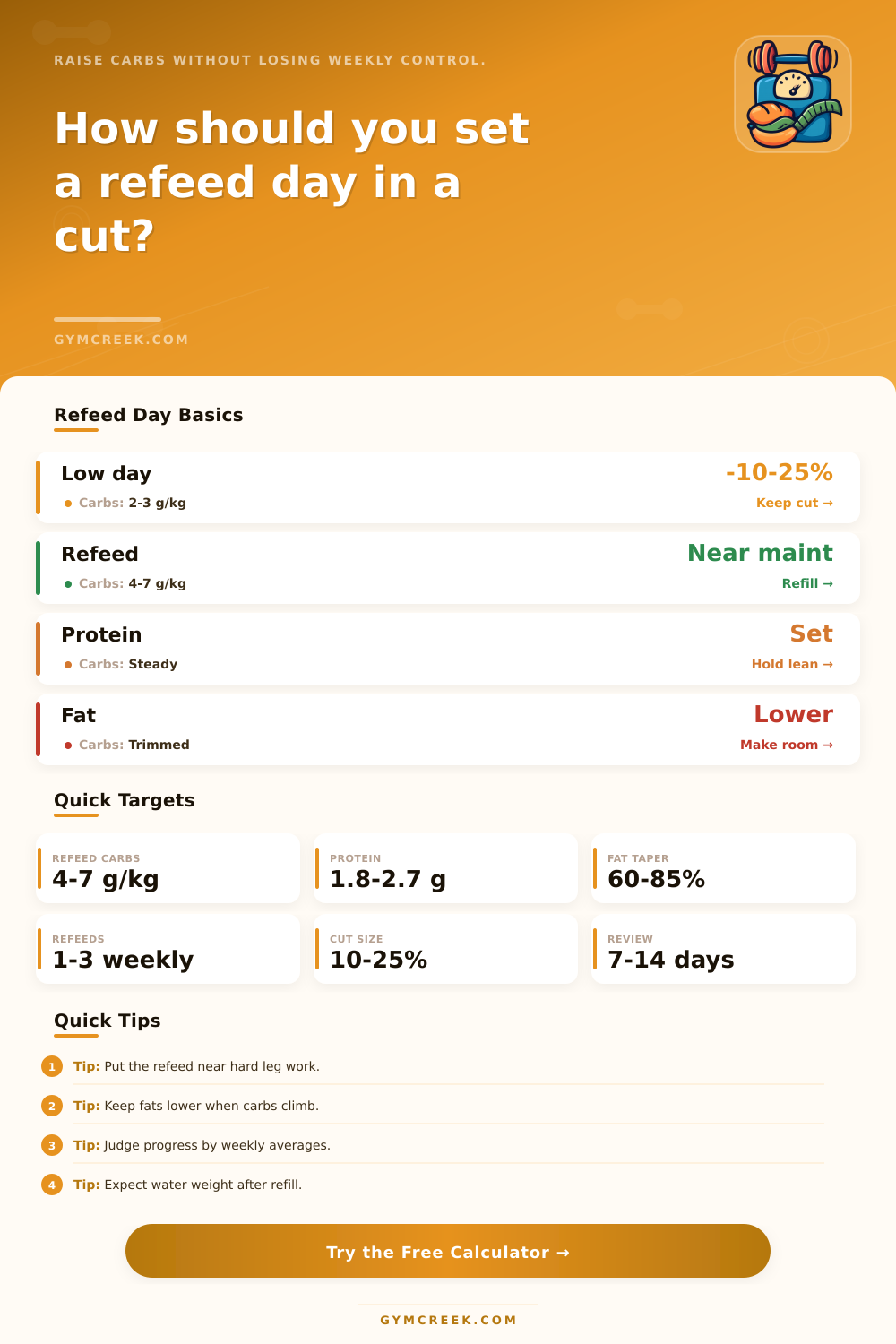
A refeed day is not a cheat day. This calculator keeps protein steady, trims fats to make room for carbs, and checks whether the high-carb bump still fits the weekly deficit.
📌Presets
Each preset loads a different deficit-and-refeed rhythm, from desk-cut weekends to competition prep blocks and long endurance work.
⚙Calculator
Refeed day snapshot
Enter your deficit and refeed plan to see how the high-carb day changes the week.
📊Refeed Metrics Grid
📑Reference Tables
| Cut size | Daily gap | Refeed role | Typical lift |
|---|---|---|---|
| 10-15% | Small | Training spark | Near maintenance |
| 15-20% | Moderate | Performance support | Restore most |
| 20-25% | Large | Glycogen refill | Often full |
| 25%+ | Very large | Recovery check | Monitor closely |
| Carb density | Lean target | Read | Best fit |
|---|---|---|---|
| 3-4 g/kg | Partial refill | Lighter bump | Upper body day |
| 4-5 g/kg | Solid refill | Balanced | Standard cut |
| 5-6 g/kg | Deep reload | Hard training | Leg or back day |
| 6-7 g/kg | Full push | Watch digestion | Stage block |
| Placement | Best before | Carb split | Why |
|---|---|---|---|
| Night before | AM lower body | 35/40/25 | Wake up topped off |
| Same day | PM lift | 25/50/25 | Fuel the session |
| Two-day wave | Weekend volume | 30/40/30 | Spread digestion |
| Post weigh-in | Combat prep | 20/60/20 | Refill quickly |
| Refeeds/wk | Best fit | Watch | Result |
|---|---|---|---|
| 1 | General fat loss | Weekend drift | Simple setup |
| 2 | High-volume lifting | Low-day squeeze | Better output |
| 3 | Endurance block | Average calories | More fuel |
| 4 | Very hard schedule | Cut may stall | Bridge phase |
💡Practical Tips
Place the refeed before your hardest lower-body, barbell, or long-duration conditioning session. Extra carbs are most useful when they can become training output instead of a random high-calorie day.
A glycogen refill pulls water with it, so the morning after a refeed often looks heavier. Compare body weight after several low days, not the first weigh-in after a carb push.
A refeed day is used to restore the glycogen stores in the body. Because many individuals reduces the amount of carbohydrates that they consume during the fat loss phase of their diet, those low carbohydrate intakes can lead to depleted muscle glycogen stores. A depletion of muscle glycogen can lead to a decrease in the physical performance of that individual, as well as a decrease in there motivation to perform physical training.
By increasing the amount of carbohydrates that an individual consumes on a refeed day, the individual can replenish those depleted muscle glycogen stores, allowing those individuals to maintain their physical performance during the fat loss phase of their diet. The biological purpose of a refeed day is to restore glycogen stores within the body, as well as to influence the hormone that are released by the body. Carbohydrates are stored in the muscles of the body as glycogen.
Refeed Days: Refill Muscle Energy and Help Your Workouts
By increasing the amount of carbohydrates that an individual consumes, the body utilize those carbohydrates to refill the muscle glycogen stores of that individual. Additionally, increasing the carbohydrate intake of the body increases the levels of the hormone leptin that the body releases. Leptin is the hormone that signals to the body that its not experiencing starvation; if the body is in a calorie deficit for long periods of time without refeed days, the body will experience a decrease in both its thyroid output and the energy that it can generate.
Thus, individuals utilize refeed days to combat these effects on the body. The amount of protein that an individual consumes should remain constant during a refeed day, as well as during the days that contains low amounts of carbohydrates. An individual should consume approximately one gram of protein for every pound of body weight that the individual possesses, or two grams of protein for every kilogram of body weight.
During refeed days, however, the individual should reduce the amount of fat that an individual consumes. Fats should be reduced to sixty or seventy percent of the amount of fat that are consumed during the other days of the week; the calories that are obtained from fats can be used to allow for an increase in the carbohydrates that an individual consumes on a refeed day. The time that an individual chooses for their refeed day may be important to the effectiveness of that refeed day.
An individual may choose to have their refeed day before they perform any physical activity of that week. For instance, if an individual plans to perform any physical training sessions during the morning hours, they may choose to consume carbohydrates the night before; this will allow for the glycogen stores within their muscles to become fully replenished prior to those training sessions. In contrast, if an individual has any training sessions during the evening hours, they may choose to consume the carbohydrates on the same day as those training sessions.
An individual may experience an increase in their weight on the scale after a refeed day. However, this increase in weight isnt due to an increase in the body fat of that individual. The weight that an individual gains after consuming carbohydrates is the result of the body storing those carbohydrates as glycogen.
Each gram of glycogen that the body stores also leads to the body pulling in four grams of water. Thus, the body contains more water after consuming carbohydrates, which leads to the increase in the weight of an individual on the scale after a refeed day. However, this weight gain is temporary; the body will return to its regular weight after the glycogen is used for energy.
Therefore, an individual should use the average weight of their body each week to monitor there progress, rather than their weight on the scale after a refeed day. An individual should also monitor their body fat percentage using measurements of their body, or visual while reflecting on their appearance in the mirror. The depth of the calorie deficit that an individual follows will determine the frequency with which that individual should utilize refeed days.
For instance, if an individual is creating a deficit of only ten to fifteen percent of their total calories that they consume each day, they may require one refeed day per week. If, however, an individual is creating a more significant calorie deficit of twenty-five percent or more of total daily calories, they may require more frequent refeed days. An individual that performs high volume of lifting may require two refeed days per week, while an individual that performs endurance training may require three refeed days each week.
In each of these cases, however, the average number of calories that are consumed each week should remain in a deficit; otherwise, the body will not continue to burn fat. Some of the mistakes that may occur during a refeed day are treating that day as a “cheat day,” wherein an individual consumes excessive amounts of junk food. If an individual consumes too many calories during a refeed day, they may create a new deficit for that week, which will cancel out the deficit that was created during the other days of the week.
In addition to these mistakes, an individual should not entirely skip refeed days; the body may experience a decline in performance and metabolic health if the individual skip refeed days entirely. Thus, an individual may choose to spread the carbohydrate intake throughout the day in smaller meals. Finally, an individual must ensure that there is still a minimum requirement of nutrition for that individual, such as requiring the fat intake to be at least twenty-five grams per day, and ensuring that the intake of protein remain the same.
I should of mentioned that naturaly, results vary. Some find this method more luxurius then others, but it depends based off the individual. You’ll find that moddern diets often ignore this, though the bodys response depends on how you’re managing it.
It’s important to avoid alot of sugar during these days, because it can affect teh overall results. Often, a person will recieve different results if they dont follow the plan. These furnitures of the diet is essential to success.