Skeletal Muscle Mass Percentage Calculator
Estimate muscle share from direct scan values or from a lean-mass model, then compare your result with a target muscle percentage.
📌Presets
Each preset loads a realistic body-comp profile and recalculates the muscle share immediately.
⚙Calculator
Muscle share snapshot
Enter your numbers and the calculator will estimate skeletal muscle mass percentage, lean mass, and target gap.
📊Muscle Metrics Grid
📑Reference Tables
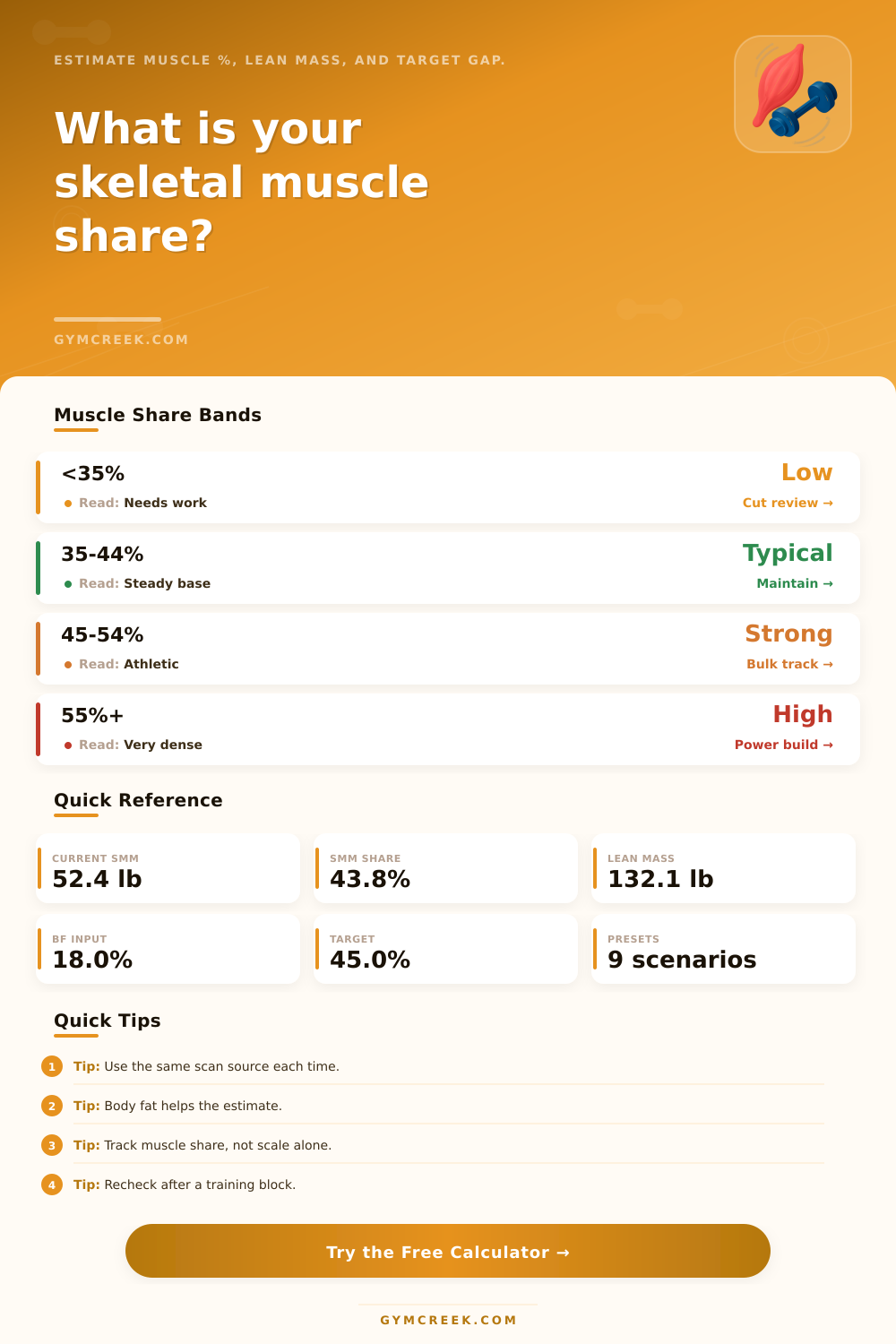
| Band | Share | Read | Move |
|---|---|---|---|
| Low | <35% | Needs work | Cut review |
| Typical | 35-44% | Steady base | Maintain |
| Strong | 45-54% | Athletic | Bulk track |
| High | 55%+ | Very dense | Power build |
| Source | Use | Strength | Caveat |
|---|---|---|---|
| DEXA | Best check | Very direct | Access needed |
| BIA | Fast trend | Easy repeat | Hydration hit |
| InBody | Gym scan | Segment data | Machine bias |
| Tape | Fallback | Cheap and quick | Less exact |
| Profile | Inputs | Output | Use |
|---|---|---|---|
| Cut | BF, waist | Share now | Keep muscle |
| Bulk | Known SMM | Gap to goal | Set target |
| Return | Old scan | Trend check | Rebuild |
| Maintain | Stable body | Base band | Hold steady |
| Formula | Inputs | Output | Use |
|---|---|---|---|
| Share | SMM, weight | Percent | Main result |
| Lean mass | Weight, BF | LBM | Base tissue |
| Tape BF | Waist, neck | BF % | Estimate path |
| Target gap | Goal %, weight | Delta | Next step |
💡Tips
Skeletal muscle mass percentage are a metric that calculate the percentage of the total body weight that come from skeletal muscle tissue. Total body weight is often used to measure muscle mass, but this is an unreliably metric because total body weight dont distinguish between the amount of fat tissue and skeletal muscle tissue in the body. Skeletal muscle mass percentage is a more accurate metric for reveal whether a person is gaining muscle mass or altering they total body weight.
While many individual focus on their total body weight, skeletal muscle mass percentage allows individuals to gain insight into the composition of there bodies. Skeletal muscle mass percentage take into account many components of the body. Compounds like lean body mass is used to calculate the amount of muscle mass in the body, but skeletal muscle mass percentage is more specific in that it only account for the muscle tissue in the body.
What Is Skeletal Muscle Mass Percentage?
For instance, two individuals can weigh the same amount, but one individual may have more muscle mass then the other. The individual with more muscle mass will have a higher skeletal muscle mass percentage. Skeletal muscle mass percentage can be calculate in several ways.
One way is to use a tape measure to measure the waist and neck measurement of an individual. The ratio of the waist to neck measurement can be used to estimate the body fat percentage of an individual. Because body fat can affect the skeletal muscle density of an individual, this measurement is helpful in estimating there skeletal muscle mass percentage.
Additionally, medical scan of the body can be used to calculate the skeletal muscle mass percentage of an individual. If medical scans isnt available, there are mathematical models that use an individual’s age, gender, and level of physical activity to calculate their percentage. Men typically have a muscle to lean ratio of around 52 percent, while women has a ratio of around 46 percent.
Skeletal muscle mass percentage falls within specific range. For men and women between the age of 20 and 80 years old, a skeletal muscle mass percentage of less than 35 percent indicates low skeletal muscle mass. Between 35 and 44 percent indicate a typical base of muscle mass for individuals of either gender.
Between 45 and 54 percent indicates an athletic range of skeletal muscle mass percentage. Finally, a percentage above 55 percent indicate very high skeletal muscle mass percentage, often found in elite athlete and muscle mass competitor. For the most accurate measurements of skeletal muscle mass percentage, individuals should look for trends over time rather than single measurement.
Because an individual’s hydration level can impact the measurement of skeletal muscle density using a bioimpedance analysis scale, skeletal muscle mass percentage measurement should be taken every eight week. This way, the individual can track there accrual of muscle. Muscle accrual is the gaining of muscle tissue to the body over time.
There is some common mistake when measuring skeletal muscle mass percentage. One of the most common is fixating on the weight of an individual on the scale during a fat loss phase. Muscle density can appear to decrease with the loss of fat mass, even though the individual is gaining muscle mass.
Another mistake is failing to consider the effect of age on skeletal muscle mass percentage. After 30 years of age, an individual lose around 1 to 2 percent of muscle mass each decade. However, the body can avoid the effect of aging by regularly performing strength training exercise.
An individual’s skeletal muscle mass percentage can inform there fitness goals. For individuals who want to lose fat from their body but maintain their muscle mass, the percentage should remain the same with total body weight. For those who would like to gain muscle mass, the goal would be to increase the percentage of muscle mass relative to body weight through the use of hypertrophy exercise.
Additionally, skeletal muscle mass percentage can be tracked with a strength log for the body. If an individual is gaining strength in they muscle while there skeletal muscle mass percentage remains the same, they are successfully building muscle. When an individual is losing fat mass while maintaining the same percentage of skeletal muscle mass, they are successfully losing fat from their body.