ABSI Calculator
Estimate body shape index, waist-to-height ratio, and a practical waist-risk view from simple body measurements.
📌Presets
Each preset loads a realistic body-composition profile and recalculates the ABSI snapshot immediately.
⚙Calculator
ABSI snapshot
Enter height, weight, and waist measurements to calculate body shape index and risk context.
📊ABSI Metrics Grid
📑Reference Tables
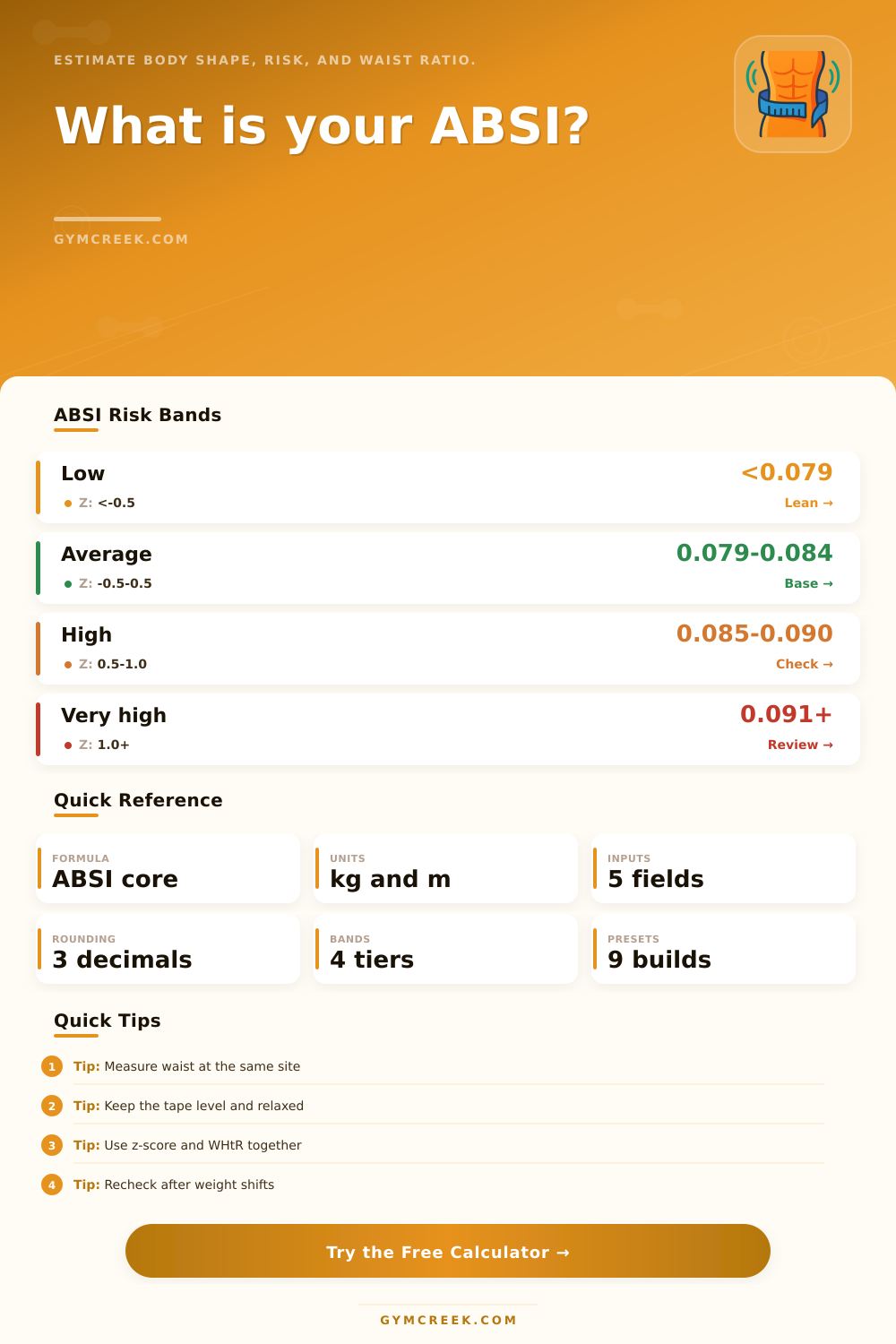
| Band | ABSI | Z | Use |
|---|---|---|---|
| Low | <0.079 | <-0.5 | Lean |
| Average | 0.079-0.084 | -0.5-0.5 | Base |
| High | 0.085-0.090 | 0.5-1.0 | Check |
| Very high | 0.091+ | 1.0+ | Review |
| WHtR | Band | Meaning | Use |
|---|---|---|---|
| <0.45 | Lean | Narrow waist | Strong cut |
| 0.45-0.49 | Healthy | Normal range | Hold steady |
| 0.50-0.54 | Raised | Watch waist | Trim line |
| 0.55+ | High | Review now | Action |
| BMI | Band | Shape | Use |
|---|---|---|---|
| <18.5 | Under | Light | Gain |
| 18.5-24.9 | Normal | Base | Hold |
| 25-29.9 | Over | Thicker | Trim |
| 30+ | High | Heavy | Review |
| Formula | Inputs | Output | Use |
|---|---|---|---|
| BMI | kg,m | Body size | Base |
| ABSI | waist/BMI,h | Shape | Core |
| WHtR | waist/h | Waist | Simple |
| Goal waist | ref*adj | Target | Action |
💡Tips
The A Body Shape Index, or ABSI, is a measurement of body shape and the risks associate with that body shape. A person’s weight dont always reflect they health status. A person can have a high weight but still be healthy, or they can have a low weight but a high health risk due to the way that they store there fat.
The A Body Shape Index is a figure that accounts for a person’s waist size, their height, and their weight to determine their body shape and health risks. This factor is more specific than the Body Mass Index in that it can spot health risks relating to the storage of body fat, which the Body Mass Index do not account for. To calculate the A Body Shape Index, a person must measure their waist circumference in inches, their height in inches, and their weight in pounds.
A Body Shape Index (ABSI) and Waist-to-Height Ratio
The A Body Shape Index take into account the waist circumference and weight of a person, but also normalizes the waist size relatively to the height of that individual. Additionally, the A Body Shape Index also takes other factors that account for the body composition of an individual into consideration, such as their age, the sex of the individual, their activity level, and the frame size of their body. For instance, young individuals will have different body composition than older individuals, and the sex of an individual will affect in which parts of the body their fat is stored.
An individual’s activity level and frame size will help to account for differences between muscular individuals and lean individuals. Finally, the A Body Shape Index provide a z-score for each individual based off these measurement, and the z-score indicates the body composition of that individual relative to the general population. Another measurement that can be used in conjunction with the A Body Shape Index is the waist-to-height ratio.
To calculate the waist-to-height ratio of an individual, the person divides their waist circumference in inches by their height in inches. A waist-to-height ratio that is below 0.5 is considered healthy, but any ratio above 0.5 indicate potential health risks. This ratio can provide an additional method of monitoring the waist circumference of an individual.
The Waist-to-Height ratio and the A Body Shape Index provides a more complete overview of the health of an individual than the Body Mass Index provide alone. The A Body Shape Index accounts for subtle difference in body compositions, and the Waist-to-Height ratio allow for an individual to check their Waist circumference. Accuracy is essential in calculating the A Body Shape Index.
An individual should not measure their waist at their belly button or at their widest point of their hips. Instead, they should measure at their narrowest point above their hips. Additionally, the individual should take the measurement after exhaling and when the tape measure is snug but not digging into their skin.
It is recommended that an individual take this measurement in the morning, after waking up but before eating. As the body fill with fluids and food, or as the individual’s posture alters during the day, their waist measurement may change by half an inch or more. The A Body Shape Index provide risk bands for individuals based upon the calculations of the index.
An ABSI score that is below 0.079 or a z-score below -0.5 indicates that an individual is at a low risk level; they are considered to be in a lean territory. An ABSI score between 0.079 and 0.084 is considered average. Any high score for the A Body Shape Index indicate a higher risk level for the health of an individual, and an individual with a high score is encouraged to review their health habits.
While the BMI indicates if an individual is within the normal or overweight range of body weight, the A Body Shape Index is more important for individuals whose body shape is more important than their weight. There are many factors that affect an individual’s body composition that the A Body Shape Index cannot measure. For instance, an individual’s genetics determine in which parts of the body they will store their fat.
Other factors include the stress that is placed into an individual’s body, their amount of sleep getting that night, and the types of activity that they perform. An individual should track their A Body Shape Index each quarter, as well as use bloodwork to determine their health. The A Body Shape Index is a tool that can assist in monitoring an individual’s health, but it isnt a medical diagnosis.
Therefore, an individual should of use the A Body Shape Index in conjunction with other indicators of an individual’s health, such as the measurement of their waist circumference, the weight of the individual, how they fit into their clothes, and their level of energy throughout the day.