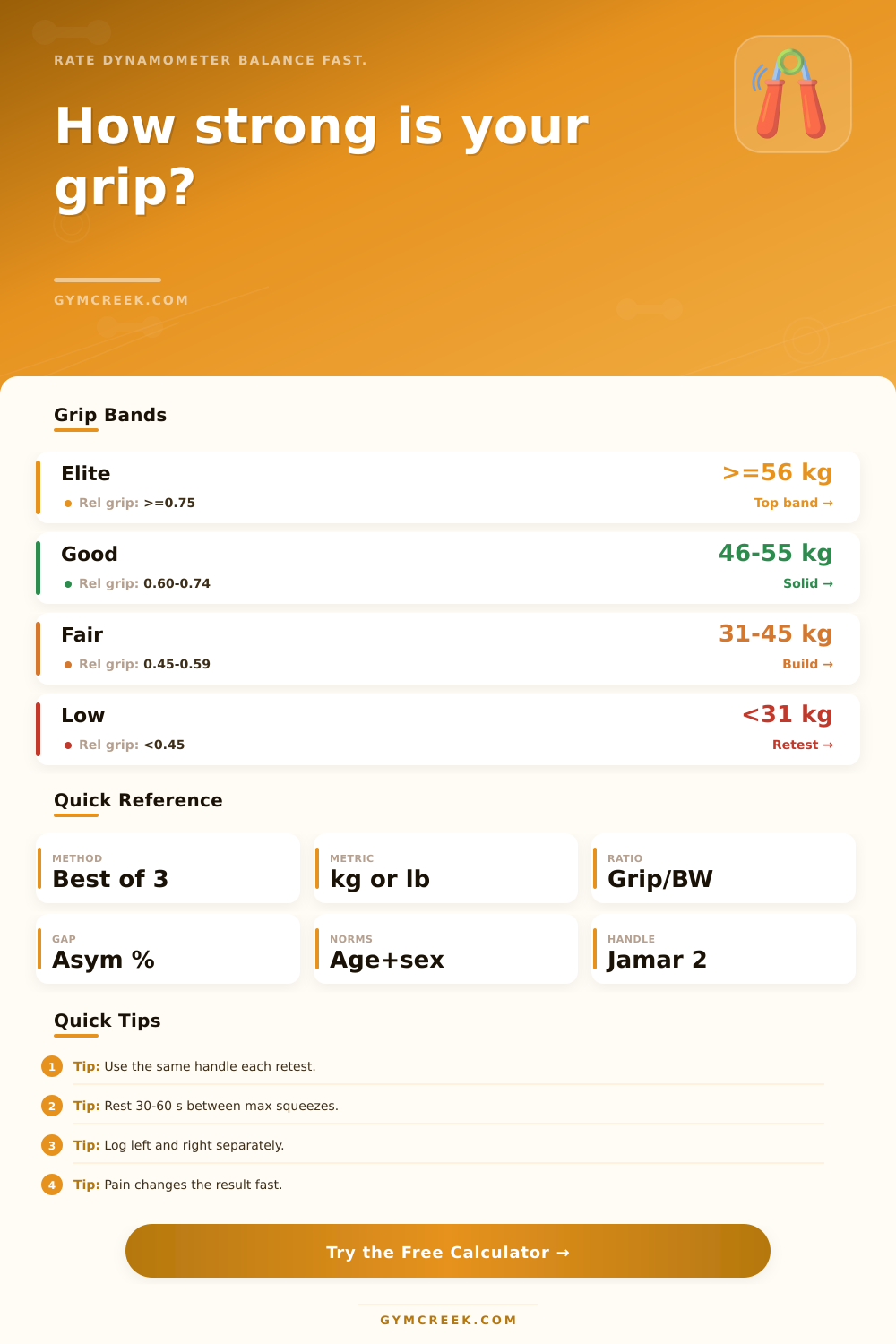
Grip Strength Calculator
Turn three dynamometer squeezes per hand into a stronger-hand score, bodyweight-relative grip index, and a clean left-versus-right asymmetry screen.
📌Presets
Best-of-three grip testing works best when handle setting, rest time, and elbow angle stay the same from session to session.
📝Testing Inputs
Grip strength screen
Enter valid left and right trials to compare asymmetry, peer bands, and relative grip.
📊Metrics Grid
📑Reference Tables
Male Best-Hand Bands
Use the stronger hand normalized to a seated, handle-2 setup before comparing to the table.
| Age | Low | Fair | Good | Excellent |
|---|---|---|---|---|
| 18-29 | <45 kg | 45-50.9 | 51-55.9 | 56+ kg |
| 30-39 | <42 kg | 42-47.9 | 48-53.9 | 54+ kg |
| 40-49 | <39 kg | 39-44.9 | 45-49.9 | 50+ kg |
| 50-59 | <34 kg | 34-39.9 | 40-45.9 | 46+ kg |
| 60-69 | <28 kg | 28-33.9 | 34-39.9 | 40+ kg |
| 70+ | <22 kg | 22-27.9 | 28-33.9 | 34+ kg |
Female Best-Hand Bands
These screening bands help show whether the stronger hand sits below, within, or above a same-age peer range.
| Age | Low | Fair | Good | Excellent |
|---|---|---|---|---|
| 18-29 | <26 kg | 26-30.9 | 31-35.9 | 36+ kg |
| 30-39 | <24 kg | 24-28.9 | 29-33.9 | 34+ kg |
| 40-49 | <21 kg | 21-25.9 | 26-30.9 | 31+ kg |
| 50-59 | <18 kg | 18-22.9 | 23-27.9 | 28+ kg |
| 60-69 | <15 kg | 15-18.9 | 19-23.9 | 24+ kg |
| 70+ | <12 kg | 12-15.9 | 16-19.9 | 20+ kg |
Relative Grip Targets
Relative grip uses combined left-plus-right best scores divided by bodyweight in kilograms.
| Context | Low | Solid | High |
|---|---|---|---|
| General strength | <0.55 | 0.55-0.69 | 0.70+ |
| Climbing | <0.68 | 0.68-0.82 | 0.83+ |
| Grappling | <0.62 | 0.62-0.77 | 0.78+ |
| Barbell lifting | <0.58 | 0.58-0.71 | 0.72+ |
| Racket sport | <0.52 | 0.52-0.63 | 0.64+ |
| Return to play | <0.48 | 0.48-0.59 | 0.60+ |
Asymmetry and Retest Cues
Compare your hand gap to the stronger hand. Large gaps matter more when the dominant hand is actually weaker.
| Asymmetry | Read | Action |
|---|---|---|
| 0-5% | Balanced | Normal hand spread |
| 5-10% | Mild | Monitor over time |
| 10-15% | Notable | Bias weak hand work |
| 15%+ | High | Retest or screen pain |
💡Coaching Notes
Grip scores climb or dip with handle choice, elbow angle, and how hard you brace through the shoulder. If you want clean trend lines, keep the same handle and position every time.
When asymmetry is high, add extra open-hand carries, towel hangs, or pinches for the weaker side before you chase bigger max squeezes on the stronger side.
Grip strength test are used to determine the amount of force that an individual can produce with their hands. The single number from a grip dynamometer dont contain much information about an individual’s grip strength. Grip strength tests is helpful in that they can indicate whether an individual’s two hand have equal strength, or how an individual compares to their body weight in terms of strength.
Many individuals use grip tests to compare there strength to others of the same age. Because grip strength is associated with many physical functions, it is useful in indicating an individual’s strength in various tasks. Grip strength can indicate for how long an individual can remain on a climbing wall.
How to Test Your Hand Grip Strength
Grip strength is also associated with the health of an individual, especially as those individuals age, because the hands are used in many tasks each day. In order to obtain an accurate measurement of an individual’s grip strength, the individual must use a consistant grip strength test setup. Factors such as an individual’s elbow angle, hand position, and the size of the handle on the dynamometer will alter the measurement of an individual’s strength.
For instance, if an individual measures their grip strength with their elbow bent at ninety degrees, they are likely to exhibit more force than an individual standing with their arms at their sides. Similarly, if the handle is too wide for an individual, their reading for grip strength will be lower than their true strength. To obtain the most accurate measurement of an individual’s strength, the individual must use the same position and equipment for each grip strength test.
Grip dynamometers often have pre-set values for the strength of various athletes who participate in different sports. These pre-set values is useful for understanding the grip strength requirements of various sports. For instance, rugby players may have high grip strength, but the ratio of their grip strength to their body weight may be different than an individual who does not play rugby.
An individual determines the relative grip strength of an individual by dividing an individual’s best grip strength by their body weight. This measurement is useful for enabling an individual to normalize their grip strength measurements. Relative grip strength does not change with body weight, so an individual can compare their grip strength to others of similar body weights.
Many individuals make the mistake of only performing a grip strength test once with each hand. An individual should perform the test three times with each hand. Each test should be followed by a thirty to sixty second rest period.
An individual should record the results of each hand separately. Grip strength asymmetry is the difference in strength between an individual’s left and right hands. If the difference between your grip strength in each hand is more than ten percent, then you have a significant asymmetry between your two hands.
This asymmetry could be the result of either uneven training between your two hands or the presence of old scar tissue in one of your two hands. Relative grip strength is calculated as a way to account for differences in body sizes between individuals. Because relative grip strength is measured in relation to your body weight, it is a measurement that will remain relatively the same for individuals of all sizes.
Different types of athletes will have different strength requirements for their grip strength. For instance, rock climbers will require higher levels of relative grip strength due to the requirement of strong fingers when climbing rocks. Grip strength norms tend to decrease with age.
Additionally, the grip strength measurements for women will be lower than men, but both groups will exhibit similar curves for strength measurements. Symmetry in the grip strength of each hand is a focus of rehab programs for patients with injuries to their hands. Grip strength symmetry is important for individuals who would like to increase their physical activity levels.
For individuals with high levels of asymmetry in their grip strength, individuals should incorporate exercises into their rehab program that focus on strengthening their weaker hand. Additionally, trial spread can be calculated by measuring the difference between the lowest and highest grip strength measurements for each hand. For trial spread to be considered within normal limits for repeatable grip strength measurements, the spread should be less than five percent.
For individuals with higher trial spreads, it is recommended that they retake their grip strength measurements when the individual is rested. A dynamometer will not measure all types of grip strength. Specifically, a dynamometer primarily measures crush grip strength.
Other measurements of grip strength, like pinch strength or grip strength endurance, will not be measured by a dynamometer. Other tests can be performed alongside dynamometer tests to obtain a more complete grip strength measurement. For instance, grip strength can be tested after performing timed plate pinches.
Additionally, it is recommended to avoid measuring an individual’s grip strength after they have performed physical exercise. After performing physical exercise, an individual will have more fatigue in their muscles, which will result in lower measured scores of their grip strength. The grip strength measurements for an individual can be used to make training plans for that individual.
For individuals with high levels of asymmetry, the training plan can include increasing the training volume for their weaker hand. For individuals with low measurements of relative grip strength, the training plan can include exercises like farmer walks. For individuals with high and balanced grip strength measurements, there is no need to make any changes to their training program…
They can continue to monitor their grip strength by testing it with the same testing equipment. Performing these tests will allow individuals to monitor their grip strength increases over time.