Cycling Power Calculator
Estimate watts from speed, distance, time, rider mass, bike mass, grade, and wind. Compare the result with watts per kilogram and target ride speed.
Results snapshot
Power, watts per kilogram, speed, and energy stay tied to the same ride conditions so you can compare training efforts with less guesswork.
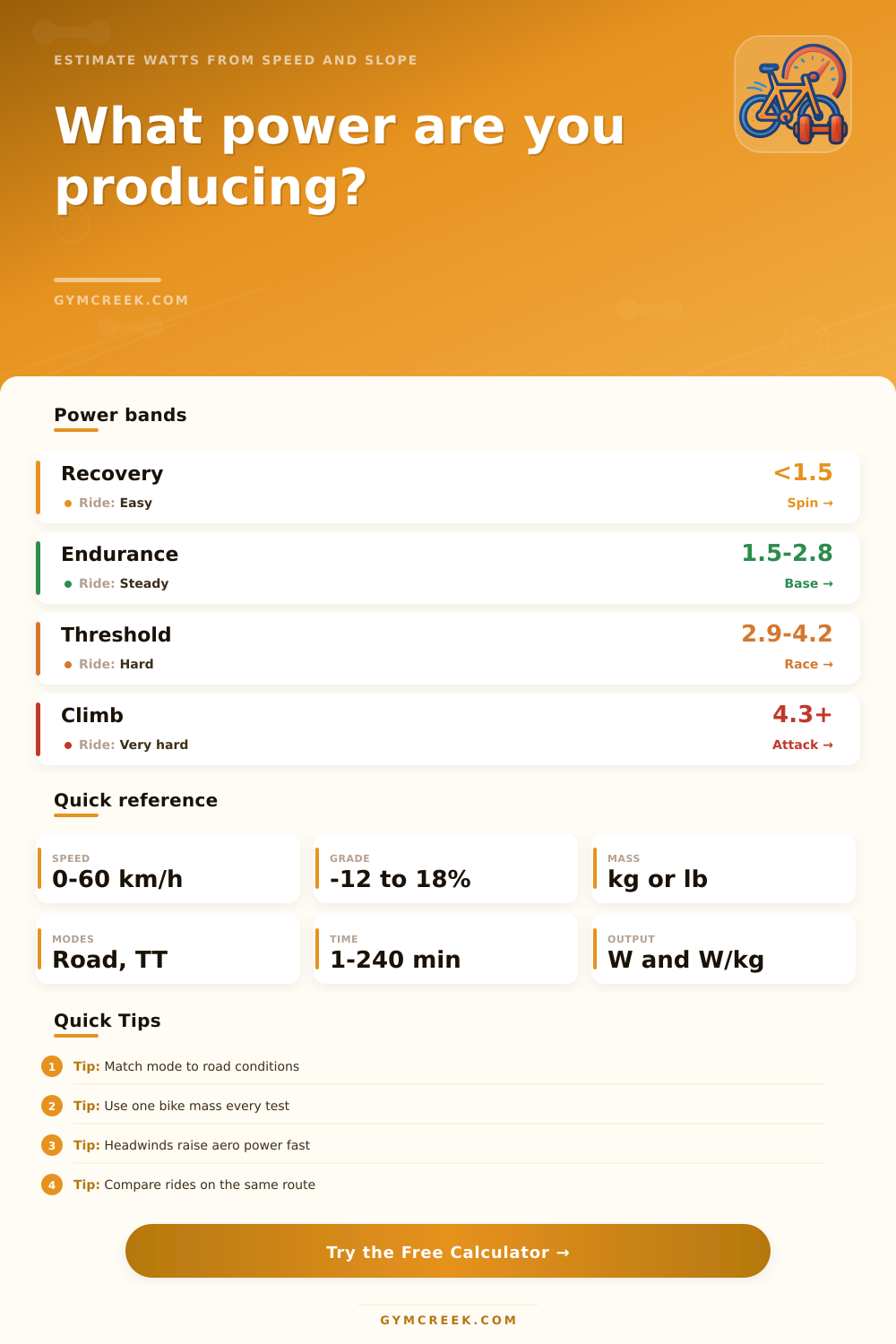
| Band | W/kg | Ride | Use |
|---|---|---|---|
| Recovery | <1.5 | Easy | Spin |
| Endurance | 1.5-2.8 | Steady | Base |
| Threshold | 2.9-4.2 | Hard | Race |
| Climb | 4.3+ | Very hard | Attack |
| Mode | CdA | Crr | Best fit |
|---|---|---|---|
| Road | 0.32 | 0.004 | General riding |
| Indoor | 0.40 | 0.003 | Trainer work |
| Climb | 0.28 | 0.005 | Steep routes |
| TT | 0.22 | 0.0035 | Aero focus |
| Formula | Use | Inputs | Output |
|---|---|---|---|
| Aero watts | Speed drag | CdA, wind | W |
| Rolling watts | Tire load | Mass, Crr | W |
| Climb watts | Gradient | Grade, mass | W |
| W/kg | Relative power | Watts, mass | W/kg |
| Scenario | Speed | Grade | Note |
|---|---|---|---|
| Indoor tempo | 30-35 | 0% | Trainer steady |
| Crit race | 38-45 | 0-2% | Fast group |
| Hill climb | 12-22 | 6-12% | Gravity heavy |
| TT aero | 38-50 | 0% | Low CdA |
Use this cycling power calculator to estimate watts from speed, grade, wind, and rider mass, then compare the result with watts per kilogram, ride intensity, and target pacing.
Cycling power depends on the energy that the rider puts in the pedals and you measure it in watts. It shows the speed that energy uses, so energy over time. In cycling you talk about energy as work, for example how much effort the rider needs to beat a climb.
To reach a certain speed, you apply a specific amount of power. Physical models of forces help to estimate the link between power in watts and groundspeed velocity in kph or mph
What Cycling Power Is and How to Improve It
The average power is the middle value of watts during the whole ride. You count it from the moment when the computer of the cyclist starts. If the rider stops pedalling or lowers the effort, everything affects the result.
Power you spend to beat air resistance, that matters most on flats and descents, and weight, that weighs during rises. There is also a bit of waste to beat, in the bike itself and between it and the road.
Cycling is differnet from running because air resistance becomes important above 25 km/h. Because of that you hardly compare two rides of same length but very different paces. A rider that does 27 km at 27 km/h needs average fewer watts than one that does the same distance at 50 km/h.
With 200 watts you can keep around 25 km/h on a cheap mountain bike with knobby tyres in vertical position, or until 35 km/h on a good lightweight road bike with great tyres and good riding position.
Watts per kilo are the most important, because it identifies the playing field to compare athletes. An untrained cyclist reaches 1 to 2 watts per kg, a trained one around 3, and professional 4 or more. The 20-minute power test is the most commonly mentioned.
FTP, or functional threshold power, shows the maximum power held during long time, usually 30 to 60 minutes. Above that limit, fatigue accrue much more quickly.
Climbing riding can strengthen muscular endurance. Cyclists usually slow the cadence and press more strongly on pedals during rise. One way to expand power is to slowly increase the climbing distance.
The most efficient way to build power on a bike is simply to spend more time riding. Consistency is everything. A good bike fit can help maximizing the efficient transfer of power to pedals and ensuring that the right muscles work correctly.
Exercises as deadlifts, squats, plyometrics and kettlebell swings unroll the skill of cycling muscles to go more heavily. Honestly and permanently training lead to progress over time.