Protein & Carb Intake Calculator
Get your personalized daily protein and carbohydrate targets based on your goal
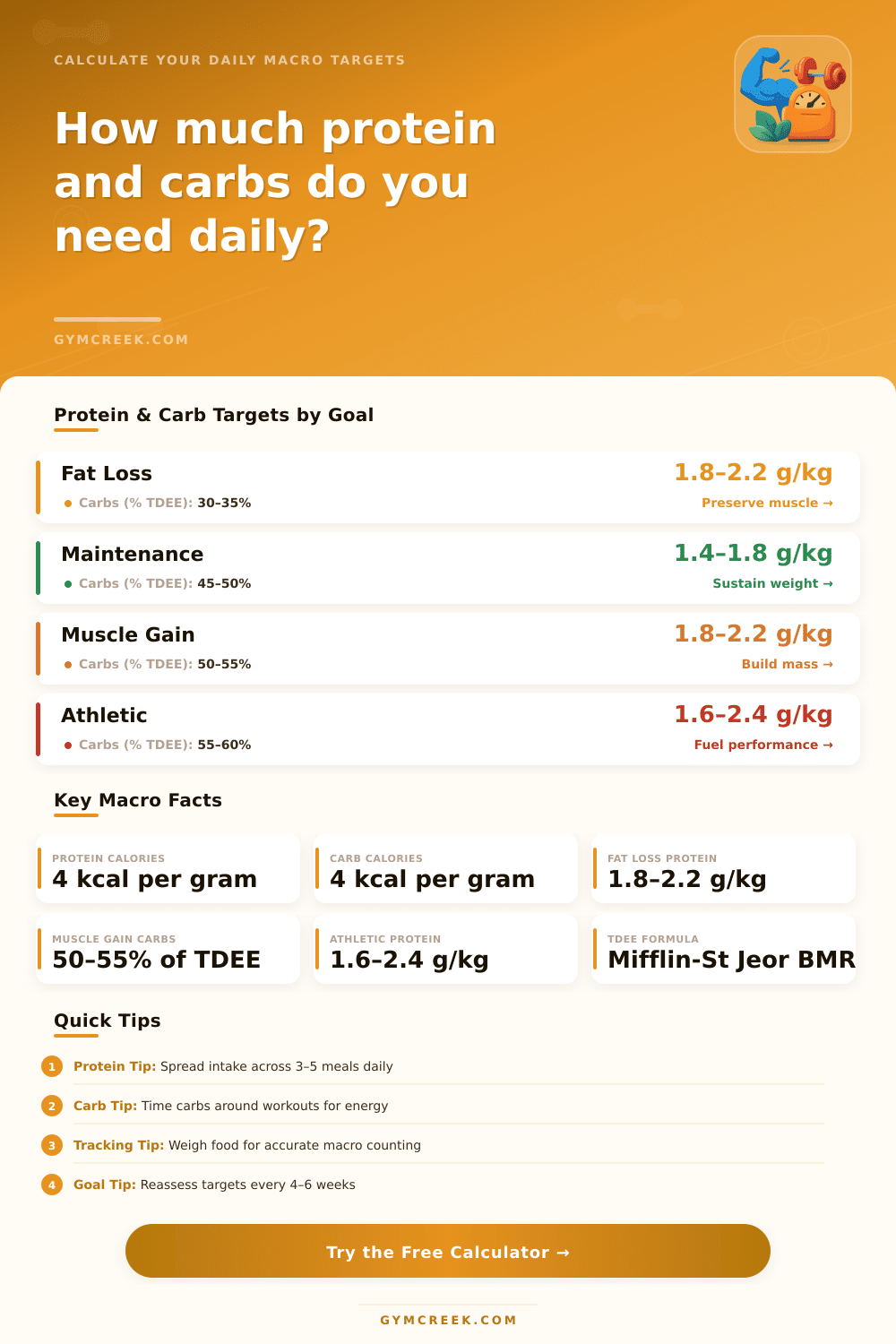
| Goal | Protein (g/kg) | Carbs (% TDEE) | Primary Focus |
|---|---|---|---|
| Fat Loss | 1.8–2.2 g/kg | 30–35% | Preserve lean muscle |
| Maintenance | 1.4–1.8 g/kg | 45–50% | Sustain body composition |
| Muscle Gain | 1.8–2.2 g/kg | 50–55% | Support hypertrophy |
| Athletic Performance | 1.6–2.4 g/kg | 55–60% | Fuel training & recovery |
| Food | Serving | Carbs (g) | Calories |
|---|---|---|---|
| White Rice (cooked) | 1 cup (186g) | 45g | 205 kcal |
| Brown Rice (cooked) | 1 cup (195g) | 45g | 215 kcal |
| Oats (dry) | ½ cup (40g) | 27g | 150 kcal |
| Sweet Potato | 1 medium (130g) | 27g | 112 kcal |
| Banana | 1 medium (118g) | 27g | 105 kcal |
| Whole Wheat Bread | 2 slices (56g) | 24g | 140 kcal |
| Quinoa (cooked) | 1 cup (185g) | 39g | 222 kcal |
| Black Beans | ½ cup (86g) | 20g | 114 kcal |
| Food | Serving | Protein (g) | Calories |
|---|---|---|---|
| Chicken Breast | 100g cooked | 31g | 165 kcal |
| Lean Ground Beef (93%) | 100g cooked | 26g | 218 kcal |
| Salmon | 100g cooked | 25g | 206 kcal |
| Whole Eggs | 2 large (100g) | 12g | 143 kcal |
| Greek Yogurt (non-fat) | 170g | 17g | 100 kcal |
| Cottage Cheese | ½ cup (113g) | 14g | 90 kcal |
| Tuna (canned) | 85g | 20g | 90 kcal |
| Tempeh | 100g | 19g | 193 kcal |
protein and carb form the base, when one thinks about energy levels, muscle building and simply good feelings. Nutrition experts usually point, that 45% to 65% of your everyday calories should come from carb. Protein takes place between 10% and 35 percent.
Fat then covers the rest namely 20% to 35%. Those guidelines are meant mainly for adult nutrition.
How to balance protein, carbs and fat
Physical needs for carb, they simply are the fuel. They are stored as glycogen, what gives energy for workouts and everyday activities. The most many folks aim at least 130 grams of carb daily as basic minimum.
For some, that live normal life, that commonly reaches 55% to 75% of the whole calories. The more strongly you train on a given day, the more useful carb become. Around rest days?
Here you can lower the amount, because your body does not burn fuel taht much quickly.
protein works entirely different in your body. It serves mainly to fix and keep muscle tissue. The basic minimum, that many guidelines offer, is around 0.36 grams each pound of body weight, that matches about 56 grams a day for men and 46 for women.
Even so, if you regularly lift weights, that amount goes up. Those, that seriously care about strong training, commonly aim won gram each pound of weight. Another popular method is 1.6 grams each kilo of body weight as a starting point.
If you eat more protein, it helps to stay full more long after meals. That filling effect naturally can lead to fewer whole calories eaten, what really helps during weight loss. Protein simply fills more than carb or fats.
So, when one cuts carb, more protein fills the calorie gap without hunger.
Soon after exercise, mixing protein with quick digesting carb surprisingly helps refuel. Aim around 20 to 40 grams of protein together with 60 to 100 grams of carb after a workout, that is a good guide. Studies show, that folks, that ate both nutrients inside two hours after hard cycling, felt themselves more well the next day than those, that only had carb.
Many folks stay at 50% carb, 25% protein and 25% fat. Others choose 40% carb, 30% protein and 30% fat. Really it depends on your goals.
Your body handles around 30 grams of protein each meal, so spreading it through the day in several portions makes sense. Mixing carb with protein and fat in one meal helps to steady the blood sugar. The main goal is reach your protein target first, later adjust carb andfats according to your activity and what feels doable.