Protein & Fiber Intake Calculator
Calculate your daily protein and fiber targets based on your age, gender, and goal
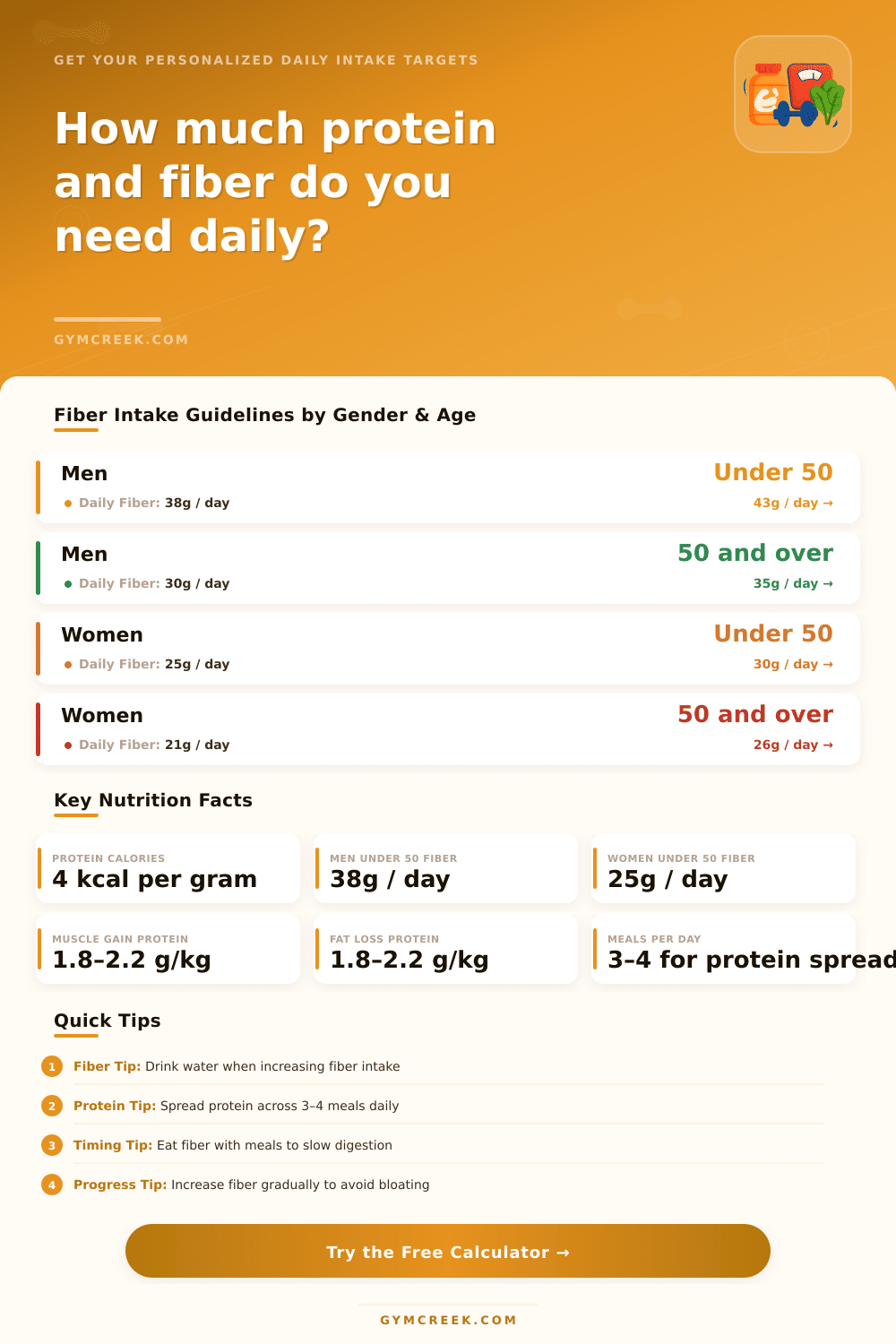
| Group | Age | Base Fiber (g/day) | Active / Athletic |
|---|---|---|---|
| Men | Under 50 | 38g / day | 43g / day |
| Men | 50 and over | 30g / day | 35g / day |
| Women | Under 50 | 25g / day | 30g / day |
| Women | 50 and over | 21g / day | 26g / day |
| Food | Serving | Fiber (g) | Category |
|---|---|---|---|
| Black Beans | ½ cup cooked | 7.5g | Legumes |
| Lentils | ½ cup cooked | 8g | Legumes |
| Chickpeas | ½ cup cooked | 6g | Legumes |
| Avocado | ½ medium (75g) | 5g | Fruit |
| Raspberries | 1 cup (123g) | 8g | Fruit |
| Apple (with skin) | 1 medium (182g) | 4.4g | Fruit |
| Broccoli | 1 cup cooked (156g) | 5.1g | Vegetables |
| Oats (dry) | ½ cup (40g) | 4g | Grains |
| Whole Wheat Bread | 2 slices (56g) | 3.8g | Grains |
| Quinoa (cooked) | 1 cup (185g) | 5.2g | Grains |
| Food | Serving | Protein (g) | Category |
|---|---|---|---|
| Chicken Breast | 100g cooked | 31g | Meat |
| Lean Ground Beef (93%) | 100g cooked | 26g | Meat |
| Salmon | 100g cooked | 25g | Fish |
| Tuna (canned in water) | 85g | 20g | Fish |
| Whole Eggs | 2 large (100g) | 12g | Eggs |
| Greek Yogurt (non-fat) | 170g | 17g | Dairy |
| Cottage Cheese | ½ cup (113g) | 14g | Dairy |
| Tempeh | 100g | 19g | Plant-Based |
| Edamame | ½ cup shelled (78g) | 9g | Plant-Based |
| Lentils | ½ cup cooked (99g) | 9g | Plant-Based |
Whether you get enough protein and fiber in your everyday diet? That turns out more tricky than one could believe. Many folks reach their targets for protein even so commonly fail on fiber, or rather.
The main trouble is in caring about both at the same time, it requires some thought, but it does deserve the effort for your good health.
How to Get Enough Protein and Fiber Every Day
Here why protein truly matters: it helps to keep your muscles strong, back your bones and strengthen your immune system. Adults should aim, that protein consist between 10% and 35% of their everyday calories. Interesting fact is, that bigger protein intake commonly helps to more efficient weight loss and can even lower the blood pressure compared to focus only on fiber.
Also, protein boosts your metabolism, helps to build muscles and keep the hunger under control during long hours. The best sources? Here eggs, meat of chicken and fishes, they form complete proteins, so they store all nine essential amino acids, that your body itself cannot produce.
Naturally, nuts, vegetables and grains also carry proteins, but those are incomplete, so you should mix them carefully.
fiber however deserves just as big attention. Women aim around 25 grams daily, while men should reach about 38 grams. Here the problem: almost 95% of Americans do not reach that target.
The most many eat only 15 grams a day, more or less. On the other hand, folks commonly too eat proteins. Loading up by means of steak and other proteins usually means to neglect fiber and nutrients from plants, that your body truly requires.
The good start? Fruits, vegetables, whole grains, beans, peas and lentils all help you get to that mark. Cleverly, beans, lentils and edamame provide both proteins and fiber (without too much packed fat and sodium).
They truly form double advantage in won package.
Together fiber and protein create a strong team. You will feel fewer cravings, especially for late night food, and you stay full for longer time. Studies show clearly, that bigger fiber intake links with more muscle mass, fewer body fat and better control of glucose at folks above 40 years.
That matches with the experiences of many folks.
If you start from a weak fiber base, the wise step is add one serving of fruits, vegetables or whole grains to every meal slowly. Increase your fiber by around 5 grams each week until the suggested level seems good. Even so, too much can cause bloating, gases and other stomach problems.
Too much fiber too soon even can block the taking in of nutrients.
Good starting points are to aim for around 80 grams of protein and roughly 20 grams of fiber a day, using foods, that you already enjoy. Carbs from whole foods come with fiber and structure, that slows the digestion and keeps theblood sugar more stable than processed foods. That balance backs weight control, improves digestion, steadies blood sugar and helps to block some major chronic diseases in the future.