🔥 TDEE Calculator with Steps
Calculate your Total Daily Energy Expenditure using the Mifflin–St Jeor formula — with a full step-by-step breakdown
🎯 Calorie Targets by Goal
| Activity Level | Multiplier | Exercise Frequency | Typical Profile |
|---|---|---|---|
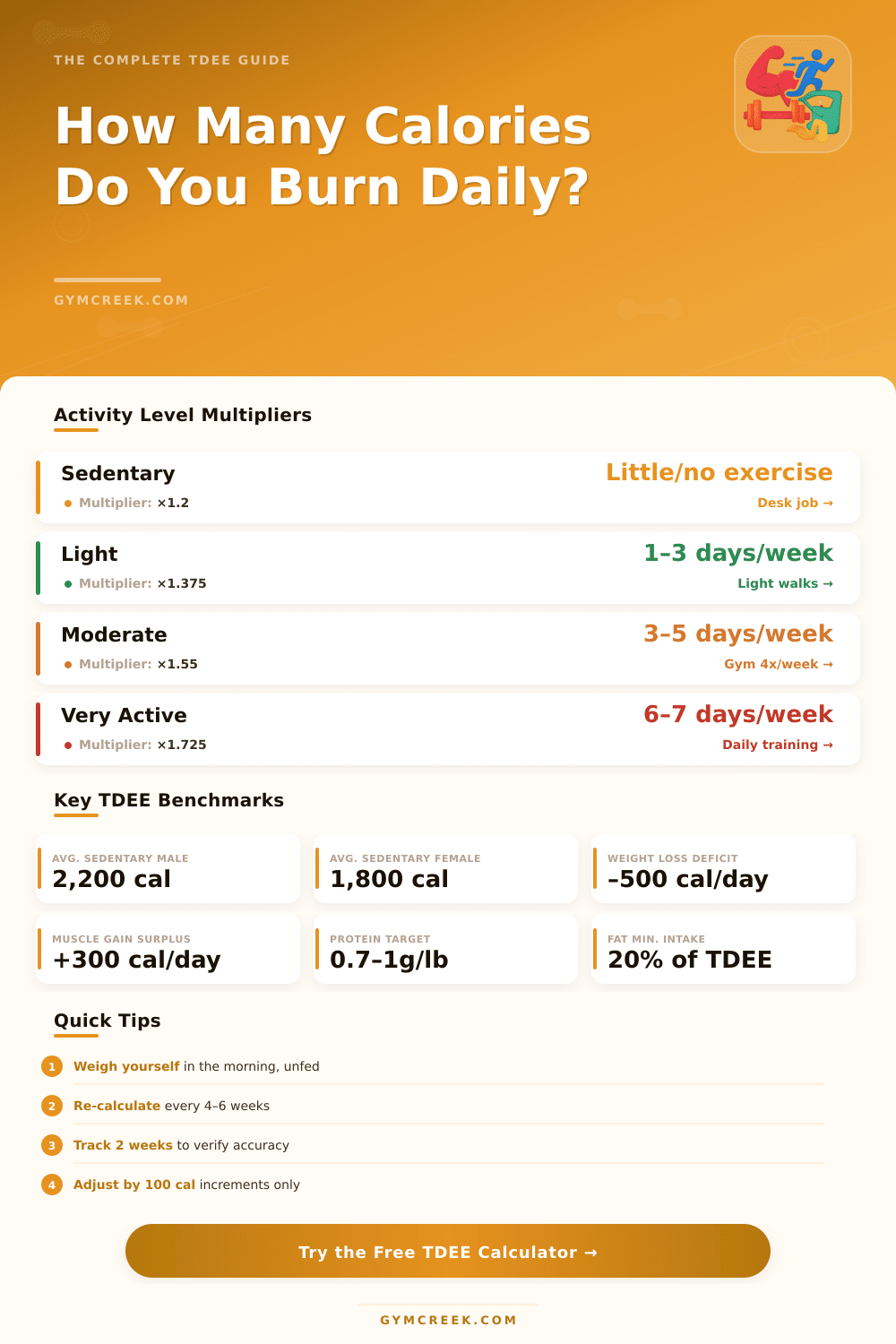
| Sedentary | ×1.2 | Little/none | Desk job, mostly seated |
| Lightly Active | ×1.375 | 1–3 days/week | Light walks, casual activity |
| Moderately Active | ×1.55 | 3–5 days/week | Regular gym sessions |
| Very Active | ×1.725 | 6–7 days/week | Daily training or sports |
| Extra Active | ×1.9 | 2x/day or physical job | Athlete + physical labor |
| Profile | Typical BMR (Male) | Typical BMR (Female) | Formula |
|---|---|---|---|
| Age 20, 150 lbs, 5'8" | 1,840 kcal | 1,620 kcal | Mifflin–St Jeor |
| Age 30, 175 lbs, 5'10" | 1,910 kcal | 1,690 kcal | Mifflin–St Jeor |
| Age 40, 185 lbs, 5'10" | 1,880 kcal | 1,660 kcal | Mifflin–St Jeor |
| Age 50, 190 lbs, 5'9" | 1,800 kcal | 1,580 kcal | Mifflin–St Jeor |
| Age 60, 170 lbs, 5'8" | 1,680 kcal | 1,460 kcal | Mifflin–St Jeor |
| Category | Men (% Body Fat) | Women (% Body Fat) | Notes |
|---|---|---|---|
| Essential Fat | 2–5% | 10–13% | Minimum for organ function |
| Athletic | 6–13% | 14–20% | Competitive sports build |
| Fitness | 14–17% | 21–24% | Healthy, lean appearance |
| Average | 18–24% | 25–31% | Typical healthy adult |
| Obese | 25%+ | 32%+ | Increased health risks |
| Split Name | Carbs % | Protein % | Fat % | Best For |
|---|---|---|---|---|
| Balanced | 40% | 30% | 30% | General health & maintenance |
| High Protein | 40% | 40% | 20% | Muscle gain, body recomposition |
| Low Carb | 25% | 40% | 35% | Fat loss, insulin sensitivity |
| Ketogenic | 5% | 35% | 60% | Metabolic therapy, strict fat loss |
| Endurance | 55% | 25% | 20% | Marathon, cycling performance |
TDEE is Total Daily Energy Spending. It shows the whole amount of calories that the body spends during one day. Here includes everything, from physical activity and walking to basic processes like breathing and sleep.
Precise count of TDEE is hard to reach and it adjusts from one day to the next.
TDEE: How Many Calories You Burn Each Day
Three main parts affect TDEE. First comes the basic metabolic rate, or BMR, that points the energy that the body needs to simply exist at rest. Second is the level of activity.
Third the heat impact of food processing. Basic metabolism usually covers 60 to 75 percent of TDEE. Because fat does not use lot of energy to maintain itself, the mass wihtout fat better predicts how many calories the body burns at rest.
For estimating TDEE, start by calculating BMR. Then adjust that value according to the level of activity. Common multipliers apply to various levels of motion.
For sitting it is BMR times 1.2. For a bit active, BMR times 1.375. For medium active.
BMR times 1.55. For a lot active… BMR times 1.725.
For extremely active. BMR times 1.9.
TDEE points the amount of calories that you must receive daily too preserve the current weight. If you eat more than that amount, you gain weight. If less, you lose weight.
To add muscle, start with around 500 calories above TDEE, then expand as needed. To lose around one pound each week, create a deficit of 500 calories under TDEE daily.
Online calculators for TDEE use age, weight, height, gender and activity level to estimate the needed calories to preserve weight. Even so they depend on the user well estimating his activity, and the results are not always precise. They base on statistical averages, so the number can differ.
The wisest way is to consider the result of any calculator only as a rough starting point.
A more reliable way is to carefully follow the eating of foods, weigh yourself daily in the morning as first thing and use the averages of several weeks to estimate the real maintenance calories. Actual data beats every formula. TDEE adjusts according to lifestyle.
Regular daily updates give more steady values, while changes in routine updateeverything.
Bigger muscular mass can raise TDEE, so each person that lifts weights should commonly check his daily intake. Calories from exercise belong to TDEE and need thought during planning of meals. Adding muscle through both cardio and strength training can raise TDEE, because more muscular mass burns more calories through the day.