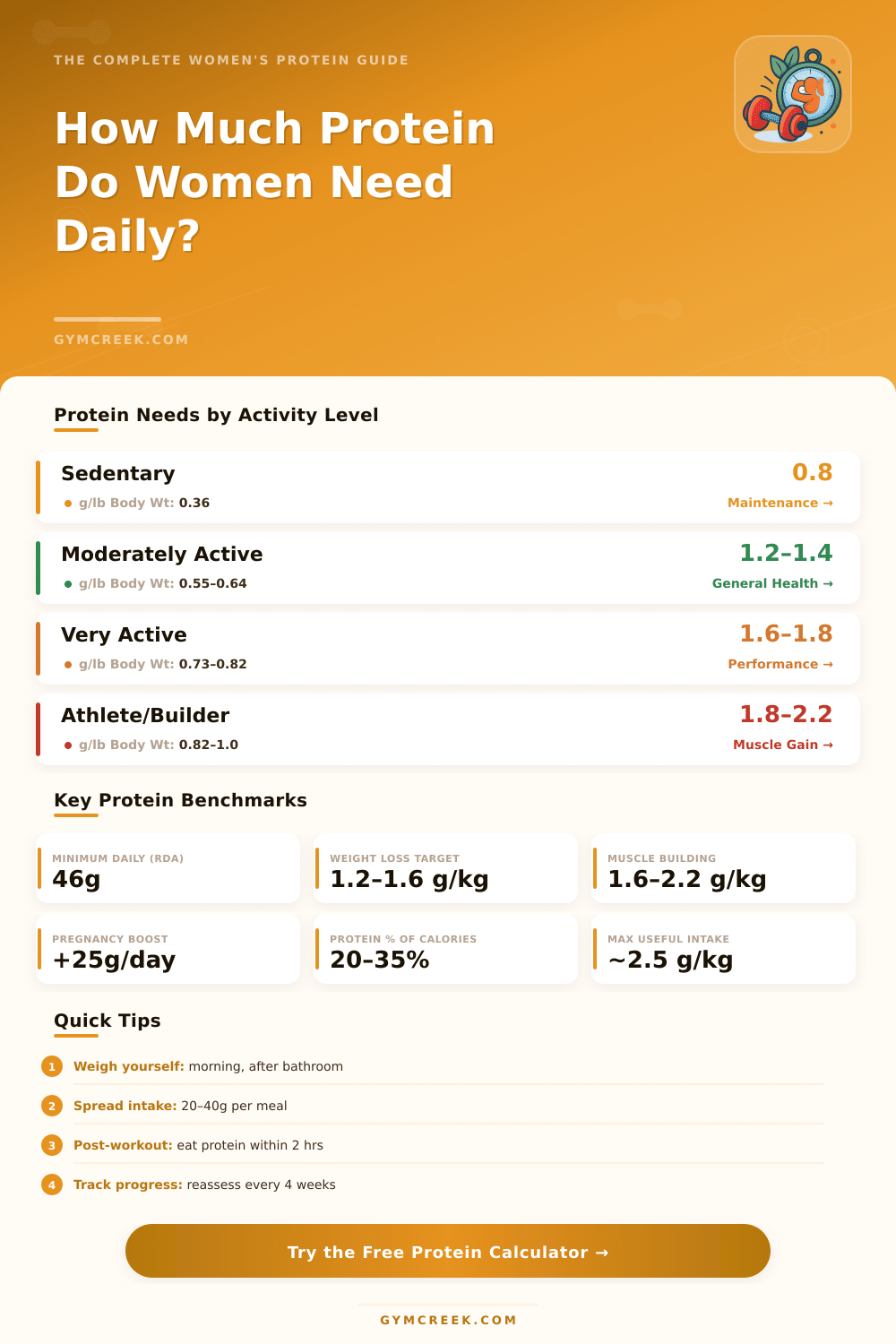
💪 Daily Protein Intake Calculator for Women
Find your ideal daily protein goal based on your weight, activity level, and fitness goals
| Goal / Lifestyle | g per kg Body Wt | g per lb Body Wt | Example: 65 kg Woman | Source / Basis |
|---|---|---|---|---|
| Sedentary (minimum) | 0.8 | 0.36 | 52 g/day | WHO / DRI RDA |
| General Health | 1.0–1.2 | 0.45–0.55 | 65–78 g/day | ACSM Guidelines |
| Weight Loss (preserve muscle) | 1.2–1.6 | 0.55–0.73 | 78–104 g/day | Helms et al. 2014 |
| Muscle Building / Toning | 1.6–2.2 | 0.73–1.0 | 104–143 g/day | Morton et al. 2018 |
| Endurance Athlete | 1.4–1.7 | 0.64–0.77 | 91–111 g/day | ISSN Position Stand |
| Competitive / Elite Athlete | 1.8–2.2 | 0.82–1.0 | 117–143 g/day | ISSN / ACSM |
| Pregnancy (2nd & 3rd trimester) | 1.1–1.5 (+25 g) | 0.5–0.68 | 96–123 g/day | Academy Nutr & Diet |
| Breastfeeding | 1.1 (+20 g) | 0.5 | ~91 g/day | IOM DRI |
| Women 50+ (aging muscle) | 1.2–1.6 | 0.55–0.73 | 78–104 g/day | Bauer et al. 2013 |
| High-Protein / Keto Diet | 2.0–2.5 | 0.91–1.14 | 130–163 g/day | Leidy et al. 2015 |
| Food Source | Protein (g) | Calories | Best For |
|---|---|---|---|
| Chicken Breast (cooked) | 31 g | 165 kcal | Muscle building, weight loss |
| Greek Yogurt (plain, 0% fat) | 10 g | 59 kcal | Snacking, bone health |
| Eggs (whole) | 13 g | 155 kcal | General health, all goals |
| Salmon (cooked) | 25 g | 208 kcal | Endurance, heart health |
| Cottage Cheese (low-fat) | 11 g | 81 kcal | Night-time protein, weight loss |
| Tuna (canned in water) | 26 g | 116 kcal | Budget-friendly muscle goal |
| Lentils (cooked) | 9 g | 116 kcal | Plant-based, pregnancy |
| Tofu (firm) | 8 g | 76 kcal | Vegan, plant-based diet |
| Edamame (shelled) | 11 g | 121 kcal | Snacking, plant protein |
| Whey Protein Powder | 74–80 g | ~370 kcal | Post-workout, muscle gain |
| Body Fat Category | Women (% Fat) | Lean Mass % | Protein Adjustment |
|---|---|---|---|
| Essential Fat | 10–13% | 87–90% | Base on lean mass x 2.2–2.5 g/kg |
| Athletes | 14–20% | 80–86% | 1.8–2.2 g/kg lean mass |
| Fitness / Average | 21–28% | 72–79% | 1.4–1.8 g/kg body weight |
| Acceptable | 29–35% | 65–71% | 1.2–1.6 g/kg body weight |
| Obese | 36%+ | <64% | Base on target weight or lean mass |
Protein has 20 kinds of amino acids. From them nine are essential, because the body alone can not produce them. One must get them from food.
DISCLOSURE: This post may contain affiliate links, meaning when you click the links and make a purchase, I receive a commission. As an Amazon Associate I earn from qualifying purchases.

In special periods of life, as infancy, youth and pregnancy, the body requires even bigger amounts of amino acids. At Women, enough Protein helps to form firm muscle, strengthen bones and help the body keep a lively metabolism.
Protein Needs for Women
The usual standard suggests 0.8 grams of Protein for every kilo of body mass. Even so that level only stops lack, but does not ensure good health. A good aim for most Women is 20 to 30 grams of Protein for every meal.
Here matters the age. For Women between 20 and 35 years, ideal daily Protein entry reaches around 1.6 to 2.2 grams per kilo of weight. During perimenopause and menopause, they maybe require a bit more.
At the age of 50 years, the body starts to lose muscle of the skeleton. Enough Protein in food helps to keep force and reduce dangers of wounds because of falls. The best way is to eat small portions of quality Protien at every meal.
On average, Women own fewer firm muscle than men. Many of them however benefit from bigger muscle mass, especially when they age. Proteins burn more calories at rest and improve motion and everyday activity.
Also the estrogen matters. In the luteal phase, when progesterone rises, Women can require a bit more Protein to meet the growing metabolic needs.
For young girls and sporty Women, good advice is two daily portions each of three types of thin Protein, as meat, bird, eggs, seafood or soy products. Plant based sources commonly require a bit bigger amounts. For healthy folk weighing 150 pounds, the everyday Protein needs fall between 80 and 136 grams.
The needs about Protein range according to individuals. Sex, age, amount of activity and other factors all affect. Men and Women have different needs.
Talks about Protein commonly stress men, but food and cooking needs of Women differ.
Powder from Protein is not required. One can get it from meat, nuts and other whole foods. However such powder makes it easy to reach daily targets, when meals lack.
No important difference exists between Protein sold for Women and the standard kind. The Protein itself does not adjust according to sex. Women simply require fewer grams daily than a typical man.
Some people hardly handle sugary Protein in the belly and favour plant based choices. Choose a brand based on food demand and taste.
The spread of Protein through the meals also matters. A study with 192 healthy Women looked at how equal spread of Protein entry affects body mass, muscle force and everyday skill. Eating Protein regularly through the day seems a smartertactic than packing it in one meal.