🏋 Bench Press Calculator by Age & Weight
Find your estimated 1-rep max, strength level, and training weights based on your age, gender, and body weight
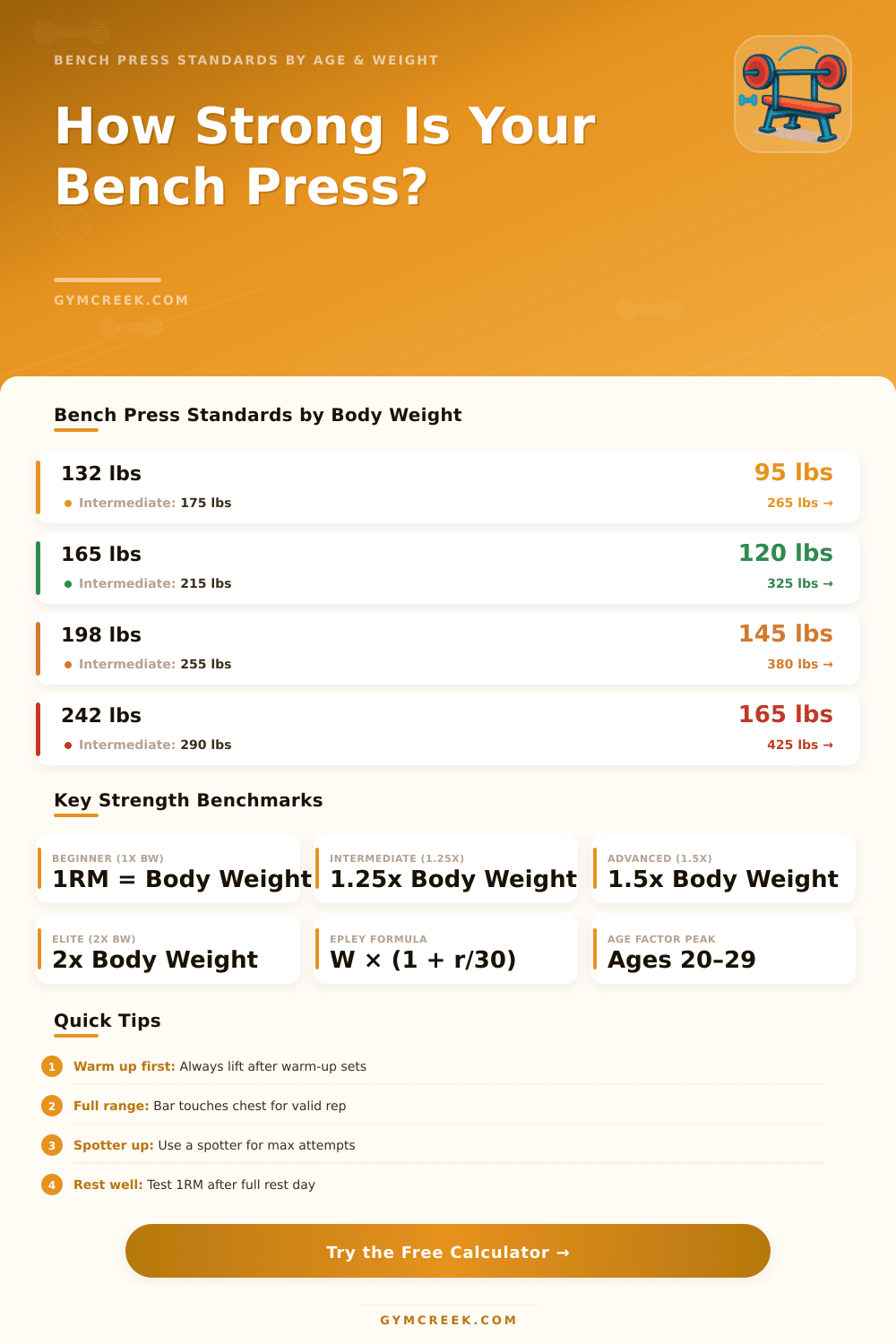
| Body Weight | Beginner | Novice | Intermediate | Advanced | Elite |
|---|---|---|---|---|---|
| 114 lbs (52 kg) | 75 lbs | 115 lbs | 150 lbs | 195 lbs | 245 lbs |
| 132 lbs (60 kg) | 90 lbs | 135 lbs | 175 lbs | 225 lbs | 285 lbs |
| 148 lbs (67 kg) | 105 lbs | 155 lbs | 200 lbs | 260 lbs | 325 lbs |
| 165 lbs (75 kg) | 115 lbs | 170 lbs | 220 lbs | 285 lbs | 360 lbs |
| 181 lbs (82 kg) | 130 lbs | 190 lbs | 245 lbs | 315 lbs | 395 lbs |
| 198 lbs (90 kg) | 140 lbs | 210 lbs | 265 lbs | 340 lbs | 425 lbs |
| 220 lbs (100 kg) | 155 lbs | 225 lbs | 285 lbs | 365 lbs | 455 lbs |
| 242 lbs (110 kg) | 165 lbs | 240 lbs | 305 lbs | 385 lbs | 480 lbs |
| Body Weight | Beginner | Novice | Intermediate | Advanced | Elite |
|---|---|---|---|---|---|
| 97 lbs (44 kg) | 40 lbs | 60 lbs | 80 lbs | 105 lbs | 135 lbs |
| 114 lbs (52 kg) | 50 lbs | 70 lbs | 95 lbs | 125 lbs | 155 lbs |
| 132 lbs (60 kg) | 55 lbs | 80 lbs | 110 lbs | 145 lbs | 180 lbs |
| 148 lbs (67 kg) | 65 lbs | 95 lbs | 125 lbs | 160 lbs | 200 lbs |
| 165 lbs (75 kg) | 70 lbs | 105 lbs | 140 lbs | 175 lbs | 220 lbs |
| 181 lbs (82 kg) | 75 lbs | 115 lbs | 150 lbs | 190 lbs | 240 lbs |
| 198 lbs (90 kg) | 80 lbs | 120 lbs | 160 lbs | 205 lbs | 255 lbs |
| Age Range | Strength Factor | Peak Performance | Notes |
|---|---|---|---|
| 14–17 | 0.80–0.90 | Developing | Focus on form, not max load |
| 18–22 | 0.93–0.98 | Near Peak | Rapid strength gains possible |
| 23–35 | 1.00 | Prime Years | Peak absolute strength window |
| 36–45 | 0.94–0.98 | Slight Decline | Recovery becomes more important |
| 46–55 | 0.86–0.93 | Moderate Decline | Prioritize technique & volume |
| 56–65 | 0.78–0.85 | Gradual Decline | Joint health becomes priority |
| 66+ | 0.65–0.77 | Senior Level | Consistent training maintains gains |
| Level | Male Ratio (1RM/BW) | Female Ratio (1RM/BW) | Example (175 lb male) |
|---|---|---|---|
| Beginner | 0.50 – 0.75x | 0.30 – 0.50x | 88 – 131 lbs |
| Novice | 0.75 – 1.00x | 0.50 – 0.65x | 131 – 175 lbs |
| Intermediate | 1.00 – 1.25x | 0.65 – 0.80x | 175 – 219 lbs |
| Advanced | 1.25 – 1.75x | 0.80 – 1.00x | 219 – 306 lbs |
| Elite | 1.75x+ | 1.00x+ | 306+ lbs |
| % of 1RM | Approx Reps | Training Goal | Rest Between Sets |
|---|---|---|---|
| 95–100% | 1 | Max Strength Test | 3–5 min |
| 90–95% | 2–3 | Maximum Strength | 3–5 min |
| 85–90% | 4–5 | Strength | 2–4 min |
| 75–85% | 6–8 | Strength-Hypertrophy | 2–3 min |
| 67–75% | 9–12 | Hypertrophy | 60–90 sec |
| 57–67% | 13–18 | Muscular Endurance | 45–60 sec |
| 50–57% | 19–25 | Endurance | 30–45 sec |
The bench press is one of the most popular and effective exercises for developing upper body strength. This exercise effectively builds the muscles of the chest, shoulders, and triceps. A person can develop tremendous strength in these areas through regular training. However, there is no easy way of determining if an individual’s bench press strength is good or not due to multiple personal factors. A calculator that determines an individual’s good bench press strength based on their age and weight will provide insights into their strength that no general standard will.
An individual’s age and body weight will have the most significant influence on there bench press strength. For example, a 20-year-old weighing 180 pound will naturaly have more strength in their bench press relative to a 55-year-old individual of the same weight. Additionally, an athlete that weigh 150 pounds has different strength benchmarks compared to a powerlifter that weighs 220 pounds.

Why Age and Weight are Important to Determine an Individual’s Bench Press Strength
Strength benchmarks will decline as an individual ages and will increase during the teenage years and the prime years of an individual’s life. After the age of 35, an individual will gradually lose some of their strength due to the natural decline in testosterone, recovery, and muscle elasticity in the body. However, the body can retain its strength if an individual focuses on regular training and recovery routines. An effective bench press calculator by age and weight will account for this with adjustments made to the strength benchmarks according to an individual’s age.
An individual’s body weight will play a significant role in the strength that they can develop in their bench press exercises. An individual that weighs more will have more muscle mass in their upper body allowing them to push more weight on the bench press bar than an individual of a lower body weight. This is one of the primary reasons that strength benchmarks are provide within specific weight classes for individuals. An individual that weighs 165 pounds and can bench press 225 pounds will have more relative strength than an individual that weighs 240 pounds and can also bench press 225 pounds. The best bench press calculators will provide individual strength benchmarks according to their strength-to-body weight ratio. These benchmarks will compare their strength to other individuals of their age that fall under specific strength levels, from beginner to elite lifters.
An individual’s strength can also be determined according to their training experience. An individual that has trained with barbells and weights for five years will have more strength than an individual that has just started training with weights. Many strength calculators will account for the number of years an individual has trained as part of their calculation. The strength benchmarks will provide an individual with a relative strength level according to whether they are a beginner, novice, intermediate, or advanced lifter.
The most popular formula used to calculate an individual’s one-rep maximum strength is the Epley equation. This formula calculates the one-rep maximum for an individual by asking how much weight they can lift for a number of repetitions. While not accurate in determining an individual’s true one-rep maximum strength, this is the safest calculation that can be made for an individual to estimate their strength. This formula accounts for an individual’s age and weight to determine their strength benchmarks.
Many weight lifters will understate the importance of relative strength benchmarks. For example, a young and lightweight athlete may be able to bench press 185 pounds. In contrast, an older and more massive athlete may have difficulty with the same weight. The truth is somewhere in the middle. This is why many individuals use strength calculators today that account for all aspect of an individual’s physical capabilities.
These strength calculators can provide an individual with insights into their strength and what they should be focusing on within their training routine. For example, if their strength benchmark is that of a novice lifter despite years of training, they may need to adjust their training routine to better develop their upper body strength. Elevation to the status of an advanced or elite lifter will provide them with an accomplishment that they can celebrate.
Additionally, as an individual ages, the type of strength training routine that they use will change. For example, younger lifters are able to train more frequently and perform more strenuously routines with their weights. An individual over the age of 40 may discover that they need to incorporate more mobility into their routine and train with greater care to allow their body to recover between sessions.
Women generally have less strength in their upper body relative to men due to the difference in the hormones that they secrete. However, the strength benchmarks for women have significantly increased over time as more and more women are embracing weight lifting and other forms of physical strength training. The strength calculators provided online will account for the gender differences in strength between men and women. This allows for the program to better celebrate the strength that female athletes have developed over time.

Bench pressing and strength training will allow an individual to develop upper body strength that can be utilized for different tasks throughout their life. Regardless of an individual’s strength goals, understanding the strength that they have developed in their upper body in the context of their age and body weight will provide them with valuable information regarding their physical conditioning.
The information that an individual gains from their strength calculators will provide them with the knowledge they need to better develop their physical strength and conditioning over time. While the secrets to strength development are the consistency, proper form, and progressive overload that an individual puts into their training program, the strength calculators will allow them to understand where they currently stand in their development and where they may be able to go.
Individuals’ genes, body structure, training history, and recovery ability all play a role in determining their strength. However, the most important measure of strength for an individual is how they compare to their former self. The other benchmarks are secondary to an individual’s ability to develop their strength over time.
Regardless of where an individual stands in their strength journey, being able to compare their strength to others of their age and weight will be of great motivation and informational value to the individual. Such knowledge will provide them with a roadmap to help them further develop their strength. Additionally, they can use this knowledge to appreciate the effort that they have put into increasing their strength.

While individual strength calculators may provide the knowledge that an individual needs to understand their relative strength to others of their age and body weight, they also serve as a motivational tool for the individual to continue training and striving to increase their strength over time. As an individual ages, the ability of the individual to recover from strength training routines will change. An individual’s bench press strength will continue to play a role in their physical conditioning and health throughout their life. Whether that individual chooses to focus on their strength as competitors in strength contests or as individuals that want to maintain their health and physical strength in their later years, understanding their potential strength will allow them to focus on the aspects of their training that are most important to their goals. As such, understanding the different factors that influence one’s bench press strength will empower an individual to train more intelligently and effectively for years to come.
Remember that strength calculators and programs are not set in stone and will not account for all aspects regarding an individual’s physical strength. However, they will provide an individual with general information about their physical capabilities and the potential that they have to increase and develop their strength. However, no matter their potential or current physical strength, the most important individual comparison will always be to their former self. As discussed above, their physical strength should be compared to their former self in relation to time to determine their genuine development and potential for additional development in their strength.
Regardless of an individual’s strength, understanding their potential ability to develop their physical strength will allow them to better focus on their training. Those who just started training with weights may be motivated by the knowledge that they have the potential for further development of their bench press strength. Those who have been training for years can utilize these insights to determine whether they may need to make changes to their training program to increase the development of their upper body strength. Thus, no matter an individual’s starting point or their strength level, the knowledge of their potential allows them to better understand the training program that they need to employ to reach their goals. In a world where most individuals have strength programs and training routines of their own, understanding the factors that influence one’s bench press strength will allow them to maximize their training and conditioning for their bodies. Therefore, the knowledge gained from these strength calculators will allow an individual to increase their strength and develop their physical conditioning over time.