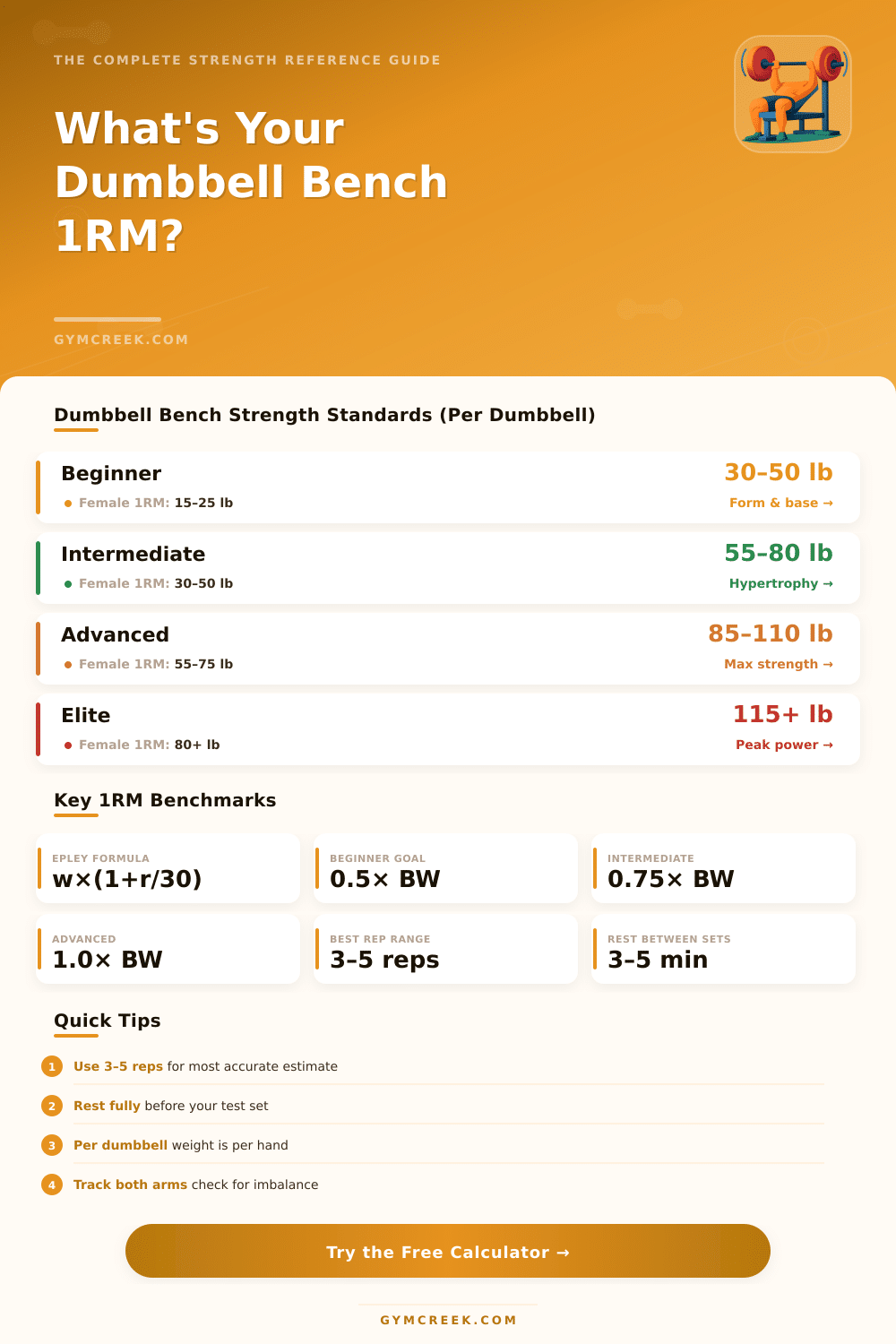
🏋 Dumbbell Bench One Rep Max Calculator
Estimate your 1RM for dumbbell bench press using your reps and weight — per dumbbell or combined
| Level | Male (lbs) | Female (lbs) | Male (kg) | Female (kg) |
|---|---|---|---|---|
| Beginner | 25–50 lb | 10–25 lb | 11–23 kg | 5–11 kg |
| Novice | 50–70 lb | 25–40 lb | 23–32 kg | 11–18 kg |
| Intermediate | 70–95 lb | 40–60 lb | 32–43 kg | 18–27 kg |
| Advanced | 95–120 lb | 60–80 lb | 43–54 kg | 27–36 kg |
| Elite | 120+ lb | 80+ lb | 54+ kg | 36+ kg |
| Reps | % of 1RM | Training Focus | RPE (Effort) |
|---|---|---|---|
| 1 | 100% | Max Strength Test | 10 / 10 |
| 2 | 97% | Near-Maximal Strength | 9.5 / 10 |
| 3 | 94% | Strength & Power | 9 / 10 |
| 4 | 92% | Strength & Power | 8.5 / 10 |
| 5 | 89% | Strength | 8 / 10 |
| 6 | 86% | Strength–Hypertrophy | 7.5 / 10 |
| 8 | 81% | Hypertrophy | 7 / 10 |
| 10 | 75% | Hypertrophy–Endurance | 6.5 / 10 |
| 12 | 70% | Muscular Endurance | 6 / 10 |
| 15 | 65% | Endurance | 5.5 / 10 |
| Formula | Equation | Best For | Rep Range |
|---|---|---|---|
| Epley | w × (1 + r/30) | General use | Any |
| Brzycki | w × 36/(37–r) | Low reps (1–10) | 1–10 |
| Lander | 100w/(101.3–2.67123r) | Moderate reps | 5–12 |
| Lombardi | w × r0.10 | Higher reps | 8–20 |
| Mayhew | 100w/(52.2+41.9×e−0.055r) | Research validated | 5–15 |
| Level | Male (× BW) | Female (× BW) | Example Male 175 lb |
|---|---|---|---|
| Beginner | 0.25–0.4 | 0.15–0.25 | 43–70 lb combined |
| Novice | 0.4–0.6 | 0.25–0.4 | 70–105 lb combined |
| Intermediate | 0.6–0.8 | 0.4–0.6 | 105–140 lb combined |
| Advanced | 0.8–1.0 | 0.6–0.75 | 140–175 lb combined |
| Elite | 1.0+ | 0.75+ | 175+ lb combined |
The dumbbell bench press exercise are one of the best for building strength in the upper body. This exercise target the chest, shoulder, and triceps muscles. In addition, it works the stabilizers that many barbell exercises leave out altogether.
The benefits of using dumbbell weights for bench pressing include greater range of motion and correcting muscularly imbalances between the two sides of the body. People as varied as beginners and strength athlete can benefit from knowing their one rep max calculator dumbbell bench for the dumbbell bench press exercises. This measurement allow individuals to know their strength level with their upper body and make better training decisions.
One Rep Max Calculator Dumbbell Bench
Knowing the maximum weight that an individual can press for one repetition allows people to determine their workout programs. They can track their strength gains and ensure that they are training at the right level for their goals. An one rep max calculator dumbbell bench allows individuals to estimate their one rep max for the dumbbell press based on the weight that they can lift for multiple repetitions.
How One Rep Max Calculations Work for Dumbbell Bench Press
The one rep max, or 1RM, represents the maximum weight that an individual can lift for one repetition. To determine the 1RM, the individual must lift the maximum weight for one repetition of an exercise. However, this method is dangerous for two reasons: it is likely to result in an injury and it requires other individuals to spot the exercise. Fortunately, mathematical formulas allow individuals to calculate their 1RM using other sets of weights and repetitions.
For the dumbbell bench press, individuals must determine if they are measuring the weight of each dumbbell or the total weight. The total 1RM for a dumbbell press exercise will always be twice the amount of weight that is measured per dumbbell because each hand lift one dumbbell at a time. The difference between using dumbbell weights as opposed to barbell weights is that the dumbbell exercise allow for more independence of the two arms. This makes it more challenging for the individuals but allows for better development of upper body strength.
Several different formula exist to calculate the 1RM for the dumbbell press exercise. The Epley formula works well with different repetitions of the exercise. The Brzycki formula works best with lower repetitions. The Mayhew formula include additional variables that work best with the total weight lifted and allows individuals to get the most accurate calculation of their 1RM.
For each calculation, individuals can use the number of repetitions of the dumbbell press exercise and the weight lifted to calculate the one rep max for the exercise. Once individuals calculate this value, they can compare their strength to their body weight. The ratio of the weights lifted and body weight can identify an individual strength level. For men, the benchmark for an impressive amount of strength in the upper body is being able to bench press a weight equal to their body weight. Women have less upper body strength than men so their standard is slightly lower.
Knowing the value of an individual’s one rep max also provide information regarding the percentage of their strength that they should use for their training. For example, individuals who wish to gain the most amount of strength should train at 85-95% of their calculated 1RM. For muscular strength and size, the ideal training range is 70-85% of one rep max. For endurance, the ideal percentage is 60-75% of one rep max.
The benefits of using dumbbells for the bench press exercise include not needing much space to perform the exercise at home. The benefits also include the ability of the dumbbell exercise to accommodate muscular conditions in the shoulders because the weights dont stress the joints in the same way that barbell weights does. Youll find that it feels more naturaly.
Using the 1RM calculations for the dumbbell press exercise, individuals can create a plan to gradually increase the weights that they lift as the upper body muscles become more conditioned. This type of training can prevent injuries and allow for the best rate of improvement in the muscles.
Form for the dumbbell exercise is the single most important measure of training. If an individual does not use proper form, they will likely develop muscularly imbalances in their upper body. The starting position for the bench press should have an individual’s back slightly arched, their shoulder blades retracted and the dumbbells should be at the level of the chest. During the exercise, the individual’s wrists should remain in a straight position and their elbows should be at a 45-degree angle to their torso.
To develop strength in the upper body muscles, muscular recovery is just as important as training. Muscles grow during the recovery period after lifting weights. The best way to allow for muscular recovery is to provide sufficient protein in the diet, get enough sleep and take rest days according to the training plan. It’s something you should of done to see progress.
There are a variety of factors other than training that affect the one rep max that an individual can develop. These factors include the age of the individual, their genetics and their previous training history with the upper body.
Most strong lifters will perform the dumbbell bench press in conjunction with other exercises. Examples of other upper body exercises include bicep curls, rows and push-ups to ensure the even development of upper body muscles and to maintain joint health.

The one rep max calculator dumbbell bench is one of the many tool that an individual can use to train effectively. While the calculations are helpful, they cannot overshadow the importance of training with proper form and providing time for muscles to recover. Whatever an individual’s goal in strength training is for the upper body, knowing their strength allows them to find the best ways to improve their strength in this area.
Strength training is a marathon event. Individuals who train themselves patient and consistently will experience the best results. The combination of training tools and training method will ensure that results are experienced long after each training cycle. You’re going to see a lot of improvements if you stay dedicated to the process.