🏋 Bench / Squat / Deadlift Ratio Calculator
Check your Big Three strength balance, identify weak points, and compare to gender & bodyweight standards
| Bodyweight | Beginner Bench | Inter. Bench | Adv. Bench | Beginner Squat | Inter. Squat | Adv. Squat | Beginner DL | Inter. DL | Adv. DL |
|---|---|---|---|---|---|---|---|---|---|
| 132 | 85 | 175 | 255 | 95 | 205 | 295 | 115 | 245 | 355 |
| 148 | 100 | 200 | 285 | 115 | 235 | 335 | 140 | 280 | 400 |
| 165 | 115 | 225 | 315 | 135 | 265 | 375 | 165 | 315 | 445 |
| 181 | 130 | 255 | 355 | 150 | 295 | 415 | 185 | 355 | 490 |
| 198 | 145 | 280 | 385 | 165 | 325 | 455 | 205 | 390 | 535 |
| 220 | 160 | 305 | 420 | 185 | 355 | 495 | 230 | 430 | 585 |
| 242 | 175 | 325 | 450 | 200 | 385 | 530 | 250 | 465 | 630 |
| 275+ | 190 | 350 | 480 | 220 | 415 | 565 | 270 | 500 | 675 |
| Bodyweight | Beginner Bench | Inter. Bench | Adv. Bench | Beginner Squat | Inter. Squat | Adv. Squat | Beginner DL | Inter. DL | Adv. DL |
|---|---|---|---|---|---|---|---|---|---|
| 97 | 45 | 95 | 145 | 55 | 115 | 175 | 65 | 135 | 205 |
| 105 | 50 | 105 | 160 | 65 | 130 | 195 | 75 | 155 | 230 |
| 114 | 55 | 115 | 175 | 70 | 145 | 215 | 85 | 170 | 255 |
| 123 | 60 | 125 | 190 | 80 | 160 | 235 | 95 | 190 | 280 |
| 132 | 65 | 135 | 200 | 85 | 175 | 255 | 105 | 210 | 305 |
| 148 | 75 | 150 | 220 | 100 | 195 | 285 | 120 | 235 | 345 |
| 165 | 85 | 165 | 240 | 110 | 215 | 315 | 135 | 260 | 380 |
| 181+ | 95 | 180 | 260 | 120 | 235 | 340 | 150 | 285 | 415 |
| Ratio | Ideal Range | Notes |
|---|---|---|
| Bench : Squat | 1 : 1.20–1.35 | Squat should lead |
| Bench : Deadlift | 1 : 1.50–1.70 | DL significantly higher |
| Squat : Deadlift | 1 : 1.20–1.30 | Close but DL leads |
| Bench x BW | 1.0–1.5x | Intermediate standard |
| Squat x BW | 1.25–2.0x | Intermediate standard |
| Deadlift x BW | 1.5–2.5x | Intermediate standard |
| Level | Bench | Squat | Deadlift |
|---|---|---|---|
| Beginner | 0.5x | 0.75x | 1.0x |
| Novice | 0.75x | 1.0x | 1.25x |
| Intermediate | 1.0x | 1.25x | 1.75x |
| Advanced | 1.5x | 2.0x | 2.5x |
| Elite | 2.0x | 2.5x | 3.0x |
🦵 Squat: Hip crease must pass below the top of the knee (parallel or below). No quarter squats.
💪 Deadlift: Bar starts on floor, lock out hips and knees at top, controlled descent. Conventional or sumo both valid.
⏰ When to test: Test after 2–3 days of rest. Do not test on back-to-back days. Warm up thoroughly with 40%, 60%, 80%, 90% before your max attempt.
| Ratio vs Ideal | Interpretation | Action |
|---|---|---|
| Within 5% | Balanced — well proportioned | Maintain current programming |
| 5–15% off | Minor imbalance — addressable | Add 1 extra session for lagging lift |
| 15–25% off | Significant imbalance | Prioritize weak lift for 8–12 weeks |
| 25%+ off | Major weak point or technique issue | Consider form check / program reset |
The bench/squat/deadlift ratio calculator has become an essential tool for strength athlete looking to understand the relationship between there three lifts. Many lifter focus on finding balance in their three primary lift to find hidden weakness in their strength.
Strength is not only about the amount of weight that you can lift in one exercise but also the relationship between you strength in push, squat, and pull movements. Having a good balance in these lift will ultimately allow for better long-term strength gain.

Understanding Strength Ratio in Powerlifting and General Training
Lifter of all ranges of strength have different strength in relation to their strength movements. Some individual will naturaly possess more strength in their deadlift than others have in their bench press performances. These difference are normal, but significant difference require the lifters attention. A good training program will aim to even out these lift over time.
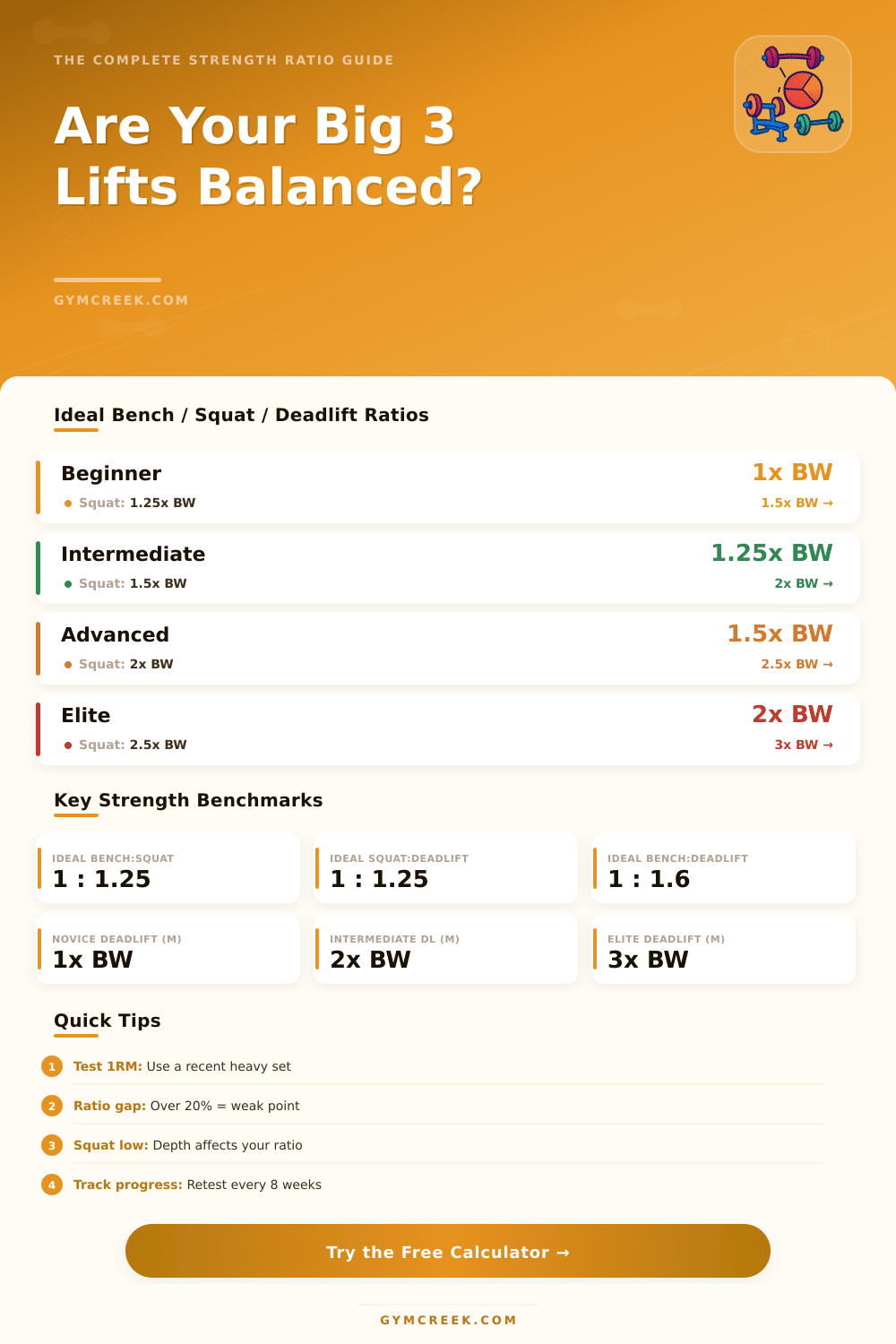
Typical strength ratios for lifter in all level will vary. The squat lift will generally be between 1.2 and 1.35 times the strength of the bench press. The deadlift will typically be between 1.5 and 1.7 times the strength of the bench press, with the squat and deadlift being roughly the same strength but with the deadlift having a 20 to 30% advantage in relation to the squat lift.

The strength ratio can be adjusted for body weight. This will allow for even better comparison between lifter of various weight. The strength ratios will naturally be higher for lifter with lower body weight but lower total weight for lifter with higher body weight.
Strength ratios will also change with the training age of the lifter. Beginner will have ratios of roughly 0.5 for bench press, 0.75 for squat lift, and 1 for deadlift. Intermediate lifter will aim for roughly 1 for bench press, 1.25 for squat lift, and 1.75 for deadlift. Advanced and elite lifter will typically have higher ratio but find it harder to increase them over time.
Strength ratios will also differ based on the gender of the lifter. Women will typically have more strength in their lower body lift in relation to their upper body lift as compared to men. These difference are natural and dont require lifter to adjust their training program.
Understanding the strength ratio can help lifter spot weak point in their program before they become obvious. A significantly lower ratio for the bench press will indicate weaker upper body or pressing strength. A high bench press strength with a low deadlift indicates a lack of posterior chain strength. These insight can help lifter adjust their training to focus on the area that need the most improvement.
Training age matters more than chronological age.
Despite the potential for individual’s body to adapt to lift weight and increase their strength, those adaptation occur more rapidly in the beginning of their training career. After the initial beginning phase, however, the adaptation rate slowly decline. At this point, ratio analysis can be incorporated into an athlete’s training as a means of avoiding become frustrated at the slow development of strength after years of training.
By utilizing the strength to ratio calculation, many lifter discover that their favorite lift actualy mask weakness in other lift category. While the ability to increase the weight that an athlete can lift is highly satisfying, such adaptation actually hide muscular deficiency. By correcting those deficiency, athlete often experience improvement in their favorite lift as well.
Periodization plan can also benefit from ratio analysis. Rather than attempting to increase the weight for each lift each month, athlete can periodize their training to even out their strength ratio. The result will be more noticeable and less likely to result in muscular imbalance within the body.

The calculator above can be used to provide athlete with insight into their current strength ratio and what those ratio should be based off their body weight and experience level. These insight can provide direction for athlete as to which lift need to be focused upon in the upcoming training period.
Additionally, the ratio can help to indicate which lift require additional focus in recovery effort. Additionally, many lifter find that lift such as deadlift lead to the accumulation of fatigue within the body. If the ratio for deadlift is relatively low compared to the athlete’s other lift, those additional focus effort may be beneficial for the athlete’s recovery effort.
Those who compete in strongwoman or powerlifting contest may even adjust their ratio accordingly. For instance, powerlifter may focus on increasing their deadlift ratio while maintaining the bench and squat ratio to ensure they have competitive strength in all category. However, such adaptation may lead to injury if not carefully monitor.
Even bodybuilder can benefit from an understanding of their lift ratio. While bodybuilding’s main goal is to develop muscular hypertrophy, having a balance in strength ratio will allow athlete to develop better overall physique and reduce the risk of injury during their lift competition. Many top bodybuilder have respectable ratio in their strength lift despite their bodybuilding focus.
The key to strong lift ratio is consistency rather than perfect ratio. While lift athlete’s ratio will fluctuate throughout their training program, extreme imbalance in ratio can lead to injury and missed training opportunity. By monitoring these ratio, athlete can ensure that their training program continues to produce the gain in strength that they have established for themselves over time.

Overall, the bench press/squat/deadlift ratio calculator is a tool that can be used to provide athlete with the information that they need to adjust their training program to achieve their goal. This information can be used in conjunction with the athlete’s general experience in weight training to continue to build a capable and strong body. By understanding these ratio, lifter can gain an advantage in their strength competition and apply the information to make smart training decision throughout their lifetime in strength training.