🏃 VO2 Max Calculator
Estimate your aerobic fitness level using proven field tests — enter your test results to get your VO2 max score, fitness category, and heart rate training zones.
| Category | Age 20–29 | Age 30–39 | Age 40–49 | Age 50–59 | Age 60+ |
|---|---|---|---|---|---|
| ♂ Males | |||||
| Superior | >55.9 | >54.0 | >52.5 | >48.9 | >45.7 |
| Excellent | 51.0–55.9 | 48.9–54.0 | 46.8–52.5 | 43.4–48.9 | 39.5–45.7 |
| Good | 43.9–51.0 | 43.9–48.9 | 40.4–46.8 | 36.8–43.4 | 35.0–39.5 |
| Fair | 38.4–43.9 | 37.4–43.9 | 34.6–40.4 | 30.2–36.8 | 25.1–35.0 |
| Poor | <38.4 | <37.4 | <34.6 | <30.2 | <25.1 |
| ♀ Females | |||||
| Superior | >49.6 | >45.3 | >42.4 | >37.8 | >35.6 |
| Excellent | 43.9–49.6 | 40.0–45.3 | 37.1–42.4 | 33.1–37.8 | 30.2–35.6 |
| Good | 37.1–43.9 | 34.6–40.0 | 31.6–37.1 | 27.2–33.1 | 24.4–30.2 |
| Fair | 30.6–37.1 | 28.7–34.6 | 25.9–31.6 | 21.7–27.2 | 18.7–24.4 |
| Poor | <30.6 | <28.7 | <25.9 | <21.7 | <18.7 |
| Zone | % Max HR | Intensity | Primary Benefit | Example Activity |
|---|---|---|---|---|
| Zone 1 | 50–60% | Very Light | Recovery, base building | Easy walk |
| Zone 2 | 60–70% | Light | Fat oxidation, aerobic base | Easy jog / brisk walk |
| Zone 3 | 70–80% | Moderate | Aerobic efficiency | Steady-state run |
| Zone 4 | 80–90% | Hard | VO2 max, lactate threshold | Tempo run, intervals |
| Zone 5 | 90–100% | Maximum | Peak speed, VO2 max | Sprints, hill reps |
| Training Experience | Training Type | Duration | Expected VO2 Max Gain |
|---|---|---|---|
| Beginner (sedentary start) | General cardio 3x/week | 8–12 weeks | +5 to +10 mL/kg/min |
| Intermediate (active) | HIIT 2–3x/week | 8 weeks | +3 to +6 mL/kg/min |
| Advanced (trained) | Polarized training | 12 weeks | +1 to +3 mL/kg/min |
| Elite | Periodized program | Full season | +0.5 to +2 mL/kg/min |
| Any level (age 50+) | Zone 2 + HIIT combo | 12 weeks | +4 to +8 mL/kg/min |
VO2 max is one of the most important measurement in exercise physiology. This figure represent how efficiently your body can utilize oxygen when performing intense exercise. As the gold standard of fitness, VO2 max measures your cardiovascular fitness by determining the maximum rate at which your heart, lungs, and muscle can work together to use oxygen. By understanding your VO2 max, you can gain insights into your current health and make sound decisions about your training as an athlete or fitness enthusiast.
While lab tests using fitness equipment can determine your VO2 max with a high degree of accuracy, there are several field test that have allowed people from all walks of life to obtain this figure. Using a VO2 max test calculator allows individuals to calculate this parameter based off other tests that can be performed in the field with minimal equipment. Though estimates are not as exact as laboratory tests, they are remarkably correlate with lab tests and allow athletes to track there changes over time.
Understanding VO2 Max Test Results
What Your VO2 Max Means
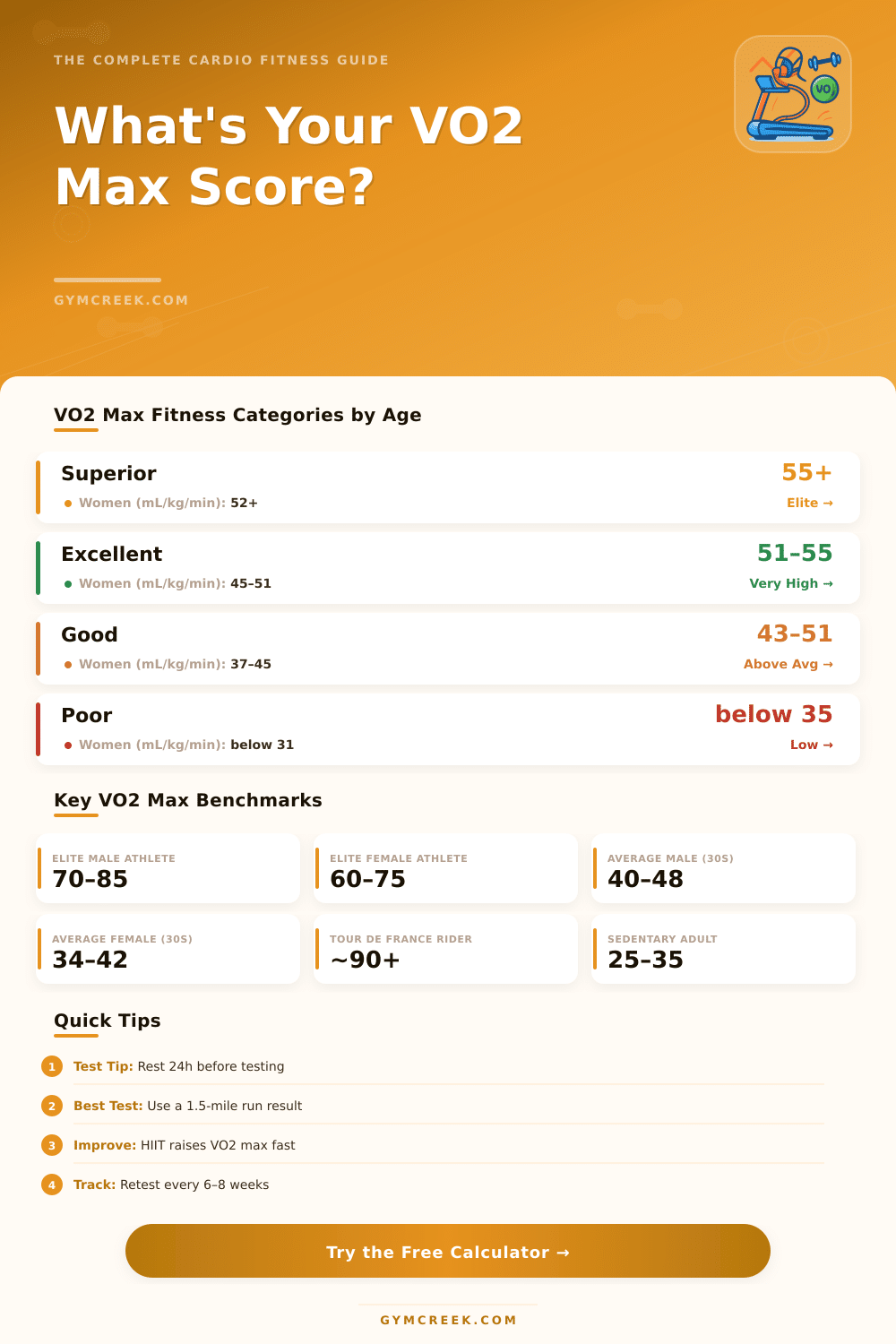
VO2 max is expressed in measurements of mL of oxygen per kg of body weight per minute. The amount of oxygen that your body can utilize correlate with your fitness level. The higher the measurement, the better your cardiovascular fitness. A higher score is better, and there are average scores for each group of individuals. The average score for individuals that do not exercise between 20 and 50 minute per week ranges between 25 and 35 mL/kg/min. Competitive athletes that perform long periods of high-intensity exercise can score between 60 and over 70 mL/kg/min. As individuals age, however, their score decline by about 1% per year after the age of 25. The good news is that athletes of all ages can improve their score with proper training methods.
Beyond athletic performance, VO2 max is also correlated with health and longevity. Studies show that as VO2 max declines, the risk of suffering from cardiovascular disease, certain cancer, and all-cause mortality increases. Aerobic fitness is a stronger predictor of lifespan than many other health factors, including smoking, blood pressure, and cholesterol levels. For these reasons, calculating an individual’s VO2 max provides valuable information to those interested in their health and fitness.
Several factor work into the calculation of an individual’s VO2 max. The strength of an individual’s heart’s pumping action, the amount of oxygen that is carried in the blood, the ability of an individual’s muscles to extract oxygen from the blood, and the density of mitochondria in those muscles all play a role in determining an individual’s VO2 max. Each of these components can be trained to improve in strength or number, which is why athletes often exhibit higher VO2 max score.
Several tests can be utilized to determine an individual’s VO2 max. Tests that involve running on a treadmill or track will yield higher score for individuals who can run longer distances or at higher speeds than tests for cyclists. Additionally, some tests involve walking. Individuals who are 50 year of age or older or those who are new to physically active lifestyles best utilize these tests. Finally, there are tests of varying intensities, with the more intense tests best suited for individuals who are already physically fit. Regardless of the test used, performing the same test repeatedly will allow for the best tracking of an individual’s performance over time.
Several training method can help to improve an individual’s VO2 max. One of the best methods involves performing high-intensity interval training (HIIT) methods, as they provide the best results for improving VO2 max. However, base training methods of performing exercise in what is known as Zone 2, or when an individual can still hold a conversation, is the foundation required to allow HIIT methods to be effective.
Improving an individual’s VO2 max takes some time. With proper training, most individuals will see improvements in 8 to 12 weeks. Beginners can improve their VO2 max by as much as 10 to 20%, while trained athletes may be able to only improve their VO2 max by 3 to 5% with proper training. However, each 1% increase in VO2 max is correlated with health and performance benefit for that individual.
Age impact both an individual’s VO2 max and their potential improvements. While those of younger ages will score higher on VO2 max tests, athletes of any age can maintain impressive scores in masters divisions (athletes between the age of 35 and 50). Additionally, performing aerobic exercise at least several times each week will allow individuals to maintain their VO2 max scores and outperform any supplement available today.
Though VO2 max is a vital measurement of fitness and health, it is just one of several components that go into determining an athlete’s performance. Other factors, such as economy of movement, mental toughness, and skill with specific sports activities are more influential on an athlete’s performance than there VO2 max score. Still, understanding and improving one component of fitness can impact an athlete’s performance in their specific sport.
By tracking an individual’s VO2 max over time, athletes and individuals interested in fitness can gather data regarding the impact that training has on their bodies. This information can impact an athlete’s training cycle for specific sports and can allow athletes to gain a more in-depth understanding of their bodies’ responses to training methods.
As presented within the calculator above, field tests can be performed to calculate an individual’s VO2 max. Though they are not as accurate as laboratory tests, they are still invaluable in the determination of fitness level of athletes and individuals who wish to improve their health.
Whether an individual trains for athletic performance or better health, improving an individual’s VO2 max will provide some of the highest returns on an individual’s physical health and wellbeing. Following the training and rest schedule described in this article will allow an individual to not only increase their performance in specific sports but to enhance their health and physical capabilities in any age. By paying attention to their VO2 max, athletes and fitness enthusiasts of all ages can gain knowledge of their bodies and how to best care for them to maximize their health and performance outcome.