🏋️ Weightlifting Plate Calculator
Find exactly which plates to load on each side of your barbell — instantly
| Plate (lbs) | Plate (kg) | Color (IPF) | Common Use |
|---|---|---|---|
| 55 lbs | 25 kg | Red | Heavy compound lifts |
| 45 lbs | 20 kg | Blue | Standard loading plate |
| 35 lbs | 15 kg | Yellow | Mid-range loading |
| 25 lbs | 10 kg | Green | Intermediate loading |
| 10 lbs | 5 kg | White | Fine tuning weight |
| 5 lbs | 2.5 kg | Black | Small increments |
| 2.5 lbs | 1.25 kg | Black | Micro loading |
| 1.25 lbs | 0.5 kg | Chrome | Precision loading |
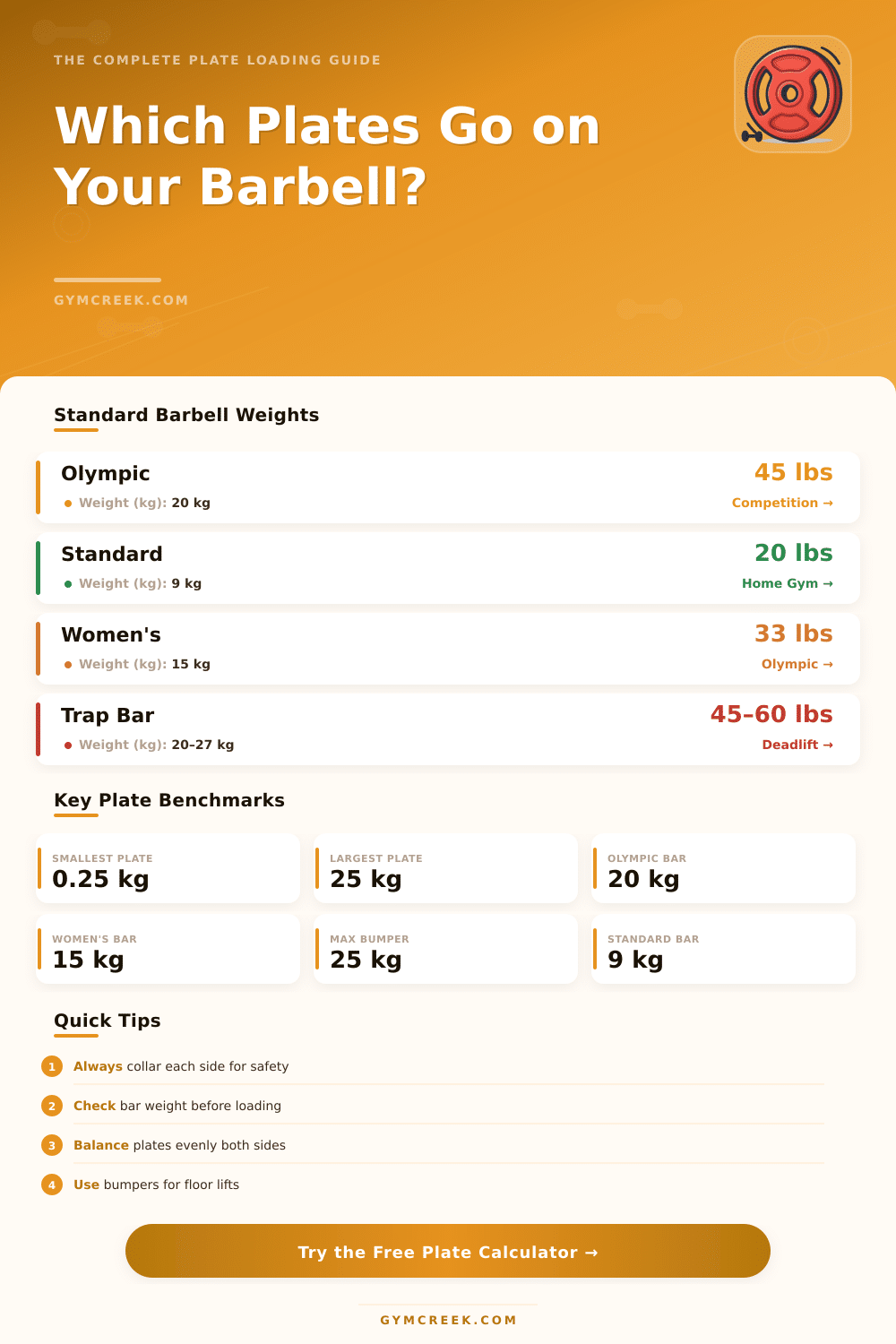
| Bar Type | Weight (lbs) | Weight (kg) | Bar Length |
|---|---|---|---|
| Olympic Men’s Bar | 45 lbs | 20 kg | 7.2 ft / 2.2 m |
| Olympic Women’s Bar | 33 lbs | 15 kg | 6.6 ft / 2.0 m |
| Standard Bar | ~20 lbs | ~9 kg | 5–6 ft |
| Trap / Hex Bar | ~55 lbs | ~25 kg | Varies |
| Safety Squat Bar | ~60 lbs | ~27 kg | 7 ft |
| EZ Curl Bar | ~18 lbs | ~8 kg | 4 ft |
| Lift | Beginner | Intermediate | Advanced |
|---|---|---|---|
| Bench Press (M) | 0.5× BW | 1.0× BW | 1.5× BW |
| Bench Press (F) | 0.35× BW | 0.65× BW | 1.0× BW |
| Back Squat (M) | 0.75× BW | 1.25× BW | 1.75× BW |
| Back Squat (F) | 0.5× BW | 0.9× BW | 1.4× BW |
| Deadlift (M) | 1.0× BW | 1.5× BW | 2.0× BW |
| Deadlift (F) | 0.8× BW | 1.2× BW | 1.8× BW |
| Overhead Press (M) | 0.3× BW | 0.65× BW | 0.9× BW |
weightlifting plate form the core of any setup for strength training. You find them in many sizes and from various materials, iron, steel, rubber, urethane, whatever you want. They go on the bar and let you do everything from heavy compound lifts to competitive olympic lifting.
DISCLOSURE: This post may contain affiliate links, meaning when you click the links and make a purchase, I receive a commission. As an Amazon Associate I earn from qualifying purchases.

Various kinds of plates exist and it matters to know their differences. Bumper plates are made from rubber to handle drops from up high without noise, so they are popular in olympic lifting, powerlifting and CrossFit. On the other hand, cast iron plates belong to the old school, they cost less at first, but sound loud and need more attention.
Types of Weight Plates
If accuracy matters to you, calibrated steel plates weigh almost exactly within some grams of what is declared, perfect for serious powerlifters. Moreover, urethane coated plates stay quiet, last longer and need almost no care compared with regular iron.
Olympic plates are not limited to olympic athletes, although the name can suggest that. They are useful for bodybuilders, fitness fans and anyone that does regular strength work. The standard big weightlifting plate weighs 45 pounds, which comes from the metric system, because it matches around 20 kilos.
When lifters simply say “plate”, they mean that 45 pounder. Lay four of them on every side of the bar? That is what people call “four plates” among folks.
The color coding simplifies evrything. You can look at a loaded bar and right away know what is on it, without needing to count. After a bit of time in lifting, those colors become totally natural.
Quality clearly separates the good from the average. Calibrated plates stay within 10 grams of there declared weight. Budget plates?
They can vary by a lot, which adds up quickly when you want precise numbers. For a good home gym, you usually need pairs of 25 pound and 45 pound bumpers, plus some smaller ones (like two pairs of 10s), one pair of 5s and one of 2.5s for good setup. Heavy lifters that do deadlifts or squats sometimes reach the limit with bumper plates (you can not load more on one end).
So mixing bumpers with iron plates solves that problem.
Some brands really stand out on the market. Rogue makes very tough, clean looking plates that work well in a home gym or professional setting. Eleiko makes rubber bumpers since 1968 and backs them with IWF and IPF approval, plus warranties that really matter.
York mixes prime materials from iron, rubber and urethane in plates that stay safe and stable through many drops. Smaller companies offer color coded sets, made in the United States and at fair prices. In the end, good gear matters because itlasts when you drop heavy bars sometimes.