🏃 VO2 Max Calculator by Age
Estimate your aerobic fitness level & heart rate training zones based on age, gender & performance
📈 Males (mL/kg/min)
| Age Group | Very Poor | Poor | Fair | Good | Excellent | Superior |
|---|---|---|---|---|---|---|
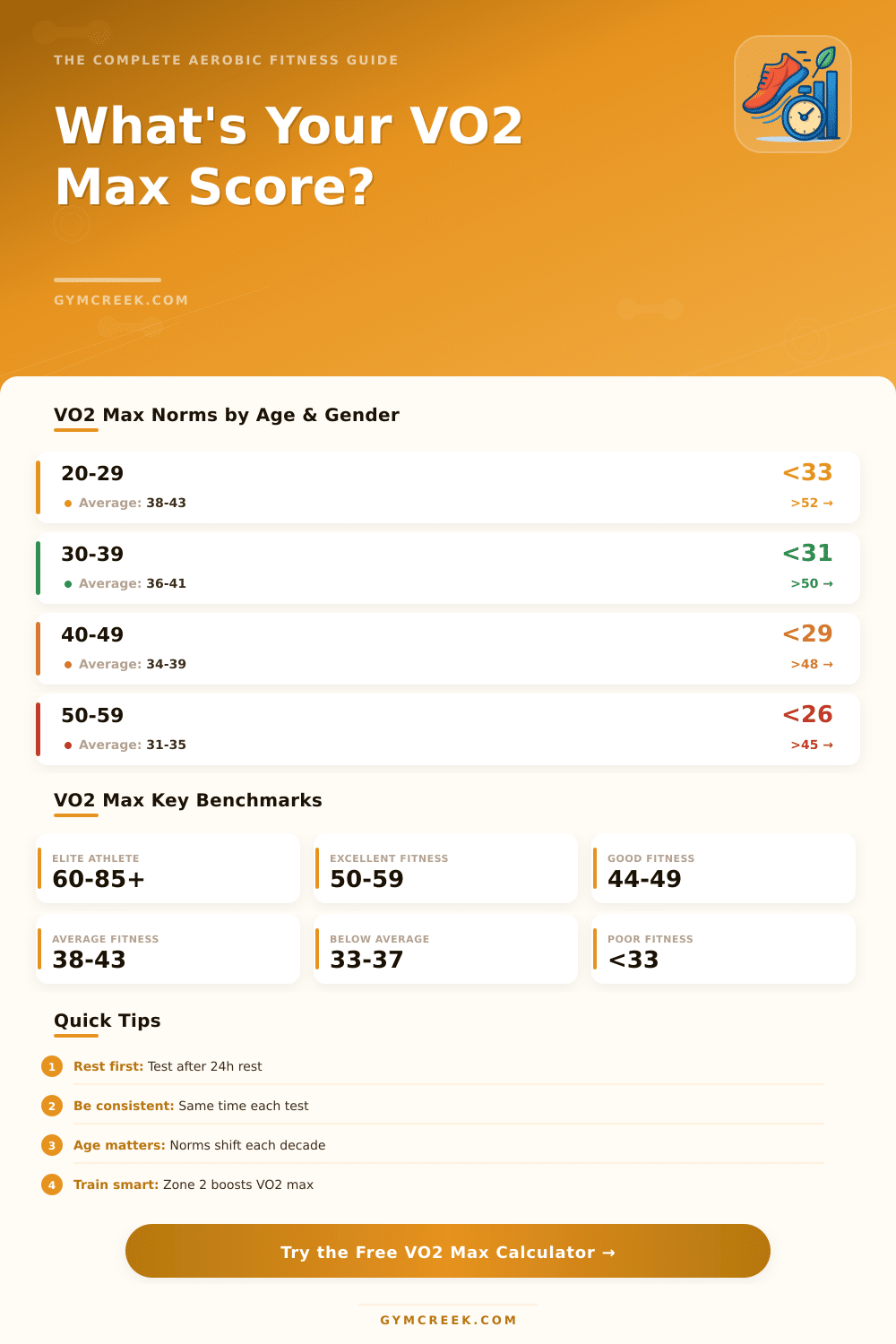
| 13–19 | <35.0 | 35.0–38.3 | 38.4–45.1 | 45.2–50.9 | 51.0–55.9 | ≥56.0 |
| 20–29 | <33.0 | 33.0–36.4 | 36.5–42.4 | 42.5–46.4 | 46.5–52.4 | ≥52.5 |
| 30–39 | <31.5 | 31.5–35.4 | 35.5–40.9 | 41.0–44.9 | 45.0–49.4 | ≥49.5 |
| 40–49 | <30.2 | 30.2–33.5 | 33.6–38.9 | 39.0–43.7 | 43.8–48.0 | ≥48.1 |
| 50–59 | <26.1 | 26.1–30.9 | 31.0–35.7 | 35.8–40.9 | 41.0–45.3 | ≥45.4 |
| 60–69 | <20.5 | 20.5–26.0 | 26.1–32.2 | 32.3–36.4 | 36.5–44.2 | ≥44.3 |
| 70+ | <17.5 | 17.5–22.7 | 22.8–29.9 | 30.0–34.5 | 34.6–41.0 | ≥41.1 |
📈 Females (mL/kg/min)
| Age Group | Very Poor | Poor | Fair | Good | Excellent | Superior |
|---|---|---|---|---|---|---|
| 13–19 | <25.0 | 25.0–30.9 | 31.0–34.9 | 35.0–38.9 | 39.0–41.9 | ≥42.0 |
| 20–29 | <23.6 | 23.6–28.9 | 29.0–32.9 | 33.0–36.9 | 37.0–41.0 | ≥41.1 |
| 30–39 | <22.8 | 22.8–26.9 | 27.0–31.4 | 31.5–35.6 | 35.7–40.0 | ≥40.1 |
| 40–49 | <21.0 | 21.0–24.4 | 24.5–28.9 | 29.0–32.8 | 32.9–36.9 | ≥37.0 |
| 50–59 | <20.2 | 20.2–22.7 | 22.8–26.9 | 27.0–31.4 | 31.5–35.7 | ≥35.8 |
| 60–69 | <17.5 | 17.5–20.1 | 20.2–24.4 | 24.5–30.2 | 30.3–31.4 | ≥31.5 |
| 70+ | <15.0 | 15.0–17.9 | 18.0–22.9 | 23.0–28.7 | 28.8–32.0 | ≥32.1 |
| Zone | Name | % Max HR | % VO2 Max | Benefit |
|---|---|---|---|---|
| Zone 1 | Active Recovery | 50–60% | ~50–55% | Recovery, fat metabolism |
| Zone 2 | Aerobic Base | 60–70% | ~56–65% | Aerobic base, fat burning |
| Zone 3 | Aerobic Threshold | 70–80% | ~66–75% | Aerobic capacity, tempo |
| Zone 4 | Lactate Threshold | 80–90% | ~76–90% | Speed endurance, lactate |
| Zone 5 | VO2 Max Zone | 90–100% | ~91–100% | Max aerobic power, VO2 max |
| Training Type | Frequency | Duration | Expected VO2 Max Gain |
|---|---|---|---|
| Low-Intensity Steady State | 3–5x/week | 30–60 min | +5–10% |
| Moderate Continuous | 3–5x/week | 20–40 min | +10–15% |
| High-Intensity Interval (HIIT) | 2–3x/week | 20–30 min | +15–20% |
| 4x4 Norwegian Intervals | 2x/week | 4 min on/3 min off | +20–30% |
| Zone 2 + HIIT Combo | 4–5x/week | Mixed | +15–25% |
DISCLOSURE: This post may contain affiliate links, meaning when you click the links and make a purchase, I receive a commission. As an Amazon Associate I earn from qualifying purchases.

VO2 Max simply said is the top limit of how much oxygen your body fits to absorb from the air and truly use at hard physical work. Break down the words: V means volume, O2 oxygen, and max the biggest value. The measure itself shows the use of oxygen for one time unit when one pushes his physical limits to the finish.
Usually one states it by means of milliliters of oxygen for one kilo of weight each minute.
What VO2 Max Is and How to Improve It
Here bigger value almost always helps. The body becomes better at pulling oxygen and moving it to the muscles, that need it. During running it results in less big efforts for any level of effort.
Noticeably, when VO2 Max grows, the resting heart rhythm usually drops. Similarly happens with your normal heart rhythm for any level of efofrt.
The weight of the body has huge influence. The real calculation shares the absorbed oxygen during 60 seconds by means of your mass in kilos. So, to reach truly wonderful figure, one must be quite slim.
Because muscular tissue and whole mass both require oxygen simply to exist, that can lower the result.
Only laboratory testing gives truly reliable value. It is the best reference: metabolic card, expert team and well fitting mask, that catches every breath in and out, usually during running on a treadmill. Smart watches?
They give sum rating, but the accuracy changes a lot. Some occasionally had laboratory mark of 52, during his Apple Watch pointed around 41. That is serious mistake.
Your genes, age, training method and whole health all determine your upper limit for VO2 Max possibility. The gains come chiefly from strengthening of the heart and lungs, both require steady hard work to advance. Training by means of high intensity intervals are between the best modes.
Many folks notice, that one to six short intervals with equal parts of work and pauses form the secret for sessions of VO2 Max. Steady runs are important also, because their devices count the measure according to heart rhythm and step rate together.
Here where it becomes tricky: only work in Zone 2 does not suffice to greatly improve your mark. One casual study shows, that VO2 Max stayed the same during a whole year, although one ran more than 40 kilometers weekly with low intensity. When one added stronger work, everything changed.
Ranging the intensity of your training sessions during the week truly helps. Most folks experience breakthrough with at least three hours of aerobic exercise weekly.
The good news for older sportsmen is, that the improvement does not depend on age. Studies followed regular men and women between 60 and 65 years, that trained during nine months to a year, both groups improved his VO2 Max by around 20 percent. That matters, because VO2 Max is widely accepted as good measure of the lifetime of folks.
Reaching the highest quarter is the spot, where the benefits for long life truly emerge. Henceendurance sportsmen, swimmers, cyclists, runners, skiers, always care about it as important measure of fitness.