🔥 Teen Daily Energy Needs Calculator
Estimate daily energy needs for healthy teen growth, activity, and nutrition planning
✅ Your Estimated Results
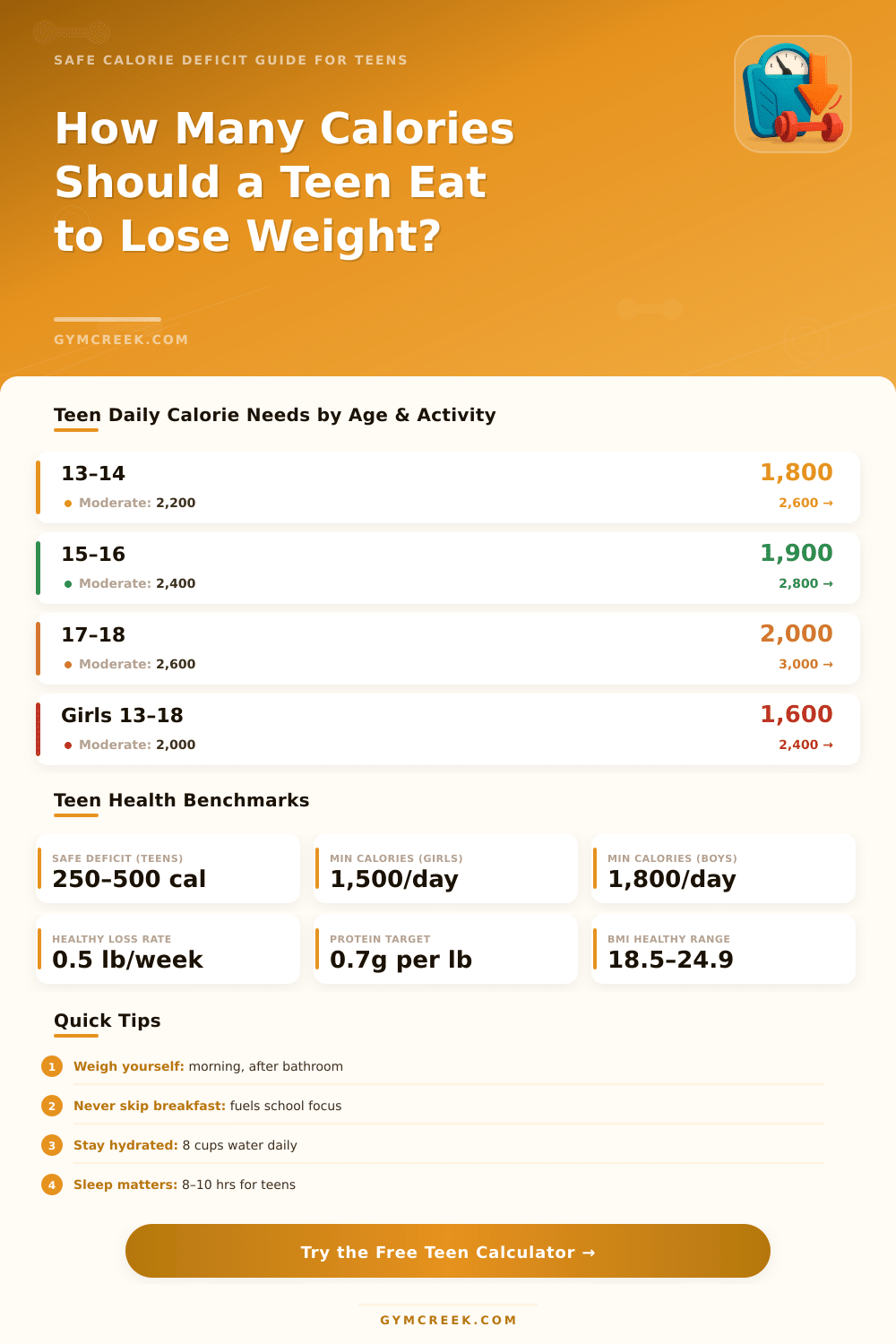
| Age & Sex | Sedentary | Moderately Active | Active |
|---|---|---|---|
| Boys 13 | 2,000 cal | 2,200 cal | 2,600 cal |
| Boys 14–15 | 2,200 cal | 2,400 cal | 2,800 cal |
| Boys 16–18 | 2,400 cal | 2,600 cal | 3,000 cal |
| Girls 13 | 1,600 cal | 2,000 cal | 2,200 cal |
| Girls 14–18 | 1,800 cal | 2,000 cal | 2,400 cal |
For teens, BMI is age- and sex-specific. It should be interpreted with BMI-for-age percentiles, not adult BMI alone.
| BMI Percentile | Category | Adult Equivalent BMI | Action Suggested |
|---|---|---|---|
| Below 5th | Underweight | Below 18.5 | Consult a doctor |
| 5th–84th | Healthy Weight | 18.5–24.9 | Maintain healthy habits |
| 85th–94th | Overweight | 25.0–29.9 | Talk to a healthcare professional |
| 95th or above | Obese | 30.0+ | Medical guidance recommended |
| Macronutrient | Calories per Gram | Teen RDA / DRI | Notes |
|---|---|---|---|
| Protein | 4 cal/g | 0.85–1.0 g/kg body weight | Important for growth and muscle |
| Carbohydrates | 4 cal/g | 130g minimum/day | Brain and performance fuel |
| Dietary Fat | 9 cal/g | 25–35% of total calories | Supports hormones and growth |
| Fiber | — | 25–31g per day | Girls 25g; Boys 31g |
Navigating the world of nutrition during the teenage years can be somewhat overwhelming. With the rapid growth of this age range, as well as the need for energy to fuel the education or sports programs that many teens are a part of, it can be difficult to find comfort in one’s own body. A calorie deficit calculator for teenager can help to provide an estimate of the amount of calories that a teenager should consume in order to safely allow their body to grow and develops normally.
Unlike adults, teenagers’ bodies require a certain amount of calories each day in order to perform essential function. If their bodies do not recieve those calories, or if their deficits of calories are too large, their bodies may begin to experience issue with metabolism, energy, mood, and even their overall growth. Instead, then, it is recommended that teens implement a plan that features gradual and sustainable progress towards achieving desired result.

Understanding Safe Calorie Deficits for Teens
For teenagers that have excess body fat, implementing a safe and effective calorie deficit can aid in their weight loss efforts. Weight loss organizations recommend that teens consume no more than one pound of weight per week. This is equivalent to a deficit of 500 calories per day. Any deficits of more than 500 calories per day should be created only under the supervision of a medical professional.
In order to accurately calculate the calories that a teenager should consume each day, it is first important to understand the difference between BMR (basal metabolic rate) and TDEE (total daily energy expenditure). BMR is the amount of calories that the body burns while resting. TDEE is the amount of calories that the individual burns during the day performing daily activities, school, and more. A calorie deficit calculator for teenager will take into account the age, sex, weight, height, and physical activity level of the individual in question to calculate these values.
The activity level of the teenager is one of the most important factor in establishing the correct calorie intake for the individual. For instance, a 15-year-old that plays soccer six days a week will require more calories each day than a teenager that spends their afternoons sitting in the classroom studying or playing video games. Teens that are largely inactive may require between 1,800 and 2,200 calories per day. Teens that are athletes, however, may require between 2,800 and 3,200 calories per day or more during their growth spurts.

In addition to consuming the appropriate amount of calories each day, the quality of those calories is also crucial for the success of any weight loss program. A teen that implements a calorie deficit should include foods high in protein, carbohydrates, and fats for energy. Additionally, ensure that the teen is consuming enough calcium and vitamin D in order to support the development of their bones to reach peak bone mass by the late teens. Skipping meals or reducing the amount of these nutrients can lead to health issue well into adulthood.
Beyond worrying about the weight of the teenager, other indicators of weight loss can also be utilized to determine if a program is successful. For example, many health professionals recommend noting if the teen feels more energetic, has better strength and physical performance, has clearer skin, or wears their clothing less loosely. These indicators may appear prior to noticing significant changes in body weight.
If a teen has any history of eating disorders or health issues, a medical professional should be consulted prior to any attempted changes in the eating habits of the teenager. A doctor may indicate that instead of focusing on weight loss efforts, the teen should be focusing on building more muscle and strength. Additionally, simply changing the type of snacks a teen eats may result in an automatic deficit of calories without having to alter the teen’s eating habit.
In order to maximize the effectiveness of any weight loss program for teens, focus on improving sleep and reducing stress. Many teens that do not get enough sleep often overeat and consume more calories than they should. Getting enough rest will allow for the teen to focus on eating healthier and performing physical activities without stressing about their body composition.

Although calorie counting can be beneficial for some teenagers, it is recommended that such efforts are limited to educational purposes only. For instance, many teens discover through these programs that they consume more calories on the weekends than during the weekdays, or that their beverages contains high levels of calories. This information can be used to make better eating decision each day. Rather than obsess over the calorie count of each meal, however, focus on eating healthy foods that will provide the body with the energy and nutrients that it require each day.
Another of the healthiest forms of exercise for teens is any form of physical activity that burns calories. Weight-bearing sports or activities like soccer, basketball, hockey, or even dancing will not only burn calories but also increase the well-being of the teen’s mental health. Teens that find enjoyment in these physical activities will be more likely to continue participating in these healthy behaviors.
For teens that have muscular bodies and high lean body mass, they may have a higher body mass index (BMI) yet have low amounts of body fat. The BMI charts for teenagers are specific to each age range and sex of the body because all teens do not gain their height and weight at the same rate. Additionally, each measurement of body fat and lean body mass is crucial to understanding how healthy the body of a teenager is.
In general, the teenage years are crucial to the development of each teenager’s body and health. A calorie deficit calculator for teenager can aid in the determination of the amount of calories that an individual should consume each day in order to lose weight. This tool, however, does not replace the knowledge of a common sense and health professionals. Instead, it acts as one of the many tools that can help a teenager make healthy decisions about their body and their health throughout their life.
The most successful approach to any type of weight loss program is to utilize a combination of patience and consistency. While many approaches to weight loss require focus and dedication from those who attempt to lose weight, the benefits of these efforts will be seen with time and with the implementation of healthy habit. By focusing on the overall health of the body rather than the weight alone, teenagers can reach their health goals while still protecting their bodies’ normal development processes.