🔥 TDEE Calculator
Total Daily Energy Expenditure — Find your exact daily calorie needs using the Mifflin-St Jeor formula
Weigh yourself first thing in the morning after using the bathroom. Use an average of 3 consecutive days for best accuracy. Be honest about your activity level — most people overestimate by 1–2 levels.
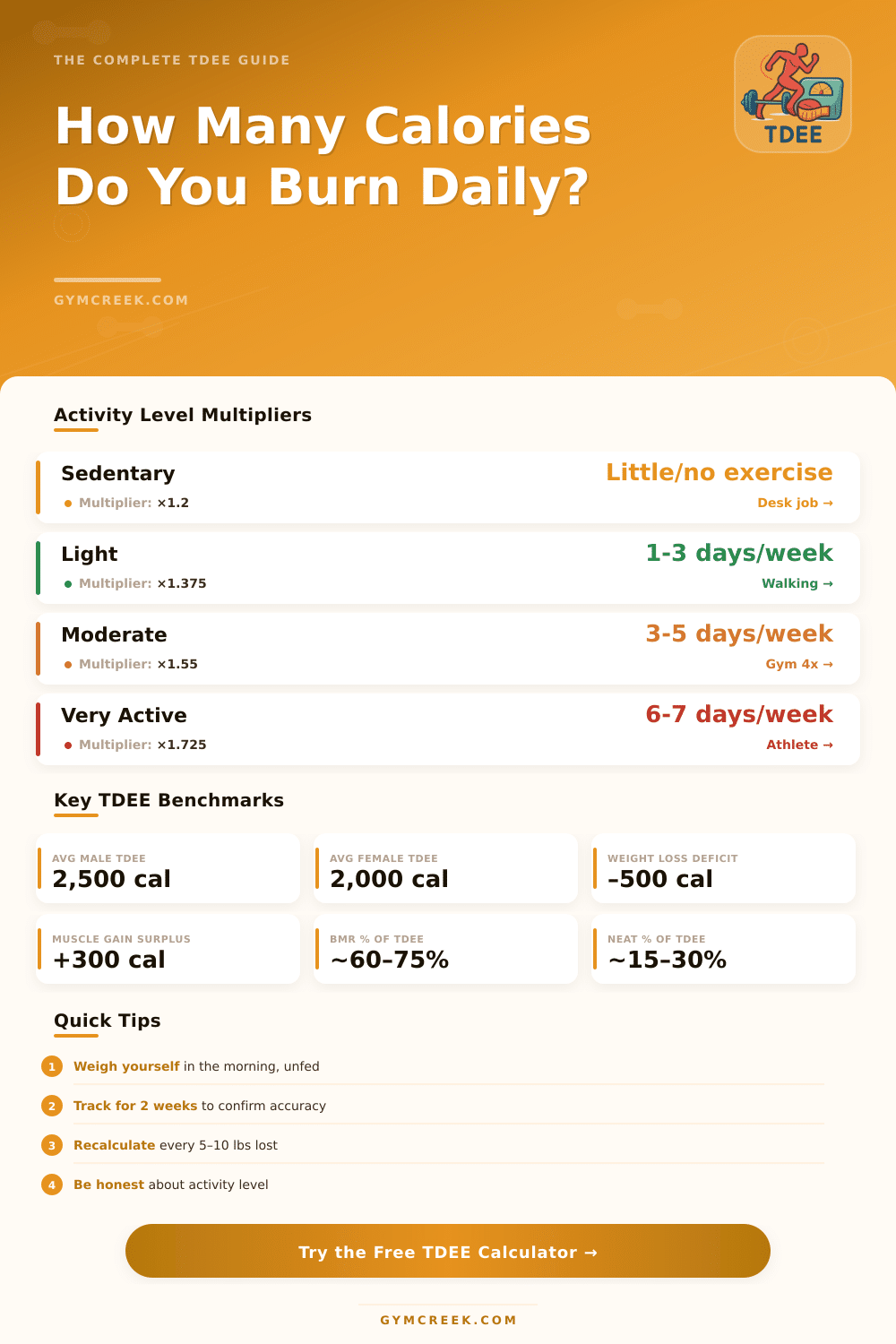
| Activity Level | Description | Multiplier | Weekly Exercise |
|---|---|---|---|
| Sedentary | Desk job, little movement | ×1.200 | None |
| Lightly Active | Light walking or easy sport | ×1.375 | 1–3 days |
| Moderately Active | Regular gym or cardio | ×1.550 | 3–5 days |
| Very Active | Hard training, physical job | ×1.725 | 6–7 days |
| Extremely Active | Two-a-days, elite sports | ×1.900 | Daily + 2x some days |
| Goal | Calorie Adjustment | Expected Rate | Best For |
|---|---|---|---|
| Aggressive Cut | −1,000 cal/day | −2 lbs/week | Short-term deficit |
| Standard Cut | −500 cal/day | −1 lb/week | Sustainable fat loss |
| Mild Cut | −250 cal/day | −0.5 lb/week | Lean bulk to cut |
| Maintenance | ±0 cal/day | Stable weight | Recomposition |
| Lean Bulk | +250 cal/day | +0.5 lb/week | Minimize fat gain |
| Standard Bulk | +500 cal/day | +1 lb/week | Muscle building |
| Age Group | Avg Male BMR | Avg Female BMR | Avg Male TDEE (Mod.) | Avg Female TDEE (Mod.) |
|---|---|---|---|---|
| 18–25 | 1,800–2,000 | 1,450–1,650 | 2,700–3,100 | 2,100–2,500 |
| 26–35 | 1,750–1,950 | 1,400–1,600 | 2,600–3,000 | 2,050–2,450 |
| 36–45 | 1,700–1,900 | 1,350–1,550 | 2,500–2,900 | 2,000–2,400 |
| 46–55 | 1,650–1,850 | 1,300–1,500 | 2,400–2,800 | 1,950–2,350 |
| 56+ | 1,550–1,750 | 1,200–1,400 | 2,250–2,650 | 1,800–2,200 |
| Goal | Protein | Carbohydrates | Fat | Notes |
|---|---|---|---|---|
| Weight Loss | 40% | 30% | 30% | High protein preserves muscle |
| Muscle Gain | 30% | 50% | 20% | Carbs fuel training |
| Maintenance | 25% | 50% | 25% | Balanced approach |
| Keto / Low Carb | 25% | 5% | 70% | Under 50g carbs/day |
| Endurance Athlete | 20% | 60% | 20% | High carb for performance |
This calculator uses the Mifflin-St Jeor equation (1990), the most validated formula for estimating Basal Metabolic Rate (BMR). If you enter body fat %, the Katch-McArdle formula is used instead for better lean-mass accuracy. Your TDEE is then calculated by multiplying BMR by your activity factor.
Total Daily Energy Spending, or TDEE, shows how many calories the body uses during one day. It covers everything from physical exercise to basic processes like breathing and blood flow. Precise measuring of TDEE is difficult and it changes from day to day.
DISCLOSURE: This post may contain affiliate links, meaning when you click the links and make a purchase, I receive a commission. As an Amazon Associate I earn from qualifying purchases.

In TDEE three main parts matter. First is the basic metabolic rate, or BMR, that shows the calories that the body burns during rest. Second comes the level of activity.
How to Work Out Your Daily Calories (TDEE)
Third is the heat effect of food processing. The resting metabolism usually forms 60 to 75 percent of TDEE. Because fat does not need much energy to maintain, the mass without fat better predicts the energy spending.
For estimating TDEE, start by calculating BMR. Later, adjust that value according to activity. For that there are separate multipliers.
Sitting life is BMR times 1.2. A bit active is BMR times 1.375. Medium active is BMR tiems 1.55.
Very active is BMR times 1.725. Extremely active is BMR times 1.9.
Calculators for TDEE use age, weight, height, sex and activity to estimate the calories needed to keep weight. Those keeping calories help to preserve the body at its present wait. If you eat more than that amount, you gain weight.
If less, you lose weight.
Problem is that those calculators are not perfect. They depend on the user to self estimate his activity, and the categories often are a bit poorly defined. No calculation is fully right or wrong, because they are based on averages and statistics.
Probably the result differs for any particular person. Better is to follow food intake regularly by means of a scale, weigh yourself daily in the morning first thing and use averages over several weeks to find the real keeping level.
TDEE changes according to lifestyle. Routine gives stability, during breaks everything falls apart. Bigger muscle mass causes bigger TDEE, so anyone that lifts weights should check his daily intake sometimes, to ensure that one does notstick in a casual deficit.
To lose weight, often one sets activity to sitting and then reduces by the wanted calorie deficit. To gain muscle, eat around 500 calories above TDEE forms a good start, with changes according to need. Calories from exercise go into TDEE and one must consider them during planning of food.
If one does six workouts weekly, that means TDEE grows a lot.