Fat Free Mass Index Calculator
Estimate fat-free mass index, adjusted FFMI, lean mass, and goal weight from body fat, height, and body weight.
Calculation Breakdown
Goal Snapshot
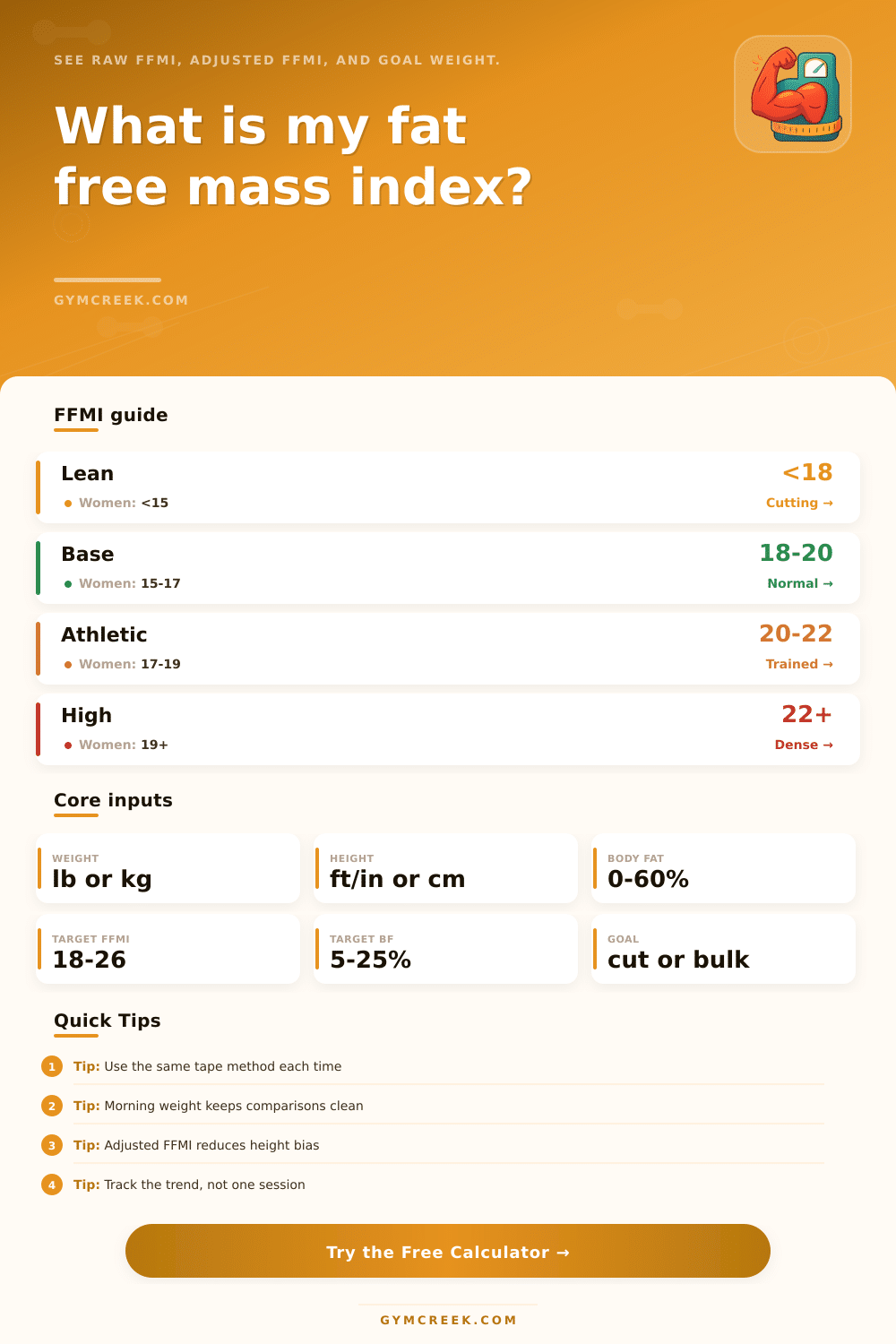
Standard Ranges
| Band | Adjusted FFMI | Look | Notes |
|---|---|---|---|
| Low | < 18.0 M / < 15.0 F | Lean or small | Often beginner or endurance focused |
| Average | 18.0 to 20.9 M / 15.0 to 17.9 F | Balanced base | Easy to maintain and improve |
| Athletic | 21.0 to 22.9 M / 18.0 to 19.9 F | Muscular | Common for strong lifters and field athletes |
| Advanced | 23.0+ M / 20.0+ F | Very dense | Big frame, long training age, or exceptional genetics |
Common Scenarios
| Scenario | Snapshot | Expected FFMI | Takeaway |
|---|---|---|---|
| Lean lifter | 5 ft 9 in, 160 lb, 10% | About 20.5 | Solid baseline strength build |
| Strong natural | 5 ft 11 in, 190 lb, 12% | About 22.9 | Upper natural range for many people |
| Female athlete | 5 ft 6 in, 145 lb, 18% | About 18.4 | Performance focused and visibly fit |
| Dense bulk | 6 ft 1 in, 230 lb, 18% | About 22.8 | Size comes with more total mass |
Formula Reference
| Formula | Equation | Use | Why it matters |
|---|---|---|---|
| Lean mass | Weight x (1 - BF%) | Fat-free tissue | Core number behind FFMI |
| FFMI | Lean mass / height^2 | Size relative to height | Compares physiques fairly |
| Adjusted FFMI | FFMI + 6.1 x (1.8 - H) | Height correction | Reduces short vs tall bias |
| Goal weight | Goal lean mass / (1 - target BF) | Target planning | Shows the scale weight needed |
Use the same body fat method every time so your FFMI trend stays meaningful.
Compare adjusted FFMI first, then check the lean mass and target weight outputs.
This calculator provides estimates only. Body fat methods vary, so treat the result as a comparison tool rather than a diagnosis or exact lab measurement.
Fat free mass is the weight of the body without fat. You calculate it by subtracting the fat from the total body weight fat free mass includes vital organs and muscles, which matter for growth. Bones, water and essential fats also belong to it.
Everything that is not fat is fat free mass, but most of it comes from muscles and bones.
What Is Fat Free Mass and Why It Is Important
The body has a ratio between fat and fat free mass. That includes muscles, cells, bones and body water. Its loss can cause sarcopenia, frailty and disability, especially in seniors.
FFMI shows the rate of fat free mass. It estimates the muscles according to height and weight. FFMI belongs to the group of body indexes, together with BMI and alike.
Bodybuilders use it to compare themselvs with others. The index shows the growth of muscles in the body. So you can use it to control results of strength training or diet changes.
For ambitious or professional strength athletes it replaces the body mass index.
Expressing fat free mass and body fat as percentages of weight does not always help. For instance, tall patients with protein-energy malnutrition have values like those of shorter well fed folks. Here it is useful to link the fat free mass to height.
While losing weight, around one fourth of the lost weight is fat free mass, and three fourths fat. More than 25% of weight lost by means of surgery or medicines come usually from fat free mass, including skeletal muscles, commonly missed, which hurts metabolic health and increases the risk of sarcopenic obesity.
Physical activity helps to expand and preserve fat free mass in old age, similar to preventin fractures by means of high peak bone mass. For strength training aim for more than two grams of protein for kilo of fat free mass. Enough protein and resistance training preserves it while weight loss.
Fat free mass does not genuinely vanish without loss of bones, muscles or organs. If you want to lose weight, reduce fat while keeping or growing fat free mass like muscles and bones is the smart way. Most people have more body fat than they need.