🦵 Squat to Leg Press Calculator
Convert your barbell squat weight to leg press equivalent — and vice versa — using evidence-based strength ratios.
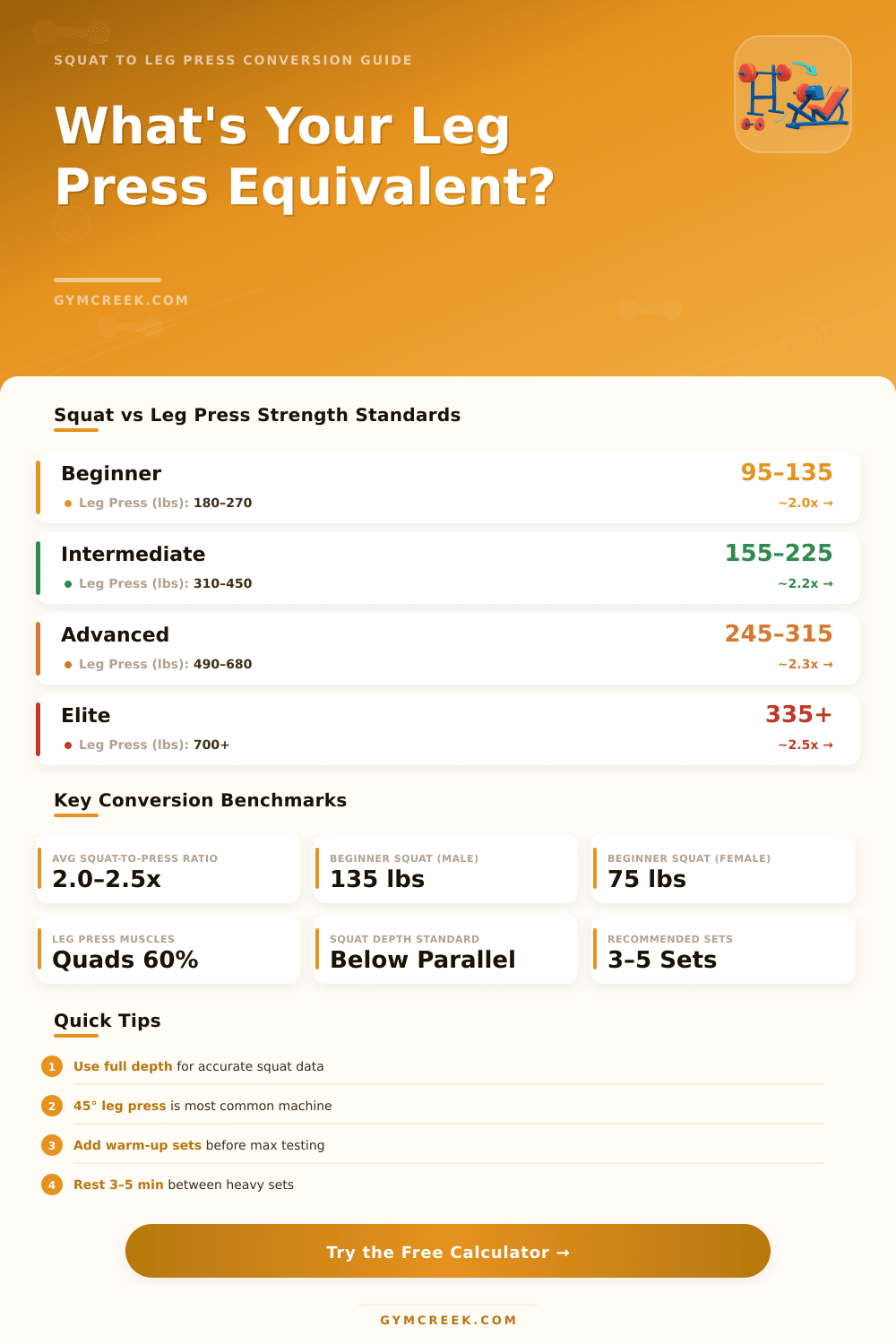
| Level | Bodyweight | Squat 1RM | Leg Press Est. | Ratio |
|---|---|---|---|---|
| Beginner | 154 lbs | 95–135 lbs | 190–280 lbs | 2.0x |
| Novice | 154 lbs | 155–185 lbs | 310–400 lbs | 2.1x |
| Intermediate | 176 lbs | 205–245 lbs | 430–530 lbs | 2.2x |
| Advanced | 198 lbs | 275–335 lbs | 590–750 lbs | 2.3x |
| Elite | 220 lbs | 365–455 lbs | 800–1050 lbs | 2.5x |
| Level | Bodyweight | Squat 1RM | Leg Press Est. | Ratio |
|---|---|---|---|---|
| Beginner | 110 lbs | 55–75 lbs | 110–155 lbs | 2.0x |
| Novice | 132 lbs | 85–115 lbs | 175–245 lbs | 2.1x |
| Intermediate | 143 lbs | 125–155 lbs | 265–330 lbs | 2.2x |
| Advanced | 154 lbs | 175–215 lbs | 370–470 lbs | 2.3x |
| Elite | 165 lbs | 230–285 lbs | 500–650 lbs | 2.5x |
| Machine Angle | Typical Ratio | Mechanical Advantage | Notes |
|---|---|---|---|
| 30° Incline | 1.8–2.0x squat | Lower | Closer to squat mechanics |
| 45° Incline | 2.0–2.3x squat | Moderate | Most common machine type |
| 60° Incline | 2.3–2.6x squat | Higher | Easier per pound loaded |
| Horizontal Seated | 1.5–1.8x squat | Lowest | Least mechanical advantage |
| Hack Squat Machine | 1.2–1.5x squat | Near squat | Closest to free squat |
| Reps (RM) | % of 1RM (Epley) | Example: 1RM = 225 lbs | Goal Zone |
|---|---|---|---|
| 1RM | 100% | 225 lbs | Max Strength |
| 3RM | ~93% | ~209 lbs | Strength |
| 5RM | ~87% | ~196 lbs | Strength / Power |
| 8RM | ~80% | ~180 lbs | Hypertrophy |
| 10RM | ~75% | ~169 lbs | Hypertrophy |
| 12RM | ~70% | ~158 lbs | Endurance / Tone |
The Leg Press is an exercise with a machine that targets the lower body. It focuses mostly on quadriceps, hamstrings, buttocks and calves. Changing the position of the feet on the platform one can reach different muscles.
DISCLOSURE: This post may contain affiliate links, meaning when you click the links and make a purchase, I receive a commission. As an Amazon Associate I earn from qualifying purchases.

With narrow stance, the quadriceps get more attention, while broad position more involves buttocks and hamstrings. Also single leg presses are possible, to isolate one leg and improve the strength balance.
Leg Press and Squat: Main Differences
Squat and Leg Press both help well to build the muscles of the legs, even so they do not match one to the other. The Leg Press uses a machine with heavy plates or built-in heavy weight. Squat one can do only with own body weight or extra resistance, for instance barbell or dumbbells.
While doing Squat, the feet stay on the ground. At the Leg Press, the feet push against the platform.
A big difference is in what happens above the waist. Squat works quadriceps, buttocks, hamstrings, calves and core. The core helps to steady the trunk during the move.
Also the lower back and spinal muscles kick in. The Leg Press mostly hits quadriceps and buttocks, but less loads the core and back. Like this it works for sparing the back as weak spot, while one however can heavily load the legs.
Squat requires a lot of precise technique. The core must be tight, the shoulders drawn back to hold the barbell, the back stays straight and the balance must be kept during the hole time. More danger risks the back and core, if one lifts too heavy weight.
The Leg Press allows bigger weight with less stress on the upper body. When the weight becomes too big at the Leg Press, safety features in the machine help to prevent injuries.
The Leg Press can seem tricky because of the heavy amounts. On a machine at 45-degree angle, the truly vertically moving weight is less than the plates that one loads. The ratio between weight for deadlift and weight for Leg Press is hardly predictable, because the machines differ a bit.
Some combo machines combine Leg Press and hack Squat in one space-saving build. The Body-Solid USA Ultimate 45-Degree Leg Press and Hack Squat Combination stores four exercises in one, Leg Press, hack Squat, calf raise and leg curl; with capacity of 1,000 pounds. The Powertec Leg Press Hack Squat Combination is another option, made for home gyms and light commercial areas, giving smooth andwell controlled movement in small format.
Setting the buttocks flat on the seat during Leg Press is really important. If the knees come too near the chest, the hips can roll off the seat and hurt the lower back. The deadlifts stay good whole-body exercise thanks to broader muscle involvement and bigger demand on the breathing, but the Leg Press is the best for pure leg work with maximum loading of the legs.