Rowing Machine Calorie Calculator
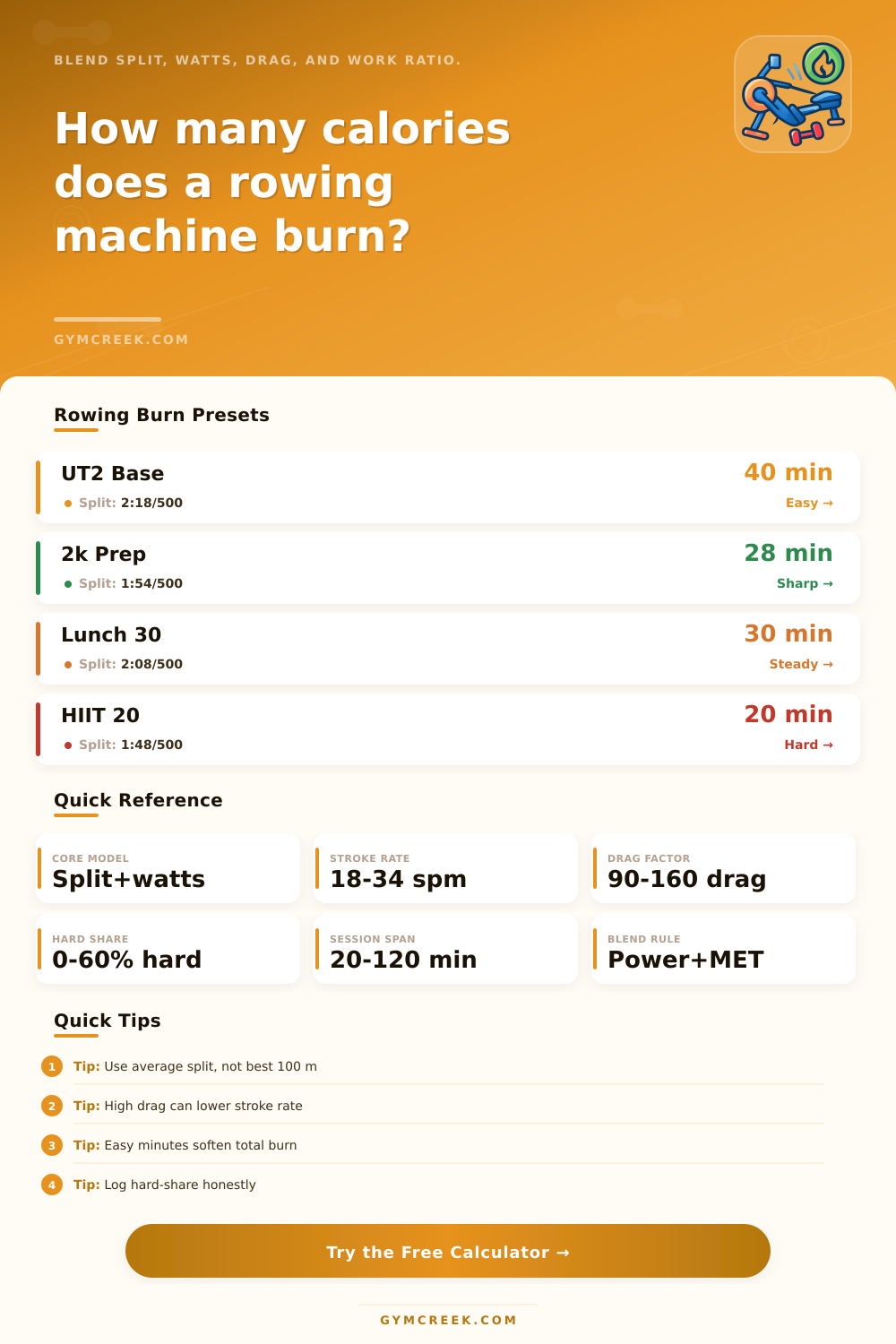
Estimate rowing machine calories with a rower-specific model that blends split-derived power, average watts, stroke rate, drag factor, work-to-easy balance, and body size so long aerobic rows and sharp 2k work stop sharing one guess.
📌Erg Session Presets
These nine presets load believable erg workouts with real split, stroke-rate, drag, and interval patterns, so you can compare a quiet steady-state row against race-pace work without rebuilding every field.
⚙Rowing Inputs
Rowing calorie snapshot
Enter your erg details to compare the blended calorie estimate against the monitor-style number.
📊Erg Metrics
📑Reference Tables
| Duration | Total kcal | Distance | Read |
|---|---|---|---|
| 20 min | --- | --- | Quick |
| 30 min | --- | --- | Base |
| 45 min | --- | --- | Long |
| 60 min | --- | --- | Full |
| Profile | Base MET | Bonus rate | Best fit |
|---|---|---|---|
| Recovery | 4.4 | 1% | Easy paddles |
| Aerobic | 6.8 | 2% | UT2 and UT1 |
| Threshold | 8.7 | 4% | Long hard work |
| Race | 10.4 | 6% | 2k rehearsal |
| HIIT | 12.2 | 9% | Short sharp sets |
| Split band | Likely watts | Session feel | Common use |
|---|---|---|---|
| 2:20-2:30 | 80-100 W | Easy | Recovery rows |
| 2:08-2:19 | 100-145 W | Steady | Base aerobic work |
| 1:55-2:07 | 146-215 W | Firm | UT1 or tempo |
| 1:45-1:54 | 216-320 W | Hard | 2k prep and pieces |
| Under 1:45 | 320+ W | Very hard | Race or sprint work |
| Setting | Factor | What changes | Rowing cue |
|---|---|---|---|
| 90-99 drag | 0.97x | Lighter catch | Good for rate work |
| 100-114 drag | 1.00x | Baseline load | Most steady rows |
| 115-129 drag | 1.03x | Balanced pressure | Sweet spot for many rowers |
| 130-144 drag | 1.02x | Heavier drive | Works if split stays clean |
| 145-160 drag | 0.99x | Rate can sag | Force rises, rhythm can fade |
| 161+ drag | 0.95x | Efficiency drops | Only useful for a few athletes |
💡Rowing Tips
In order to calculate the number of calories that are burned during the use of a rowing machine, there are several different factors that must be considered. The calorie estimates that are displayed on the monitor of a rowing machine are not necessarily accurate in relation to the number of calories that an individual burns, and the intensity with which that individual row on the rowing machine can influence the number of calories that is burned. The number of calories that are burned while rowing on a rowing machine can be determined by the individual’s power output, the individual’s stroke rate, the individual’s body weight, and the drag factor of the rowing machine’s flywheel.
The power output of an individual can be measured in the unit of watt. The number of watts that an individual outputs can reveal the amount of work that an individual performs on the rowing machine. However, the number of watts that an individual outputs may not accurately reflect the number of calories that are burned by that individual due to the efficiency of that individuals body.
What Changes How Many Calories You Burn on a Rowing Machine
In order to more accurately calculate the number of calories that are burned, an individual can consider the number of metabolic equivalents (often referred to as METs) that an individual consumes during rowing machine intervals. The METs that are calculated for an individual can determine the amount of oxygen that an individual consumes during rowing intervals, and the amount of oxygen that an individual consumes is correlated with the amount of calories that are burned by that individual in the body. The stroke rate of an individual is another factor that can contribute to the calculation of the number of calories that are burned by that individual while using a rowing machine.
The stroke rate is a measure of the number of strokes that an individual can perform in a minute. An increase in the stroke rate of an individual will increase the number of calories that is burned. For instance, a stroke rate of 32 strokes per minute will burn more calories then an individual that rows at 18 strokes per minute.
The drag factor of the rowing machine’s flywheel indicates the force that an individual will have to apply with each stroke. An increase in drag factor will increase the force that is applied to each stroke, but if the drag factor becomes too high, the stroke rate will decrease for that individual. A decrease in stroke rate will lead to a decrease in the amount of work that an individual performs on the rowing machine.
The body weight of an individual is another primary factor in the calculation of the number of calories that are burned by that individual while using a rowing machine. An individual that has a higher body weight than another individual will burn more calories than that other individual when using a rowing machine. Additionally, the height of an individual may play a role in the calculation of the number of calories that are burned on a rowing machine.
An individual that is of a taller stature than another individual may have a longer lever that applies to the rowing machines flywheel. The type of rowing machine session that an individual performs will impact the calculation of that individuals calorie burn rate. Aerobic rowing will burn fewer calories than high intensity interval training (HIIT) sessions.
Aerobic exercise is used to increase the endurance of an individual’s body, while high-intensity interval training is used to burn more calories, and creates an “oxygen debt” for the body. An “oxygen debt” occurs after high-intensity interval training sessions when the body continues to burn calories after the rowing machine intervals has ended. Therefore, a session that includes many high-intensity interval training sessions will burn more calories than a session that includes only aerobic rowing machine intervals.
The number of calories that are displayed on the monitor of a rowing machine is not the number of calories that an individual that use the rowing machine will burn. The calorie count that is displayed on the monitor may significantly overestimate the number of calories that are burned during steady aerobic rowing intervals, but may underestimate the calories that are burned during high-intensity interval training. For example, an individual that rows for 40 minutes at a steady pace will burn 500 calories according to the monitor of their rowing machine, but the actual number of calories that are burned may be 420.
However, during high-intensity interval training intervals, an individual may burn more calories then is calculated by the monitor. In order to properly track the number of calories burned by an individual while rowing on a rowing machine, an individual should consider their power, stroke rate, and drag factor. These factors will allow an individual to map the effort that is expended during rowing to the reality of the number of calories that are burned on the rowing machine.
For instance, if the goal of an individual is to lose fat from their body, they may utilize aerobic rowing intervals and adjust their rowing machines hard-share percentage to ensure that they burn the required calories to reach their goal. However, if an individual desires to increase their endurance, they can increase the length of each rowing session on the machine. By understanding the relationship between these three factors, an individual can make more informed decisions regarding the type of rowing interval that they use on their rowing machine, and understand the number of calories that are burned by their body.
They should of considered these things earlier. It is alot of work to track everything naturaly.