⚖️ Percent Ideal Body Weight Calculator
Calculate your % IBW using four validated clinical formulas instantly
| % IBW Range | Category | Clinical Significance | Action |
|---|---|---|---|
| < 70% | Severely Underweight | High risk of malnutrition, organ damage | Seek medical care immediately |
| 70 – 80% | Moderately Underweight | Nutritional deficiency risk | Medical & dietary evaluation |
| 80 – 90% | Mildly Underweight | Some risk; monitor closely | Increase caloric intake |
| 90 – 110% | Ideal Range | Lowest health risk | Maintain current weight |
| 110 – 120% | Overweight | Increased metabolic risk | Gradual weight reduction |
| 120 – 130% | Obese | Elevated cardiovascular risk | Supervised weight management |
| > 130% | Severely Obese | High risk of comorbidities | Medical intervention advised |
| Formula | IBW (kg) | IBW (lb) | Based On |
|---|---|---|---|
| Devine (1974) | 74.8 kg | 165 lb | Insurance actuarial data |
| Robinson (1983) | 72.6 kg | 160 lb | Updated Devine model |
| Miller (1983) | 74.4 kg | 164 lb | NHANES population data |
| Hamwi (1964) | 78.2 kg | 172 lb | Oldest clinical standard |
| Average of All | 74.9 kg | 165 lb | Best consensus estimate |
| Height | Male IBW (lb) | Female IBW (lb) | Ideal Range |
|---|---|---|---|
| 5'0" (152 cm) | 106 lb | 100 lb | 95 – 117 lb |
| 5'2" (157 cm) | 111 lb | 105 lb | 100 – 122 lb |
| 5'4" (163 cm) | 122 lb | 115 lb | 110 – 134 lb |
| 5'6" (168 cm) | 133 lb | 126 lb | 120 – 146 lb |
| 5'8" (173 cm) | 144 lb | 136 lb | 130 – 158 lb |
| 5'10" (178 cm) | 165 lb | 147 lb | 149 – 182 lb |
| 6'0" (183 cm) | 176 lb | 158 lb | 158 – 194 lb |
| 6'2" (188 cm) | 187 lb | 168 lb | 168 – 206 lb |
| Formula | Male Equation | Female Equation | Height Base |
|---|---|---|---|
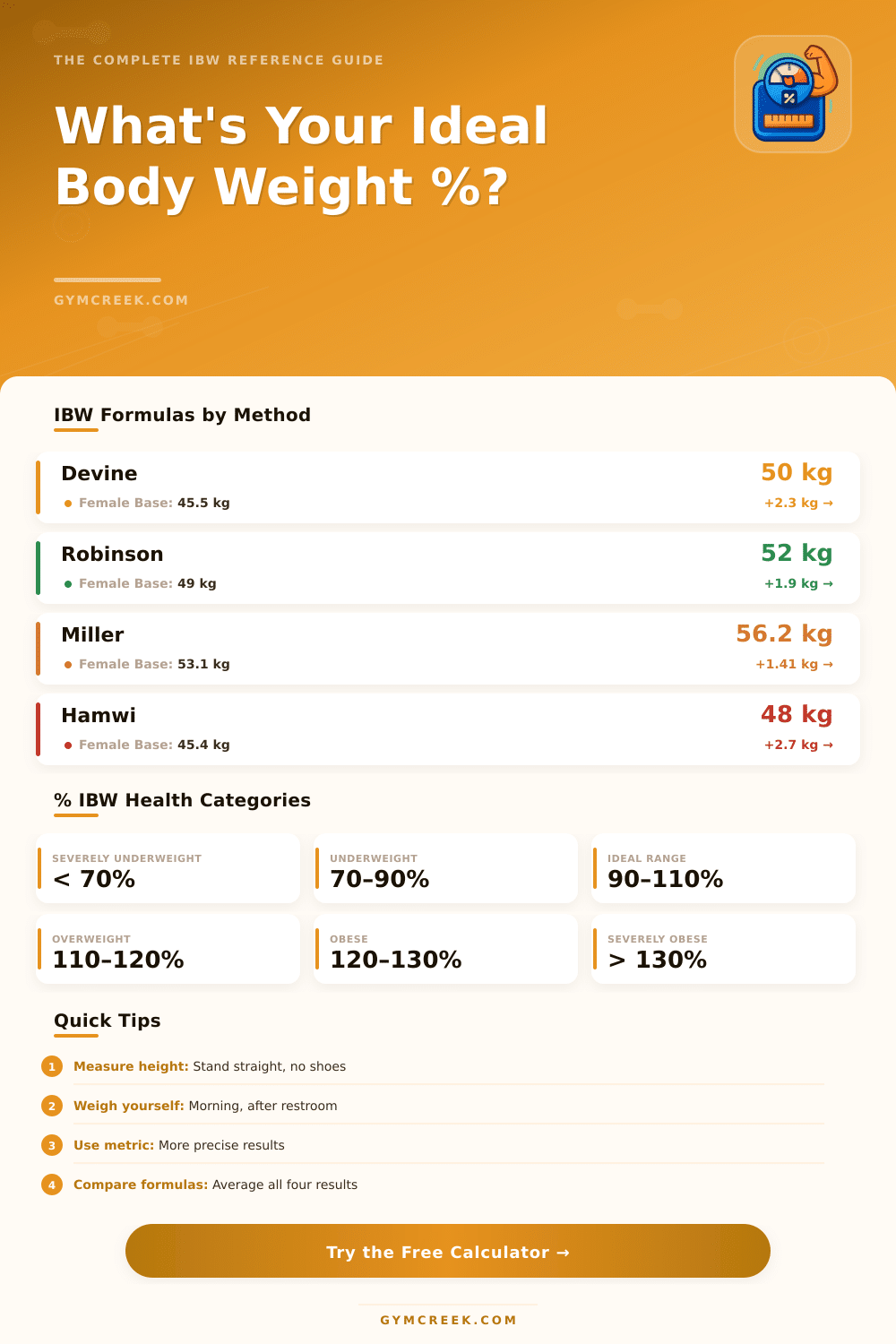
| Devine | 50 + 2.3 × (inches > 60) | 45.5 + 2.3 × (inches > 60) | 5 ft (60 in) |
| Robinson | 52 + 1.9 × (inches > 60) | 49 + 1.7 × (inches > 60) | 5 ft (60 in) |
| Miller | 56.2 + 1.41 × (inches > 60) | 53.1 + 1.36 × (inches > 60) | 5 ft (60 in) |
| Hamwi | 48 + 2.7 × (inches > 60) | 45.4 + 2.27 × (inches > 60) | 5 ft (60 in) |
That is not one magic number when dealing about the ideal Body Weight. It depends on your age, height, gender and body build. Every person is built differently so the ideal Body Weight also looks different for each.
DISCLOSURE: This post may contain affiliate links, meaning when you click the links and make a purchase, I receive a commission. As an Amazon Associate I earn from qualifying purchases.

No formula can exactly determine what weight any person should have. And here is the key cause: no sign can exactly say to you how far healthy you are or what healthy risks can expect you in the future.
There Is No Single Ideal Body Weight
Various formulas try to estimate the ideal Body Weight, and the Devine-formula probably is the most famous between them. For males one starts at 50 kilos and adds 2.3 kilos for every inch above five feet. A man of five feet and ten inches would do the calculation, that is 10 inches more, tiems 2.3, and would get around 73 kilos, what matches roughly to 161 pounds.
There is also another version that goes around: it starts at 110 pounds for males and adds 5 pounds for every inch above five feet.
Later comes the Robinson-formula, the Miller-formula and the Hamwi-formula, each of them gives a bit different results. I tried that with some numbers and received results between about 138 and 177 pounds. Honestly, that is quite a big difference.
The Body Mass Index, or BMI, comes always as another tool for measuring. It tries to estimate the body fat using only weight and height. The idea is that one compares your weight with your height to estimate the whole mass.
But BMI does not say everything. It does not consider muscle, bone thickness or the real makeup of you’re body. One could measure a whole team of the NFL, and BMI almost would say that all of them are overweight, what does not match with the reality.
BMI points to a range instead of a precise number, and staying in that range usually means fewer healthy risks.
Really useful is thinking about the percentage of body fat. There is no magic weight that counts only because of your height. The body structure matters a lot.
You could be slim with a thin frame, broader with a wider build or stronger with a bigger chest. Width of shoulders, of hips, size of chest… All those things decide what feels right for you.
Those calculations about ideal Body Weight come from the tables of Metropolitan Life Insurance from the 1940s. Those tables tied weight to the lowest death rates for various heights, ages, genders and frame sizes. The idea helps doctors in clinics. For example to figure out doses of medicines…
Rather than serve as a strict target that one must reach.
Your genes, existing health problems that you have, and your body makeup all affect what really is healthy for you. Talk about that with a doctor, set real targets for yourself and buildlong-lasting habits around good food and regular exercise… That is the wiser way.