🏋 Overhead Press One Rep Max Calculator
Estimate your true 1RM using proven formulas. Plan training loads and track strength progress.
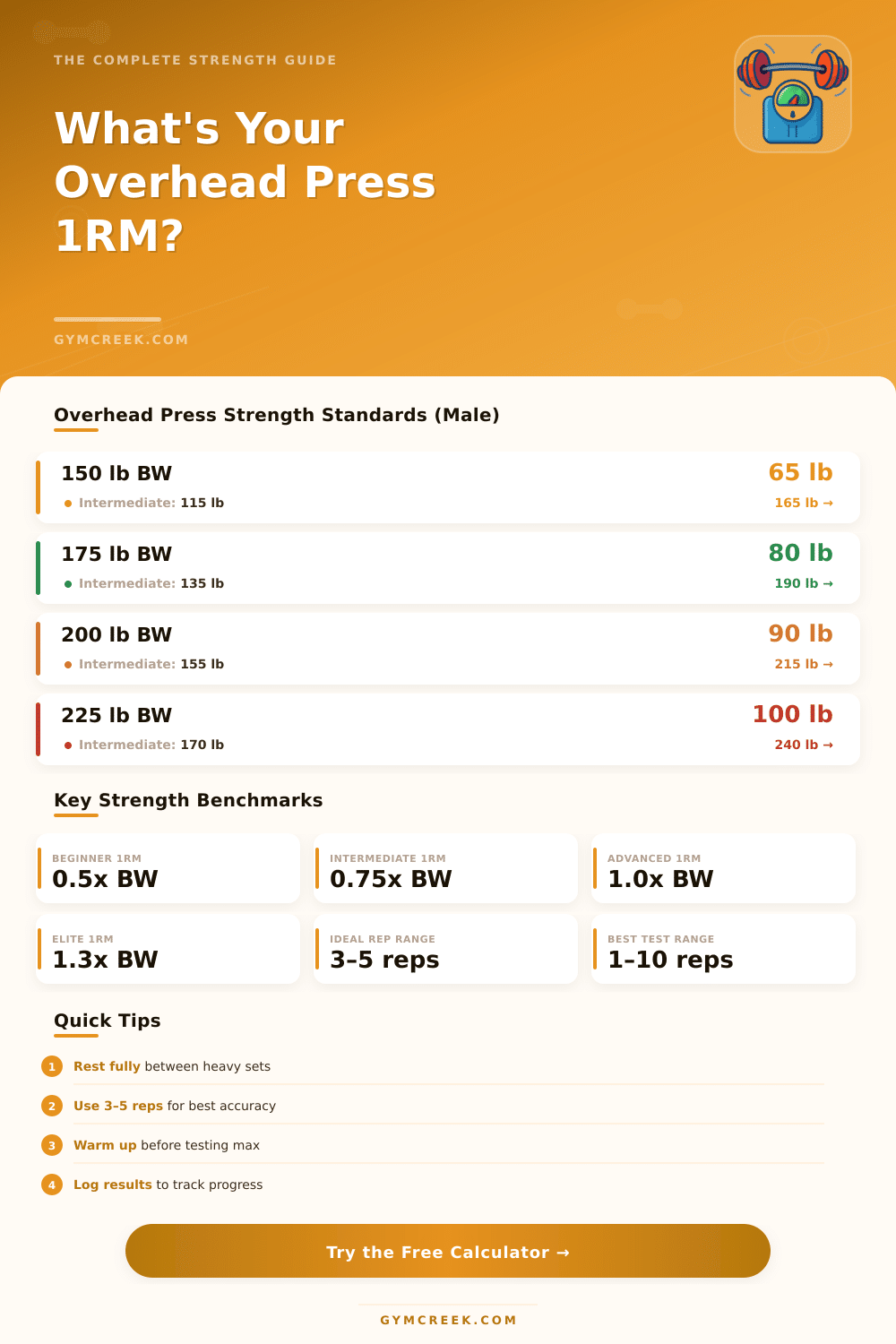
| Bodyweight | Beginner | Novice | Intermediate | Advanced | Elite |
|---|---|---|---|---|---|
| 132 lbs | 55 | 80 | 105 | 140 | 175 |
| 148 lbs | 65 | 90 | 120 | 155 | 195 |
| 165 lbs | 70 | 100 | 130 | 170 | 215 |
| 181 lbs | 80 | 110 | 145 | 185 | 235 |
| 198 lbs | 85 | 120 | 155 | 200 | 250 |
| 220 lbs | 90 | 130 | 165 | 215 | 270 |
| 242 lbs | 95 | 135 | 175 | 225 | 285 |
| Bodyweight | Beginner | Novice | Intermediate | Advanced | Elite |
|---|---|---|---|---|---|
| 97 lbs | 25 | 40 | 55 | 75 | 95 |
| 114 lbs | 30 | 45 | 60 | 85 | 105 |
| 123 lbs | 33 | 50 | 65 | 90 | 115 |
| 132 lbs | 35 | 53 | 70 | 95 | 120 |
| 148 lbs | 38 | 58 | 78 | 105 | 130 |
| 165 lbs | 42 | 63 | 85 | 113 | 142 |
| 181 lbs | 45 | 68 | 90 | 120 | 150 |
| Reps | % of 1RM | Training Goal | Rest Period |
|---|---|---|---|
| 1 | 100% | Max Strength Test | 3–5 min |
| 2 | 97% | Max Strength | 3–5 min |
| 3 | 94% | Max Strength | 3–5 min |
| 4 | 91% | Strength | 2–4 min |
| 5 | 87% | Strength / Power | 2–4 min |
| 6 | 85% | Strength / Hypertrophy | 2–3 min |
| 8 | 80% | Hypertrophy | 60–90 sec |
| 10 | 75% | Hypertrophy | 60–90 sec |
| 12 | 70% | Hypertrophy / Endurance | 60 sec |
| 15 | 65% | Muscular Endurance | 30–60 sec |
| 20 | 60% | Muscular Endurance | 30 sec |
Brzycki (1993): 1RM = Weight x 36 / (37 – Reps)
Lander: 1RM = Weight x 100 / (101.3 – 2.67123 x Reps)
Lombardi: 1RM = Weight x Reps0.10
Mayhew et al.: 1RM = Weight x 100 / (52.2 + 41.9 x e–0.055 x Reps)
O'Conner et al.: 1RM = Weight x (1 + 0.025 x Reps)
Wathan: 1RM = Weight x 100 / (48.8 + 53.8 x e–0.075 x Reps)
Note: All formulas are most accurate for 1–10 rep ranges. For maximum accuracy, choose "Average of All Formulas."
✅ Optimal rep range: Use 3–5 reps with a heavy weight for the most reliable results.
✅ Full range of motion: Only count reps that reach full lockout overhead and return to collar-bone level.
✅ Track over time: Re-test every 4–6 weeks to monitor strength progress accurately.
The Overhead Press is between the best exercises for the upper body. It has many names, for instance shoulder press, strict press or even military press. One can do it sitting or standing, and it mainly strengthens the front part of the shoulder muscles.
DISCLOSURE: This post may contain affiliate links, meaning when you click the links and make a purchase, I receive a commission. As an Amazon Associate I earn from qualifying purchases.

Besides the shoulders it also works the triceps and the core. The standing version requires strong core support to keep the back straight while one pushes the weight upward.
How to Do the Overhead Press
The standing Overhead Press with correct form is actually truly safe. It can be the best choice for building upper body strength in everyday life, besides direct exercises for the back. Unlike the bench press, it engages the whole body and is a much more useful move.
Usually, when we raise objects in real life, we stand on our feet, not lie on our back. Sports like basketball, volleyball or football involve upper moves, so the press helps to become more athletic.
The version with a bar allows big weights, which works well for Olympic lifters, CrossFit athletes and strong sportsmen, that need upper skills with a bar in their activity. CrossFit truly brought back the press, the push presses and the push jerks, making them mainstream parts in its program. Before, the bench press and fly moves almost alone made up the upper body training, commonly for looks instead of for real readiness.
The Overhead Press always was the mainstream shoulder exercise for growing strength and size. It builds mass in the shoulders, traps and triceps, which gives impressive looks. The front delts rank between the most visible muscles in bodybuilding poses, and the Overhead Press is almost needed to fully build them for the majority of folks.
Even so, for pure muscle growth, one can swap the bar for dumbbells and add form, which sometimes works more well.
Progress in this lift is truly hard. It almost is the most difficult lift for adding wait, and it always moves more slowly than other basic lifts. Adding more volume and reps commonly helps to get past plates.
Use micro-plates to add only one pound each week as one practical method. Lateral raises stay important and should not be replaced, although they hit the shoulders somewhat differently.
For the form, start standing with feet wide as the shoulders. Push the bar upward until the elbows fully straighten, then the shoulders raise to the ceiling. Pause briefly up top.
Lower the bar to the front shoulders and repeat. The legs stay straight, without knee push. Keeping the bar in the center and moving in a straight line helps good form and results.
Keeping the hands just outside of the shoulders and pressing the bar tight also is useful. Tighten everything to make the lift more strong. Breathe in before or while lowering thebar, following the usual rhythm.
One thing to keep in mind is, that the sitting Overhead Press adds more stress to the lower back. The Overhead Press also helps to build the upper chest, but it does not work alone to get chest size and volume.