💪 Protein Intake Calculator to Build Muscle
Calculate your personalized daily protein target using science-backed formulas
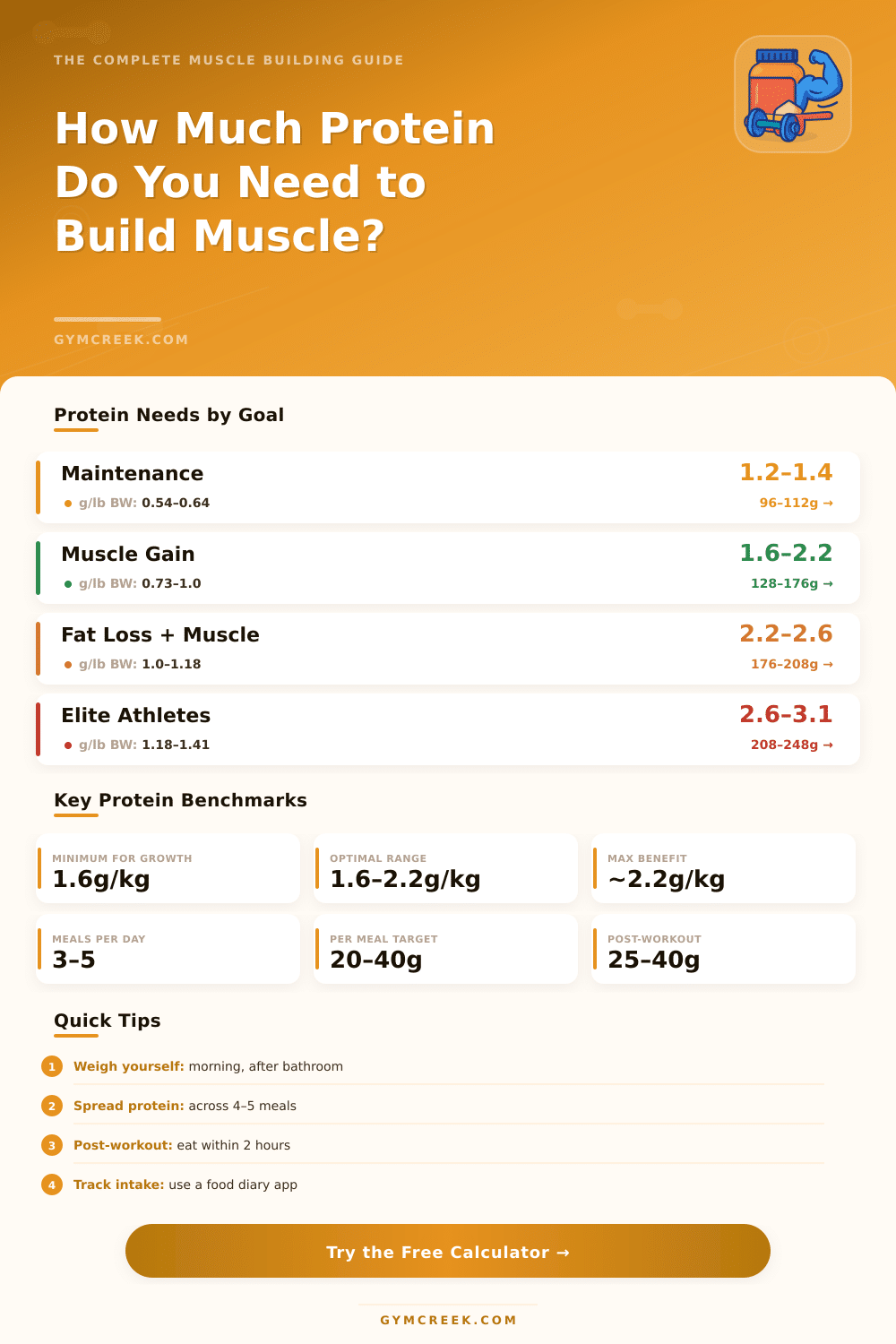
| Goal | g per kg BW | g per lb BW | Example (80kg / 176lb) |
|---|---|---|---|
| General Health / Maintenance | 1.2 – 1.4 g/kg | 0.54 – 0.64 g/lb | 96 – 112g/day |
| Muscle Growth (Lean Bulk) | 1.6 – 2.2 g/kg | 0.73 – 1.0 g/lb | 128 – 176g/day |
| Aggressive Bulk | 2.0 – 2.4 g/kg | 0.91 – 1.09 g/lb | 160 – 192g/day |
| Fat Loss + Muscle Retention | 2.2 – 2.6 g/kg | 1.0 – 1.18 g/lb | 176 – 208g/day |
| Body Recomposition | 2.0 – 2.4 g/kg | 0.91 – 1.09 g/lb | 160 – 192g/day |
| Elite / Competitive Athletes | 2.6 – 3.1 g/kg | 1.18 – 1.41 g/lb | 208 – 248g/day |
| Food Source | Serving Size | Protein (g) | Calories |
|---|---|---|---|
| Chicken Breast (cooked) | 100g / 3.5oz | ~31g | ~165 kcal |
| Lean Beef (95% lean) | 100g / 3.5oz | ~26g | ~176 kcal |
| Salmon (Atlantic) | 100g / 3.5oz | ~25g | ~208 kcal |
| Whole Eggs | 2 large eggs | ~12g | ~143 kcal |
| Greek Yogurt (plain, 0%) | 170g / 6oz | ~17g | ~100 kcal |
| Cottage Cheese (low fat) | 100g / 3.5oz | ~11g | ~72 kcal |
| Tuna (canned in water) | 100g / 3.5oz | ~25g | ~116 kcal |
| Lentils (cooked) | 100g / 3.5oz | ~9g | ~116 kcal |
| Tofu (firm) | 100g / 3.5oz | ~8g | ~76 kcal |
| Whey Protein Powder | 1 scoop (~30g) | ~24g | ~120 kcal |
| Category | Men (%) | Women (%) | Muscle Building Note |
|---|---|---|---|
| Essential Fat | 2 – 5% | 10 – 13% | Too low — performance risk |
| Athletic | 6 – 13% | 14 – 20% | Optimal for muscle gain |
| Fitness | 14 – 17% | 21 – 24% | Good for lean bulk |
| Average | 18 – 24% | 25 – 31% | Consider cut first |
| Obese | 25%+ | 32%+ | High protein for recomp |
| Timing / Frequency | Recommendation | Rationale |
|---|---|---|
| Meals per day | 3 – 5 meals | Maximizes muscle protein synthesis |
| Protein per meal | 20 – 40g | Leucine threshold for MPS activation |
| Post-workout window | Within 2 hours | Elevated MPS after resistance training |
| Pre-sleep protein | 30 – 40g | Overnight muscle repair (casein ideal) |
| Training days vs. rest days | Same total protein | MPS elevated 24–48h post-training |
| Minimum leucine per meal | ~2 – 3g | Triggers muscle protein synthesis signal |
Protein is needed for the functions of your body, it helps to build Muscle, fix tissues and make sure that everything works well. It is made up of amino acids and there are around 20 different types that your body needs. The amount of Protein that you truly need depends on your goals, your activity and your level in training.
DISCLOSURE: This post may contain affiliate links, meaning when you click the links and make a purchase, I receive a commission. As an Amazon Associate I earn from qualifying purchases.

The official Recommended Daily Dose is 46 grams a day for women of 19 years and older, while men in that age group need 56 grams. That RDA figure shows what is enough for most folks to stay healthy and avoid gaps. Actually, new scientific findings suggest something different, around 1.2 to 1.6 grams per kilo of body weight.
How Much Protein Do You Need?
That marks a big change compared to the prior 0.8 gram level, that aimed to only prevent nitrogen loss and nutritional gaps.
In the best case, Protein should make up between 10 and 35 percent of your daily calories. If you are over 65 years, aiming for the higher limit has much sense. Folk that only reaches the basic RDA will get only around 10 percent of thier calories from Protein.
On the other hand, the typical American reaches about 16 percent.
Let us look at it more closely. A woman weighing 140 pounds needs around 100 grams of Protein daily. And a man of 220 pounds?
For him the answer is more, namely 155 to 165 grams. Here is the main point. There is no universal amount, because the needs for Protein range a lot from one person too the next.
For one meal, between 15 and 30 grams of Protein correctly hit the target. Going past 40 grams in one sitting does not give big gains. Your body indeed can process only around 30 grams at a time, although many folks end up finding that three quarters of their daily load of Protein come from lunch and the main meal together.
When you try to lose weight, Protein becomes even more important. One clinical study followed 65 overweight women that followed a diet rich in Protein, as Protein formed more than a quarter of the total calories. And they lost much more weight during six months than the other groups.
While you cut calories, assign a bigger part of the remaining calories to Protein instead of to carbs or fats to help protect your Muscle.
Recall that the tips about Protein relate to the total amount from everything that you eat, not only from powders or shakes. Complete Protein sources, like meat, fish and eggs, provide all eight needed amino acids that your body itself cannot produce. Chicken and turkey are good lean options, they have everything needed and do not cost as much as beef or seafood.
There truly is no basis for the idea that too much Protein hurts the kidneys in healthy folks; that matters only if you already have kidney disease. At the end of the day, the best plan is to eatregularly with plenty of nutrients, fibers, vitamins, minerals and good Protein through the whole day.