💪 TDEE Calculator for Muscle Gain
Calculate your Total Daily Energy Expenditure and ideal calorie surplus for lean muscle building
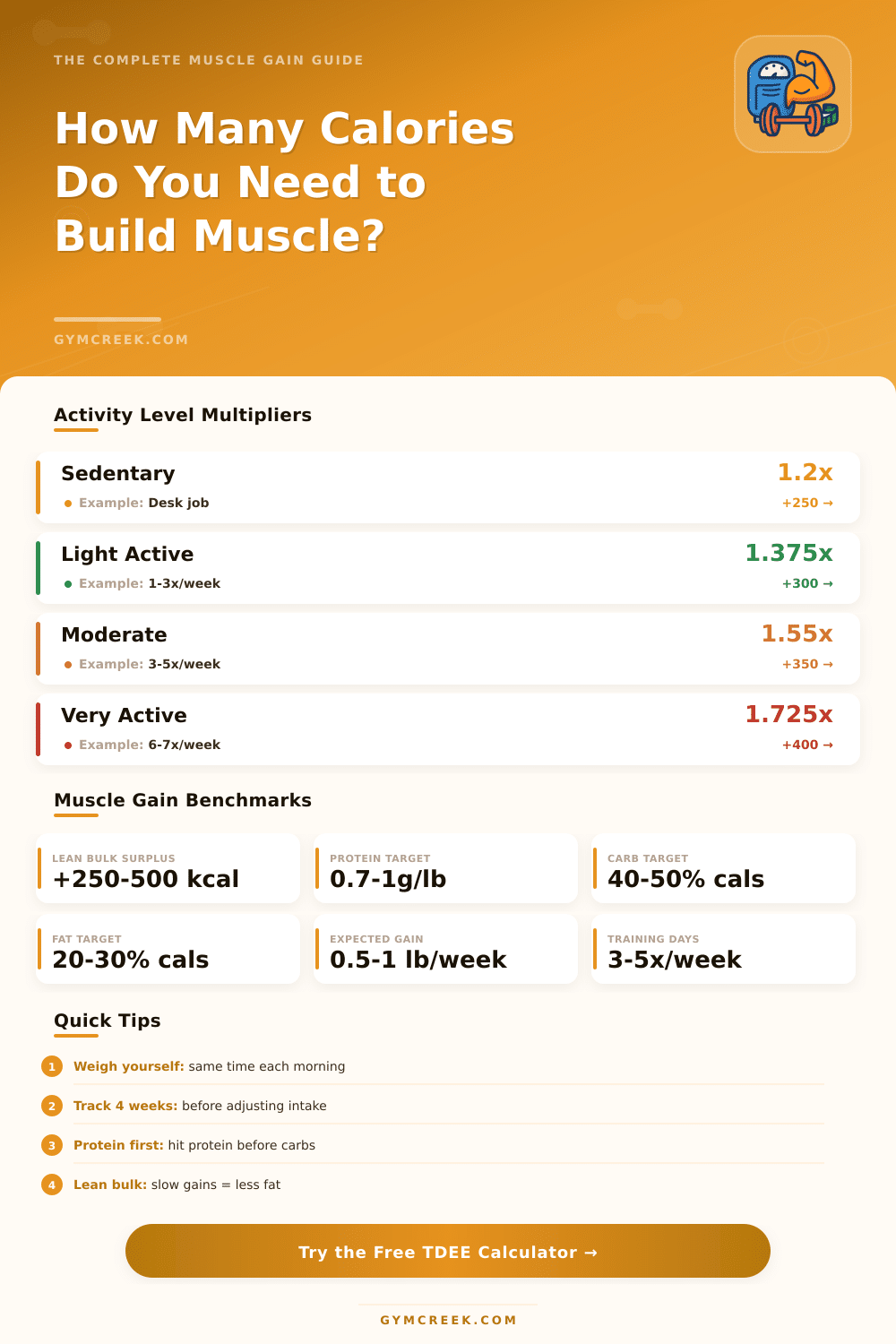
| Activity Level | Multiplier | Weekly Exercise | Recommended Surplus | Expected Gain/Week |
|---|---|---|---|---|
| Sedentary | 1.2x | None / desk job | +200–250 kcal | 0.25–0.5 lb |
| Lightly Active | 1.375x | 1–3 days/week | +250–300 kcal | 0.25–0.5 lb |
| Moderately Active | 1.55x | 3–5 days/week | +300–400 kcal | 0.5–0.75 lb |
| Very Active | 1.725x | 6–7 days/week | +400–500 kcal | 0.5–1 lb |
| Extra Active | 1.9x | Physical job + daily training | +500–600 kcal | 0.75–1 lb |
| Goal | Protein | Carbohydrates | Fats | Notes |
|---|---|---|---|---|
| Lean Bulk | 30–35% | 40–45% | 20–25% | 0.8–1g protein/lb BW |
| Moderate Bulk | 25–30% | 45–50% | 20–25% | Carbs fuel performance |
| Aggressive Bulk | 20–25% | 50–55% | 20–25% | Higher carbs for volume training |
| Body Recomp | 35–40% | 35–40% | 20–25% | High protein, calorie cycling |
| Category | Males | Females | Muscle Gain Suitability |
|---|---|---|---|
| Essential Fat | 2–5% | 10–13% | Not recommended — too low |
| Athletic | 6–13% | 14–20% | Ideal for lean bulk |
| Fitness | 14–17% | 21–24% | Good starting point |
| Average | 18–24% | 25–31% | Consider cut first |
| Obese | 25%+ | 32%+ | Cut recommended before bulk |
| Experience Level | Protein (g/lb BW) | Protein (g/kg BW) | Source |
|---|---|---|---|
| Beginner (0–1 yr) | 0.7–0.8g | 1.6–1.8g | ISSN Position Stand |
| Intermediate (1–3 yr) | 0.8–0.9g | 1.8–2.0g | ISSN Position Stand |
| Advanced (3+ yr) | 0.9–1.0g | 2.0–2.2g | ISSN Position Stand |
| Maximum threshold | 1.0–1.2g | 2.2–2.6g | Morton et al. 2018 meta-analysis |
| Experience Level | Males (lbs/month) | Females (lbs/month) | Annual Potential (lbs) |
|---|---|---|---|
| Beginner (0–1 yr) | 1.0–2.0 lbs | 0.5–1.0 lbs | 12–24 lbs (M) / 6–12 lbs (F) |
| Intermediate (1–3 yr) | 0.5–1.0 lbs | 0.25–0.5 lbs | 6–12 lbs (M) / 3–6 lbs (F) |
| Advanced (3–5 yr) | 0.25–0.5 lbs | 0.1–0.25 lbs | 3–6 lbs (M) / 1–3 lbs (F) |
| Elite (5+ yr) | 0.1–0.25 lbs | 0.05–0.1 lbs | 1–3 lbs (M) / 0.5–1 lbs (F) |
TDEE, Total Daily Energy Use; simply shows how many calories you burn daily, when one considers your exercise. A calculator for TDEE uses your age the shape of your body and your activity, to give a rating about your daily calorie expense. When you know your TDEE, you have a basic spot to reach anything: lose weight, stay same or build muscles.
DISCLOSURE: This post may contain affiliate links, meaning when you click the links and make a purchase, I receive a commission. As an Amazon Associate I earn from qualifying purchases.

To grow muscle, you must eat more than your TDEE. You need a calorie surplus. Studies show that raising your intake by 5 to 10 percent above TDEE helps with Muscle Gain, while one limits the extra fat.
How Many Calories to Eat to Build Muscle
It commonly must be around 200 to 500 extra calories than what you already burn. Assume that your TDEE is 2 500 calories. Then a 10 percent extra puts you at 2 750.
Some prefer to start right away with 500 exrta calories and adjust according to need.
A bottom approach that commonly works well is made up of raising calories by 200 to 300 every two weeks. For proteins, aim for 1,8 to 2,0 grams per kilo of body weight, that gives a firm base to build. The secret is raising proteins without letting the whole calorie amount get out of control.
A split of nutrients with 40 percent proteins, 30 percent carbs and 30 percent fat commonly gives good results. Even so, not all calories match when one aims for muscle.
Here is the main point: no calculator exactly captures your real long-term calories. So it matters to follow your wait and food over time. Programs like MyFitnessPal help a lot with the follow-up.
After one or two weeks, if the scale moves in an unexpected way, it signals that you must change your calorie target.
Here is where it gets funny. One pound of muscle burns around ten calories, even when it simply sits without activity. Add ten pounds of muscle, and you have an extra 100 calories burned daily.
People with little lean muscle commonly find it hard to lose weight, they simply do not burn quite a lot at rest. Fat tissue, on the other hand, almost does not burn anything. So, lifting weights and adding lean mass is a good way to quickly raise your TDEE.
Training with resistance raises TDEE by adding muscle to your body. Cardio, instead, only briefly raises the calorie burning during the activity. Complex heavy exercises, like bench press, squats, deadlifts and shoulder press, give the most impact for your effort during overall building.
Keeping on raising weights. Whether with dumbbells, machines or body weight, helpsto keep progress.
Muscle Gain is not easy work. Most folks reach between 3 and 6 pounds of real Muscle Gain per year of regular training. Your genes, your food, whether you use supplements and the quality of your methods, everything affects the speed.
If you too quickly or too badly limit calories, you risk losing the muscle that you already got, certainly not a wanted situation.