🏃 Marathon Running Pace Calculator
Calculate your race pace, finish time, and mile-by-mile splits for any distance
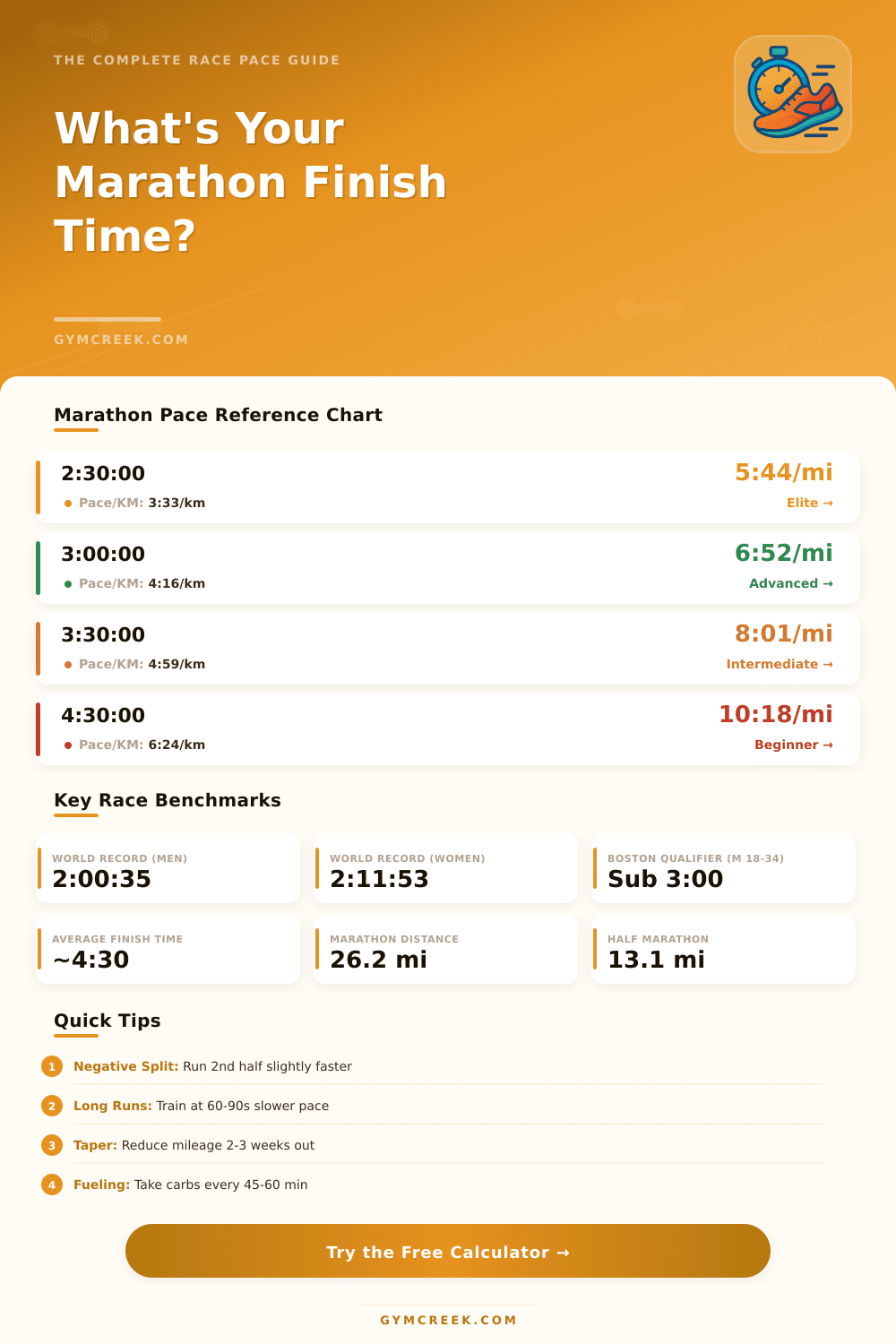
| Finish Time | Pace / Mile | Pace / KM | Runner Category |
|---|---|---|---|
| 2:00–2:15 | 4:35–5:10 /mi | 2:51–3:12 /km | 🏆 World Class / Elite |
| 2:30–2:59 | 5:44–6:50 /mi | 3:33–4:14 /km | 🥇 Sub-Elite / Advanced |
| 3:00–3:29 | 6:52–7:59 /mi | 4:16–4:58 /km | 🏅 Boston Qualifier Range |
| 3:30–3:59 | 8:01–9:09 /mi | 4:59–5:41 /km | 💪 Competitive Amateur |
| 4:00–4:29 | 9:09–10:18 /mi | 5:41–6:24 /km | 🏃 Strong Recreational |
| 4:30–4:59 | 10:18–11:27 /mi | 6:24–7:06 /km | 🚶 Average Recreational |
| 5:00–5:59 | 11:27–13:44 /mi | 7:06–8:32 /km | 🌱 Run/Walk Finisher |
| 6:00+ | 13:44+ /mi | 8:32+ /km | 🚶 Walk/Run Finisher |
| Age Group | Men BQ Time | Women BQ Time | Pace / Mile (Men) |
|---|---|---|---|
| 18–34 | 3:00:00 | 3:30:00 | 6:52 /mi |
| 35–39 | 3:05:00 | 3:35:00 | 7:03 /mi |
| 40–44 | 3:10:00 | 3:40:00 | 7:15 /mi |
| 45–49 | 3:20:00 | 3:50:00 | 7:38 /mi |
| 50–54 | 3:25:00 | 3:55:00 | 7:50 /mi |
| 55–59 | 3:35:00 | 4:05:00 | 8:12 /mi |
| 60–64 | 3:50:00 | 4:20:00 | 8:47 /mi |
| 65–69 | 4:05:00 | 4:35:00 | 9:21 /mi |
| 70–74 | 4:20:00 | 4:50:00 | 9:55 /mi |
| 75+ | 4:35:00 | 5:05:00 | 10:30 /mi |
| If 5K Time is | Predicted 10K | Predicted Half | Predicted Marathon |
|---|---|---|---|
| 18:00 | 37:30 | 1:22:30 | 2:54:00 |
| 20:00 | 41:40 | 1:31:40 | 3:14:00 |
| 22:00 | 45:50 | 1:40:50 | 3:33:00 |
| 25:00 | 52:05 | 1:54:35 | 4:03:00 |
| 28:00 | 58:20 | 2:08:20 | 4:32:00 |
| 30:00 | 1:02:30 | 2:17:30 | 4:51:00 |
| 35:00 | 1:12:55 | 2:40:30 | 5:39:00 |
| Zone | % Max HR | Effort Level | Training Purpose |
|---|---|---|---|
| Zone 1 | 50–60% | Very Easy | Recovery, warm-up |
| Zone 2 | 60–70% | Easy / Aerobic | Long runs, base building |
| Zone 3 | 70–80% | Moderate | Tempo, marathon pace |
| Zone 4 | 80–90% | Hard / Threshold | 10K race pace, intervals |
| Zone 5 | 90–100% | Maximum | 5K, sprints, VO2 max |
Marathon Running Pace is the speed that one can keep during the whole 26.2-mile way. It requires only moderate effort and one usually can keep it during some hours. Strengthening the aerobic threshold, one reaches a more solid steady pace, and that forms the core of many programs for Marathon preparation.
DISCLOSURE: This post may contain affiliate links, meaning when you click the links and make a purchase, I receive a commission. As an Amazon Associate I earn from qualifying purchases.

Pace charts help well to estimate the time of arrival. Commonly, they cover final times for Marathon of two until eight hours by means of one-minute steps. Other versions extend from under-two-hour runs until six hours with 30-second gaps.
Find and Train Your Marathon Pace
Those charts usually point paces and times for 5K, 10K and the halfway point. For instance, a Running Pace of 3 minutes 30 seconds per kilometer gives a 5K-finish in 17 minutes 30 seconds, 10K in 35 minutes, half Marathon roughly in 1 hour 13 minutes and whole Marathon around 2 hours 27 minutes.
Online calculators for paces also estimate finish times for common distances as 5K, 10K, half Marathon, Marathon and even 50K, depending on teh planned pace.
The best runners of Marathon in the world finish in a bit more than two hours. Actually, world-class men reach around 2:03 until 2:07, while world-class women do around 2:17 until 2:23. The Marathon world record is 2:01:09, set during the Berlin Marathon.
There was also an unofficial under-two-hour run ending in 1 hour 59 minutes and 40.2 seconds, with average Running Pace of around 4:33.5 per mile. For most amateur athletes, finishing under three hours is already a wonderful achievement. Professional male level starts around 2:12, but to live from it you need to bee under 2:10.
Strategy for a race is very important. For best chance at a personal record, it works best to avoid a fast start. The first three or four miles should be 10 until 15 seconds per mile slower than the intended Marathon Running Pace.
Those initial miles should feel very slow. Moving too quickly ends badly. There are various ways about splits, negative, where the pace becomes faster, positive, where it slows, or equal, where it stays same.
Everything depends on personal tastes and prior races.
Common advice is the 10-10-10 method: run the first ten miles with the mind, the second ten miles with the legs and the final 10K with the heart.
Getting ready for a Marathon wants a lot of running in light effort. Doing around 80 percent of the miles in slow, comfortable pace and 20 percent in hard workouts leads to good results. Long slow runs are meant to be thorough and truly slow.
Plans for Marathon training commonly stress, that the weekly long run should happen in much slower pace than the intended for Marathon. Runs of at least 20 miles regularly are one of the main parts of Marathon preparation, and careful practice of the intended pace with a GPS watch or with agroup of fast runners helps to set it firmly. No shortcut exists, it requires hours and miles of work.