🦵 Leg Press One Rep Max Calculator
Estimate your maximum leg press from any weight & rep combination using proven formulas
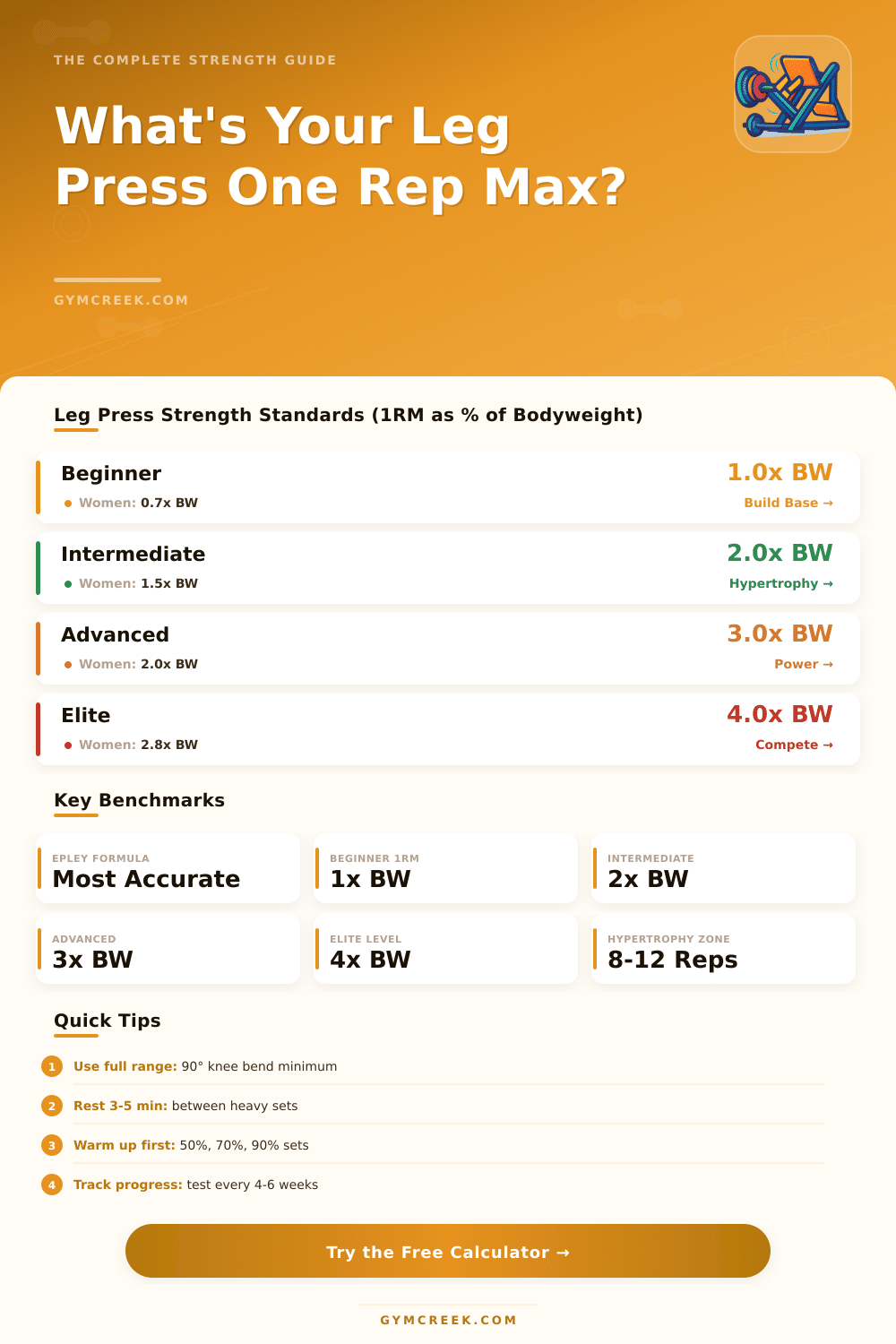
| Level | Men (x BW) | Women (x BW) | Training Focus |
|---|---|---|---|
| 🟢 Beginner | 0.8 – 1.2x | 0.5 – 0.9x | Form & Base Building |
| 🟡 Novice | 1.3 – 1.8x | 1.0 – 1.4x | Progressive Overload |
| 🟠 Intermediate | 1.9 – 2.5x | 1.5 – 2.0x | Hypertrophy & Strength |
| 🔴 Advanced | 2.6 – 3.5x | 2.1 – 2.7x | Peaking & Power |
| 🟣 Elite | 3.6x+ | 2.8x+ | Competition Prep |
| Reps | % of 1RM | Training Zone | Recommended Sets |
|---|---|---|---|
| 1 | 100% | Maximal Strength | 1–3 sets |
| 2 | 97% | Near-Maximal | 2–4 sets |
| 3 | 94% | Maximal Strength | 3–5 sets |
| 4 | 91% | Power / Strength | 3–5 sets |
| 5 | 87% | Strength | 3–5 sets |
| 6 | 85% | Strength-Hypertrophy | 3–4 sets |
| 8 | 80% | Hypertrophy | 3–4 sets |
| 10 | 75% | Hypertrophy | 3–4 sets |
| 12 | 70% | Hypertrophy-Endurance | 2–4 sets |
| 15 | 65% | Muscular Endurance | 2–3 sets |
| 20 | 60% | Endurance | 2–3 sets |
| Formula | Best For | Equation | Notes |
|---|---|---|---|
| Epley | General use, any rep range | w x (1 + r/30) | Most widely used |
| Brzycki | Low reps (1–10) | w x 36 / (37 - r) | Accurate for strength |
| Lander | Mid reps (5–15) | 100w / (101.3 - 2.67123r) | Good all-rounder |
| Lombardi | Higher reps (10+) | w x r^0.10 | Tends to overestimate |
The Leg Press is a compound exercise for moving weight with the body by means of the legs. It strongly works the quads, glute muscles, hamstrings and calves at the same time. Beyond simply building the muscles, that move helps to estimate the real force of your lower body overall.
DISCLOSURE: This post may contain affiliate links, meaning when you click the links and make a purchase, I receive a commission. As an Amazon Associate I earn from qualifying purchases.

It is an exercise on a machine that fits well into almost every training.
Leg Press: Muscles, Types and How to Do It
In most gyms you find two main kinds of Leg Press. The usual horizontal model is simple and efficient. Then comes the 45-degree version where the chair leans backwards at an angle and the legs move upward along a diagonal.
Some gyms have combined devices, that tie the Leg Press with hack squat in one unit. A really smart idea, when space is tight.
Here is what makes the machine so appealing: it handles all the balancing instead of you. Especially on a 45-degree device, the weight does not push against your body like it does during a squat. So most people can lift much more weight with the Leg Press than they ever could in a hack squat.
The device takes care of the stable part of the lift, so you can load it heavily without big worry. The downside? It can trick you into thinknig you are stronger than you really are.
The position is key here. Your heels stay flat on the foot plate during the whole move. Push with your hips and knees until you reach a comfortable, relaxed state.
But do not lock them fully, because that only stresses the joints for nothing. Your tailbone does not leave the chair, and the lower back does not arch too much. While you lower the weight, bend the knees flat until almost a 90-degree angle, moving slowly and carefully.
Make sure that your thighs do not press against the chest. Place the feet just like for a hack squat. If the standard model already goes well, try single-leg pressure as a good next step.
The Leg Press shines when you want big force in the legs without stressing the lower back. It allows you to add wait step by step through a wide range of motion, without your core having to hold the spine like in a squat. That makes it ideal for bodybuilding, especially for hitting the big leg muscles like the quads.
The quads bear the main load, but the glutes, adductors and soleus help as main movers. The hamstrings and calves work more as helper muscles.
The real secret comes when you control the lowering and burst upward, here is where the results are born. Chasing your old records helps you progress. Only remember that machines differ a lot in the curve of resistance and the actual range ofmotion, so do not compare numbers between different devices too much.