❤️ Heart Rate Zone & Lactate Threshold Calculator
Calculate your personalized training zones using age, resting heart rate & fitness level
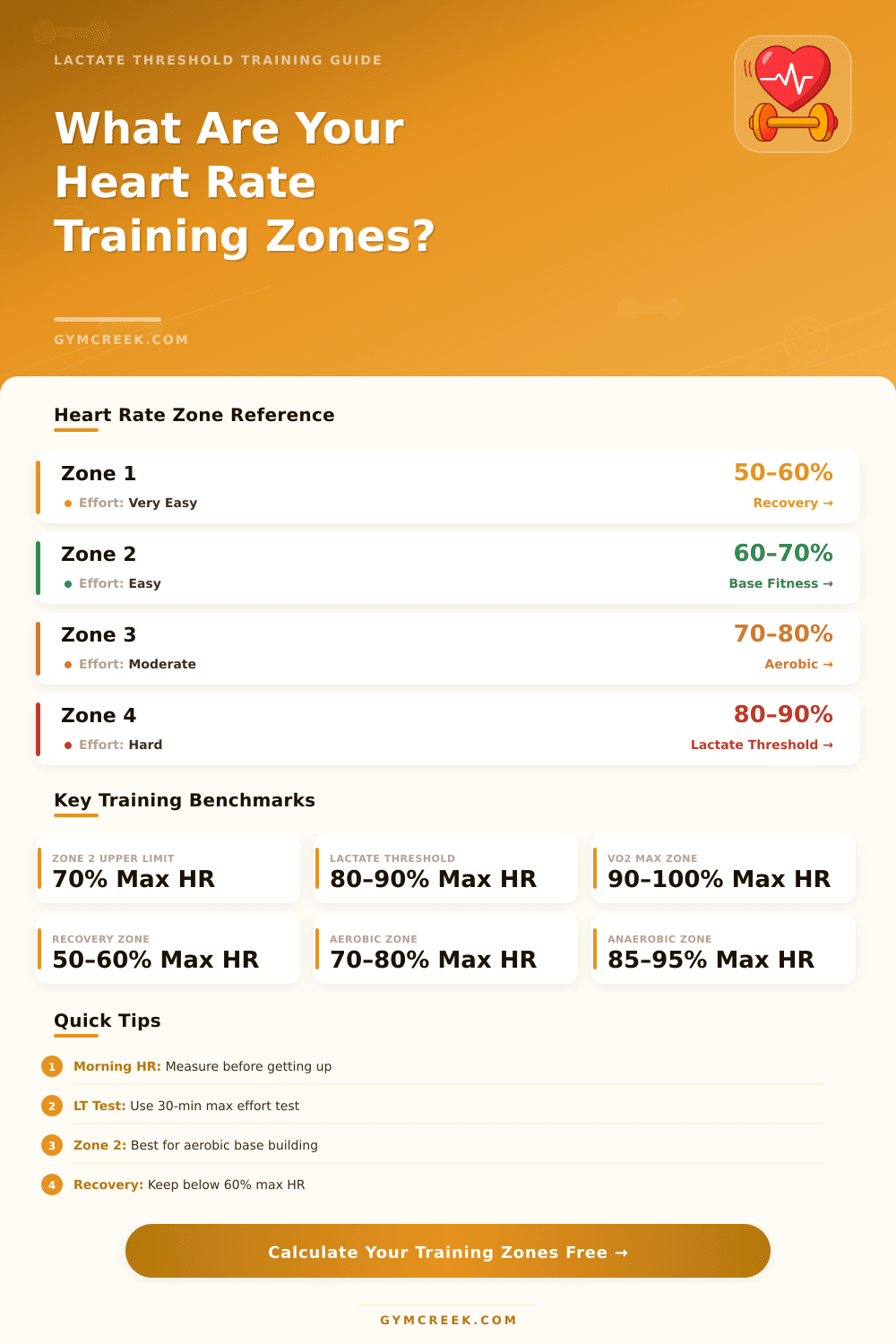
| Zone | Name | % Max HR | % HRR (Karvonen) | Perceived Effort | Primary Benefit | Typical Duration |
|---|---|---|---|---|---|---|
| Zone 1 | Recovery | 50–60% | 30–40% | Very easy — conversation easy | Active recovery, warm-up | 20–60 min |
| Zone 2 | Aerobic Base | 60–70% | 40–55% | Easy — can sing | Fat oxidation, aerobic base | 30 min–3 hrs |
| Zone 3 | Aerobic / Tempo | 70–80% | 55–70% | Moderate — short sentences | Aerobic efficiency, endurance | 20–90 min |
| Zone 4 | Lactate Threshold | 80–90% | 70–85% | Hard — words only | Raise LT, speed endurance | 10–50 min |
| Zone 5 | VO2 Max / Anaerobic | 90–100% | 85–100% | Maximum — unsustainable | VO2 max, speed, power | 30 sec–8 min |
| Fitness Level | LT as % Max HR | Typical RHR (bpm) | VO2 Max Estimate | Training Focus |
|---|---|---|---|---|
| Sedentary | 50–60% | 70–90 | 25–35 ml/kg/min | Zone 1–2 base building |
| Beginner | 60–70% | 65–80 | 35–45 ml/kg/min | Aerobic conditioning |
| Intermediate | 70–78% | 58–70 | 45–55 ml/kg/min | Zone 3–4 threshold work |
| Advanced | 78–85% | 50–65 | 55–65 ml/kg/min | LT intervals + polarized |
| Elite / Pro | 85–92% | 35–55 | 65–90+ ml/kg/min | Race-specific + VO2 max |
| Training Model | Zone 1–2 | Zone 3 | Zone 4–5 | Best For |
|---|---|---|---|---|
| 80/20 Polarized | 80% | 0% | 20% | Endurance athletes, runners |
| Pyramidal | 70% | 20% | 10% | Cyclists, triathletes |
| Threshold Model | 50% | 35% | 15% | Time-crunched athletes |
| High Volume Base | 90% | 8% | 2% | Beginners, base phase |
| HIIT Focused | 40% | 20% | 40% | Sprint, short events |
Talk Test: LT1 (aerobic threshold) is where conversation becomes uncomfortable. LT2 (anaerobic threshold) is where only 1–2 word answers are possible.
30-Minute Field Test: Warm up 10 min, then run/cycle at maximum sustainable effort for 30 minutes. Average HR over last 20 minutes = approximate LT2 heart rate.
RPE Scale: LT1 ≈ RPE 4–5/10; LT2 ≈ RPE 7–8/10.
Heart Rate Zone helps to understand how hard the heart works during physical exercise. There are five main zones for Heart Rate Zone and each of them offers different health benefits. Those zones are made up of ranges of heart rates, that show the effort that someone put in their workout.
DISCLOSURE: This post may contain affiliate links, meaning when you click the links and make a purchase, I receive a commission. As an Amazon Associate I earn from qualifying purchases.

A good program of exercise includes sessions in all those five levels.
What Are Heart Rate Zones
The usual way to estimate the maximum heart rate is 220 minus the age. For instance, folks of 50 years have around 170 beats per minute as upper limit. That calculation serves as a basic guide, even though use of such formulas for zones commonly gives too general and unreliable results.
The normal delay is about 12 beats per minute, so the actual range varies a lot between individuals. The most reliable way is testing in a lab on a treadmill. Also there are tests to estimate the Lactate Threshold and other measures.
Zone 1 involves 50 to 60 percent of the maximum Heart Rate Zone. It is the gentlest level and works well for warming or for newcomers in fitness programs. In Zone 2 the heart rate starts to rise a bit more.
That zone sits between 60 and 70 percent of the top. For some folks fast hiking reaches it, while others need an easy run. A simple method to check is the talk test.
If one can talk comfortably during the exercise, probably one is in Zone 2 or below.
In Zones 1 and 2 the body mainly uses fat along with a bit of glucose. When the intensity grows in Zones 3 to 5, the body reaches the limits of its aerobic skill and depends more on the burning way. Work with low heart rate burns wait well, because one can do it long and easily rest after it.
Zone 5 is the hardest and needs the most rest, so one spends here the least time. It covers 90 to 100 percent of the maximum and is saved for short bursts, like sprints.
For sports about endurance, like running or cycling, the general advice is to give around 80 percent of the workout to Zones 1 and 2, mostly to the second. The other 20 percent go to the higher levels 3 to 5. Heart Rate Zone can differ between various sports, so that cycling zones do not always match with those for swimming.
Counting the zones another way is to use the resting heart rate. One takes the resting rate from the maximum, multiplies by the wanted percent, and later adds the resting to get the target. Newcomers aim for the bottom part of their zone, around 50 percent, and slowly expand.
High heart rate is not needed for good training. Zones 0 to 1 are of low intensity, 2 to 3 medium, andabove 3 is high intensity.