💓 Heart Rate VO2 Max Calculator
Estimate your aerobic fitness level using your resting and max heart rate — no lab required
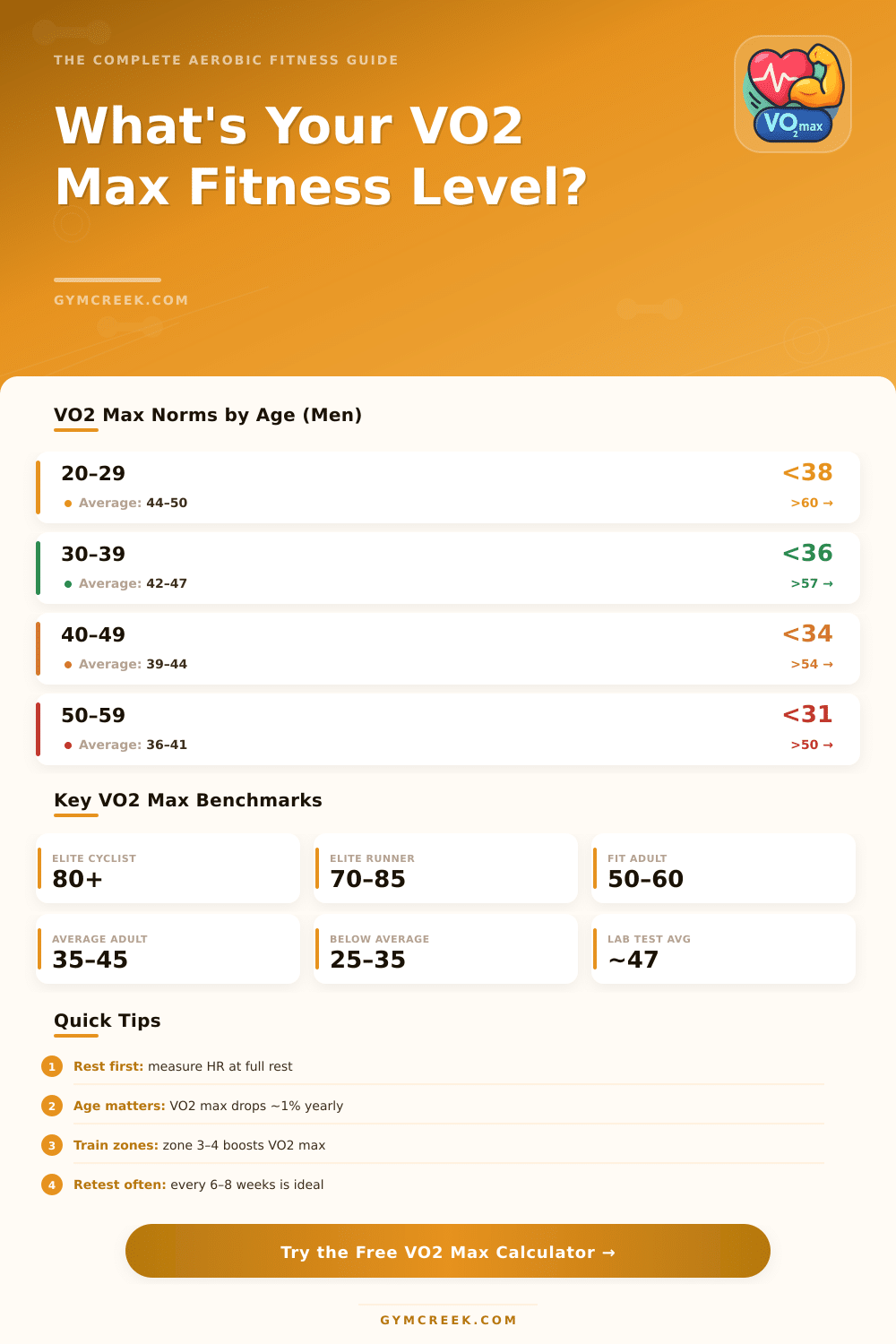
| Age Group | Very Poor | Poor | Fair | Good | Excellent | Superior |
|---|---|---|---|---|---|---|
| ♂ Males | ||||||
| 20–29 | <33 | 33–36 | 37–41 | 42–45 | 46–52 | >52 |
| 30–39 | <31 | 31–34 | 35–38 | 39–43 | 44–50 | >50 |
| 40–49 | <30 | 30–32 | 33–36 | 37–41 | 42–49 | >49 |
| 50–59 | <26 | 26–30 | 31–34 | 35–39 | 40–46 | >46 |
| 60–69 | <22 | 22–25 | 26–29 | 30–35 | 36–43 | >43 |
| ♀ Females | ||||||
| 20–29 | <28 | 28–31 | 32–35 | 36–39 | 40–45 | >45 |
| 30–39 | <27 | 27–30 | 31–33 | 34–37 | 38–44 | >44 |
| 40–49 | <25 | 25–28 | 29–31 | 32–35 | 36–42 | >42 |
| 50–59 | <22 | 22–25 | 26–28 | 29–32 | 33–39 | >39 |
| 60–69 | <19 | 19–22 | 23–26 | 27–30 | 31–37 | >37 |
| Sport / Profile | Typical VO2 Max | Sex | Notable Examples |
|---|---|---|---|
| Cross-Country Skiing | 80–96 mL/kg/min | Male | Bjorn Daehlie ~96 |
| Cycling (Road) | 78–88 mL/kg/min | Male | Greg LeMond ~92 |
| Marathon Running | 70–85 mL/kg/min | Male | Haile G. ~84 |
| Rowing | 60–75 mL/kg/min | Male | Olympic level |
| Swimming | 55–70 mL/kg/min | Male | Elite national level |
| Soccer / Football | 55–67 mL/kg/min | Male | Professional league |
| Cross-Country Skiing | 70–85 mL/kg/min | Female | Elite women |
| Marathon Running | 62–77 mL/kg/min | Female | Joan Benoit ~78 |
| Zone | % of Max HR | Effort Feel | Primary Benefit | VO2 Max Impact |
|---|---|---|---|---|
| Zone 1 – Recovery | 50–60% | Very easy | Active recovery | Minimal |
| Zone 2 – Aerobic Base | 60–70% | Conversational | Fat burning, endurance | Low–Moderate |
| Zone 3 – Tempo | 70–80% | Moderate, slightly hard | Aerobic capacity | Moderate |
| Zone 4 – Threshold | 80–90% | Hard, sustainable | Lactate threshold | High |
| Zone 5 – VO2 Max | 90–100% | Maximum effort | Max oxygen uptake | Very High |
VO2 Max is the biggest amount of oxygen that the body can absorb and use during physical activity. The words in the name explain quite a lot easily: V shows volume, O2 means oxygen, and max means maximum. It measures how much oxygen the body manages to pick, transport and consume during one minute.
DISCLOSURE: This post may contain affiliate links, meaning when you click the links and make a purchase, I receive a commission. As an Amazon Associate I earn from qualifying purchases.

Most tools present it as milliliters of oxygen for every kilo of body mass in one minute.
VO2 Max: What It Is and How to Improve It
Top level athletes, like swimmers, cyclists, runners and cross country skiers, commonly mention VO2 Max. It gives a fair way to measure the real skill of people. If VO2 Max is higher, that shows that the body more well takes oxygen from the air and delivers it to the muscles. The more oxygen the muscles receive during training the more easily one feels the exercise and the more long one can stay at a certain intensity.
VO2 Max is measured exactly only in a special lab for testing. For that you need special gear, expert workers and a mask fit for intense test, that gathers every bit of inhaled oxygen and exhaled carbon dioxide, usually during a treadmill test with increasing load. Smart watches estimate VO2 Max, but they are not always right.
Some of them can differ a lot compared to results from a lab.
The weight of the body seriously affects that value. One counts the oxygen that one consumes during 60 seconds, divided by kilos of body mass. So being slimmer commonly helps too reach a higher score.
Big people need stronger VO2 Max only to move their own weight at the same speed. Small and slim people with strong lung skill is the ideal for VO2 Max.
Genes, age and general health all limit the possibilities of VO2 Max. Even so almost every person can improve it with enough work near their aerobic limit. Training with high intensity and intervals are among the most efficient ways to raise it. Typical intervals last from one to six minutes, with same periods for work and rest, and one considers them good for VO2 Max. Also easy runs and interval runs well help.
Ranging the intensity during a run helps also.
Training in zone 2 alone does not raise VO2 Max. Its main goal is to build bigger heart and lung skill, so that the body later handles more severe sessions. When VO2 Max grows, the resting Heart Rate usually drops. At the same level of effort, the Heart Rate should be lower.
VO2 Max also serves as a strong sign for long life. If one is in the upper quarter of the general population, likely it will not limit the lifetime a lot. In home training older adults, that worked during nine months to a year, raised their VO2 Max on average by twenty percent.
Thatcounted equally for men and women.