🚴 Cycling Heart Rate Zone Calculator
Find your personalized training zones for smarter, more effective cycling workouts
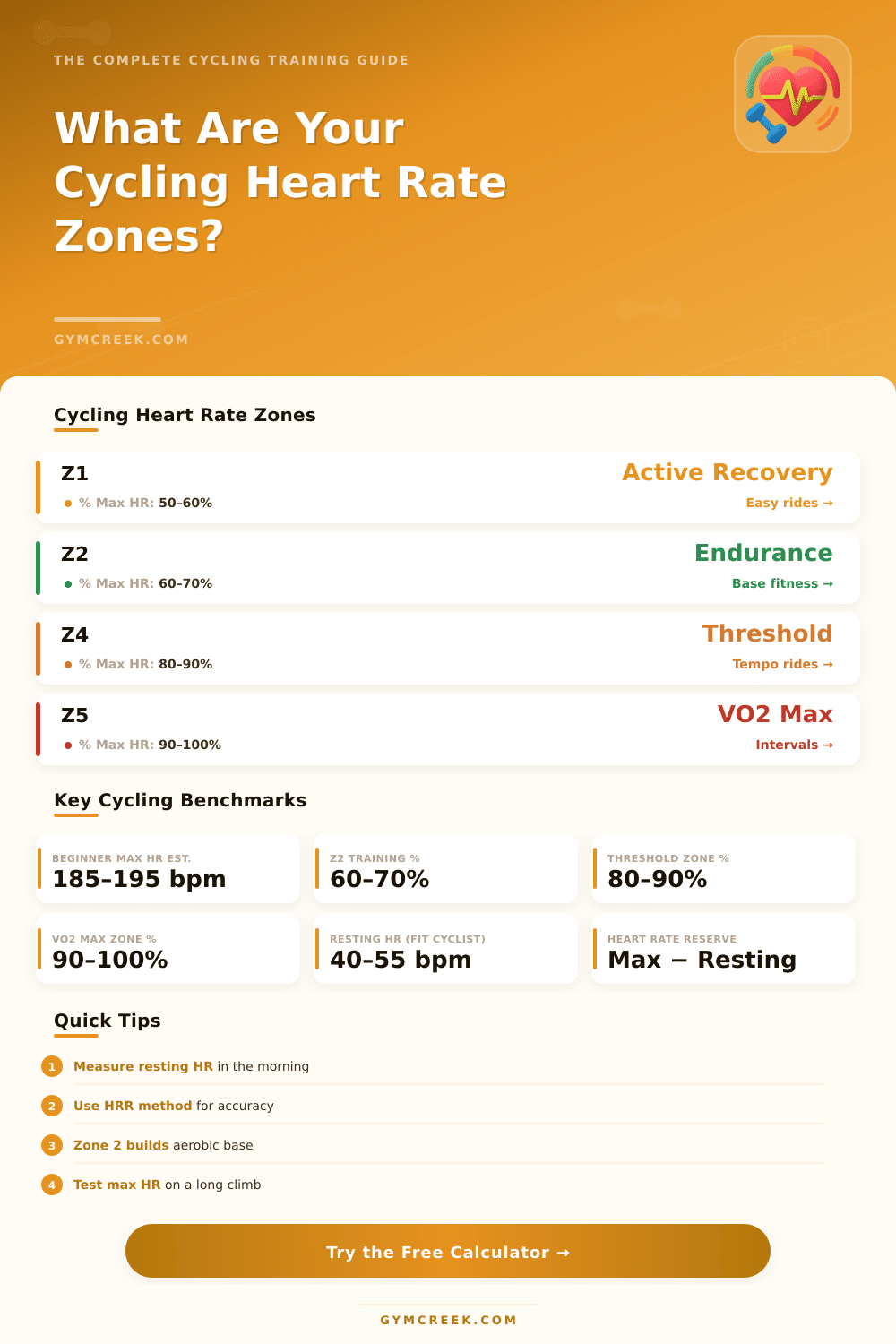
| Zone | Name | % Max HR | Effort Feel | Duration | Primary Benefit |
|---|---|---|---|---|---|
| Zone 1 | Active Recovery | 50–60% | Very easy, can sing | 30–90 min | Recovery, warm-up |
| Zone 2 | Aerobic Endurance | 60–70% | Comfortable, conversational | 1–6 hours | Aerobic base, fat burn |
| Zone 3 | Aerobic Tempo | 70–80% | Moderate, short sentences | 30–90 min | Aerobic capacity |
| Zone 4 | Lactate Threshold | 80–90% | Hard, few words only | 10–30 min | Threshold power |
| Zone 5 | VO2 Max / Anaerobic | 90–100% | Maximum, cannot speak | 1–8 min | Speed, VO2 max |
| Category | Resting HR (bpm) | Typical Profile | Implications |
|---|---|---|---|
| Athlete | 40–55 | Trained endurance cyclist | High cardiac efficiency |
| Excellent | 55–60 | Regularly active adult | Good cardiovascular fitness |
| Good | 60–70 | Moderately active | Average fitness level |
| Average | 70–80 | Sedentary adult | Room for improvement |
| Below Average | 80–100+ | Very sedentary / stressed | Consult a physician |
Heart Rate Zone groups are made up of groups of readings about heart pulse, that show the work level of the heart during physical activity. One measures them as a share of the maximum heart rate, that matches to the highest speed that the heart is able to reach. They help you adjust and change the intensity of your training, what makes them useful for building stamina and stopping overtraining.
DISCLOSURE: This post may contain affiliate links, meaning when you click the links and make a purchase, I receive a commission. As an Amazon Associate I earn from qualifying purchases.

There exist five zones of Heart Rate Zone numbered from one to five. A good training plan includes sessions in each of those zones. Zone 1 falls between 50% and 60% of the maximum heart rate.
Simple Guide to Heart Rate Zones
In it the intensity stays low, and you can easily chat. One uses this zone for warm-ups, cool-downs or simple workouts.
Zone 2 sits close to 60% to 70% of the maximum heart rate, with focus on burning of fat and boosting of stamina. Usually it matches with comfortable pace, where talk feels natural. For newcomers, building a base level by means of running at talking speed in that zone is a wise starting point.
Training in zone 2 makes the heart more efficient and expands the aerobic skill, what allows the body to last well and rest after more severe effrots.
Activity in 60% to 75% of the maximum heart rate sometimes is called the sweet spot of heart training (neither too easy), neither too heavy, but perfect. Zone 3 means middle intensity and helps to improve the blood flow in the heart and in the muscles of the body. Here also starts to build up lactic acid.
While zones 1 and 2 mainly depend on fat as fuel, zones 3 to 5 more use stored energy, when the aerobic system reaches its limit.
Zone 5 represents the highest levels of training. It requires the most rest time, so one spends hear only little of time. People that are not in good shape or have sat for a long time, maybe can not safely reach zones 4 and 5, but as the aerobic fitness grows, those targets become reachable.
The simple way to guess the maximum heart rate is 220 minus the age. For women, one uses 226 minus the age. The heart rate very much depends on the person and differs between folks.
Using the real maximum heart rate together with the resting heart rate gives more precise numbers for the zones than only age-based guesses. One way is to take the resting heart rate from the maximum, multiply by the wanted share, then add the resting heart rate to get the target.
For sports about stamina, like running, Cycling and triathlon, around 80% of the training should happen in zones 1 and 2, while the other 20% in zones 3 to 5. The zones of Heart Rate Zone can slightly differ between different sports. When the heart rate seems too low during training and the work feels too light, pushing a bit more strongly can help, especially for goals of weight loss.
Newcomers aim for the lower limit of their target zone andprogress upward over time.