🏋 Bench Press Percentile Calculator
Find out how your bench press compares to others your age, gender & bodyweight
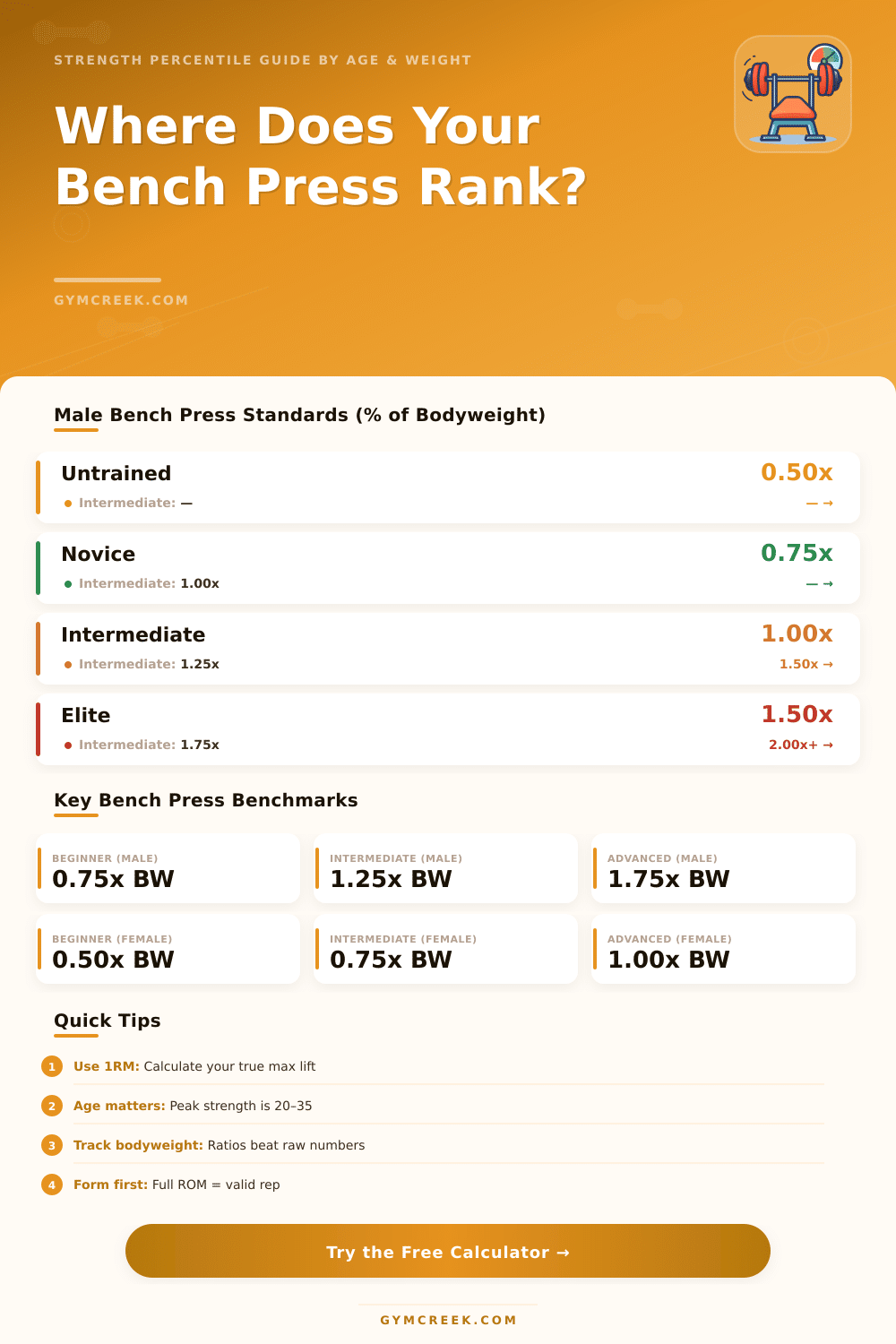
| Age Group | Untrained (<25th) | Beginner (25th) | Intermediate (50th) | Advanced (75th) | Elite (90th+) |
|---|---|---|---|---|---|
| 14–17 | <0.60x | 0.60x | 0.85x | 1.10x | 1.35x+ |
| 18–25 | <0.75x | 0.75x | 1.10x | 1.40x | 1.75x+ |
| 26–35 | <0.80x | 0.80x | 1.15x | 1.45x | 1.80x+ |
| 36–45 | <0.75x | 0.75x | 1.05x | 1.35x | 1.65x+ |
| 46–55 | <0.65x | 0.65x | 0.95x | 1.20x | 1.50x+ |
| 56–65 | <0.55x | 0.55x | 0.80x | 1.05x | 1.30x+ |
| 65+ | <0.45x | 0.45x | 0.65x | 0.90x | 1.10x+ |
| Age Group | Untrained (<25th) | Beginner (25th) | Intermediate (50th) | Advanced (75th) | Elite (90th+) |
|---|---|---|---|---|---|
| 14–17 | <0.30x | 0.30x | 0.50x | 0.70x | 0.90x+ |
| 18–25 | <0.40x | 0.40x | 0.65x | 0.85x | 1.05x+ |
| 26–35 | <0.45x | 0.45x | 0.70x | 0.90x | 1.10x+ |
| 36–45 | <0.40x | 0.40x | 0.65x | 0.85x | 1.00x+ |
| 46–55 | <0.35x | 0.35x | 0.55x | 0.75x | 0.90x+ |
| 56–65 | <0.28x | 0.28x | 0.48x | 0.65x | 0.80x+ |
| 65+ | <0.22x | 0.22x | 0.40x | 0.55x | 0.70x+ |
| Reps | % of 1RM | Example (135 lbs) | Example (185 lbs) | Example (225 lbs) |
|---|---|---|---|---|
| 1 | 100% | 135 lbs | 185 lbs | 225 lbs |
| 2 | 97% | 139 lbs | 191 lbs | 232 lbs |
| 3 | 94% | 144 lbs | 197 lbs | 239 lbs |
| 4 | 92% | 147 lbs | 201 lbs | 245 lbs |
| 5 | 89% | 152 lbs | 208 lbs | 253 lbs |
| 6 | 86% | 157 lbs | 215 lbs | 262 lbs |
| 8 | 81% | 167 lbs | 228 lbs | 278 lbs |
| 10 | 75% | 180 lbs | 247 lbs | 300 lbs |
| 12 | 70% | 193 lbs | 264 lbs | 321 lbs |
| 15 | 65% | 208 lbs | 285 lbs | 346 lbs |
Full range of motion counts: A valid bench press rep means the bar touches your chest and arms fully lock out at the top. Partial reps will inflate your number.
No belt or board: For standard percentile comparison, use a flat barbell bench press without board pressing or bouncing the bar off your chest.
1RM vs. rep max: If you've never maxed out, use your heaviest set and number of clean reps — the calculator will estimate your 1RM using the Epley formula.
The bench press is exercise with weights, in that one pushes the weight upward, while one stays lying on a bench. It is made up of sitting on the bench and pushing of weight by means of a bar or pair of dumbbells. One lowers the weight until the level of the chest later pushes it upward while one extends the arms.
DISCLOSURE: This post may contain affiliate links, meaning when you click the links and make a purchase, I receive a commission. As an Amazon Associate I earn from qualifying purchases.

That move is combined, so it works several muscles at the same time. The main muscles, that it works, is the big chest muscle, the front shoulder muscles and the triceps.
How to Do the Bench Press
The bench press ranks between the best exercises for building muscle and force in the upper body. Although it mainly targets the chest, it also trains the shoulders, triceps and the core. It creates a pushing moment at the elbow, what simply wants to say, that the muscle force on the bones works as levers for pushing the weighr upward.
For good position on a flat bench, the bar should rest directly above the eyes, if an assistant is ready, or above the nose and mouth area, if not. The feet stand flat on the floor, and the back with the upper back need be firmly pressed against the bench. It is important to pull the shoulders by means of pushing them down in the position.
One draws the shoulder blades back, and the back stays tight during the whole lift. Do not let the back and chest loosen near the bottom of the move; that is a mistake, that many make.
Smith machine can serve also for bench press. Place the body like this, that the paths of the bar pass above the middle chest four lowering. The shoulders stay pressed down and drawn back, while the forearms stay lined up with the path of the bar.
Dumbbells form a good replacement for the bar. They work the two sides of the chest separately, what is an advantage, because a bar can allow, that one side works more than the other. On the other hand, usually one can raise less weight by means of dumbbells, because of the more unstable movement.
Doing bench press three times weekly, with different sets of repetitions and high amount, is a useful way. It matters more to use controlled repetitions than go heavy with bad technique. Even lowering the weight controlled can give better training results, if the exercise happens correctly.
For muscle growth, a range of eight until a dozen of repetitions per set works well. Change the routine of bench press by means of different sets, repetitions and weights, to pass plateaus.
Using different angles for bench press, one reaches the chest from several directions. The incline bench press with a bar and the decline with dumbbells match well with the possible options. Decline pressing commonly works the chest well.
Incline pressing helps the triceps and front deltas. Interestingly, the weight, that one can raise on flat or decline, is similar, but for incline one usually must lower the weight. Exercises like overhead pressing and JM presses give better transfer to the bench press than simple tricepspushdowns.
Weak moments during the lift show, that muscles need more training. Failing halfway shows weak deltas, while failing from the chest points to weak chest or back muscles.