🚗 Anti Squat Calculator
Calculate your suspension's anti squat percentage for optimal traction & handling geometry
✅ Anti Squat Results
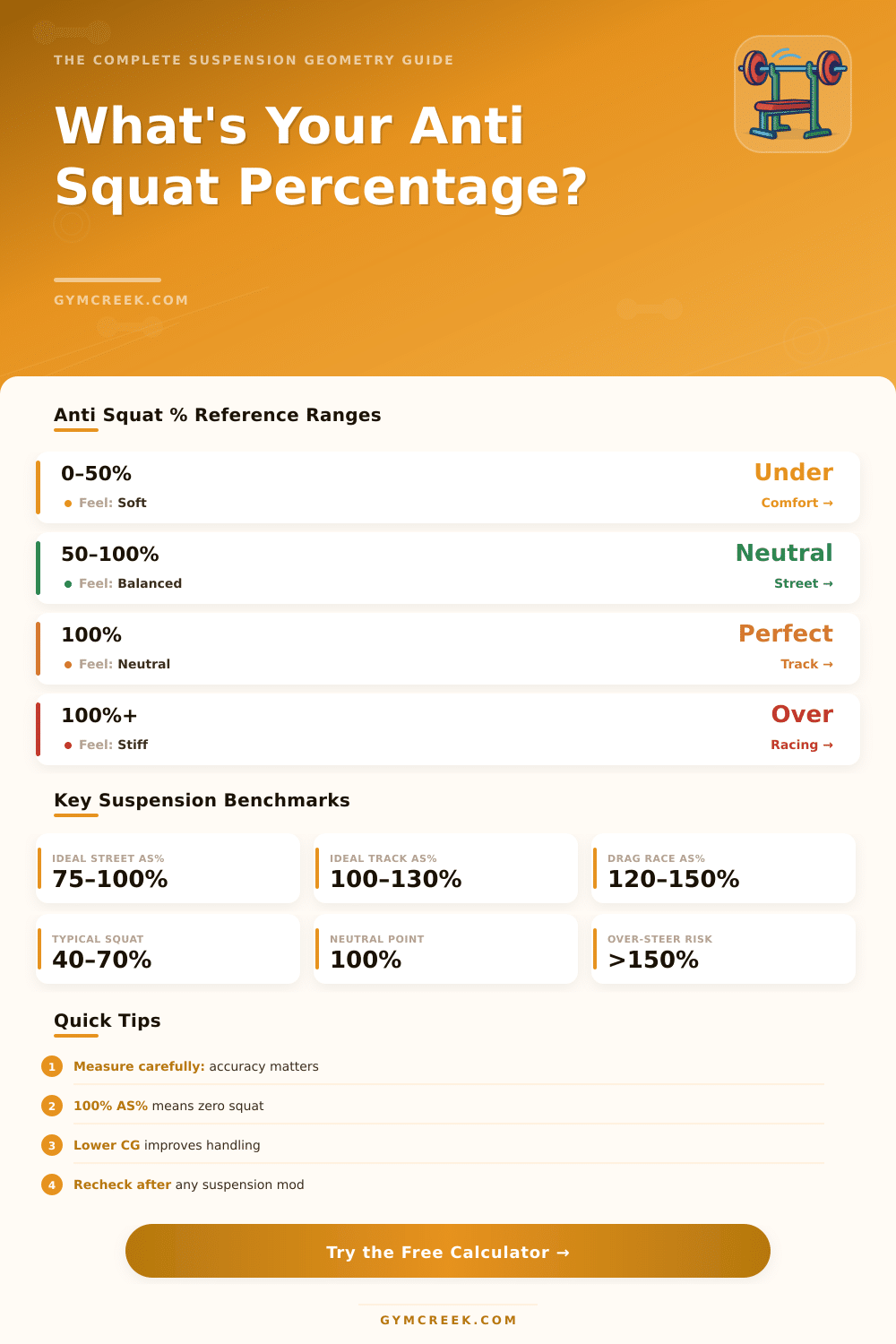
| Anti Squat % | Behavior | Handling Feel | Typical Use Case | Notes |
|---|---|---|---|---|
| < 0% | Pro-Squat | Very soft rear, excessive dive | Not recommended | Rear suspension compresses hard under acceleration; reduces traction |
| 0 – 50% | Under Anti Squat | Soft, weight transfer rearward | Comfort / Luxury | Some squat under acceleration; acceptable for comfort builds |
| 50 – 75% | Moderate Anti Squat | Balanced, mild squat | Daily Driver | Most factory street cars fall in this range |
| 75 – 100% | High Anti Squat | Stable, minimal squat | Performance Street | Good traction with comfortable ride quality |
| 100% | Perfect Anti Squat | Zero body movement (neutral) | Track / Competition | All acceleration forces cancel body roll; ideal geometry point |
| 100 – 130% | Over Anti Squat | Slight front lift under accel | Track / Drag | Improves rear traction; can induce understeer |
| 130 – 150% | High Over Anti Squat | Notable front rise | Drag Racing | Maximum rear traction; harsh ride; not street appropriate |
| > 150% | Extreme Over Anti Squat | Aggressive front lift | Specialized Racing | Risk of instability; oversteer tendency; expert tuning required |
| IC Height | IC Distance (from rear axle) | Approx. AS% | Application |
|---|---|---|---|
| -10 in / -254 mm | 100 in / 2540 mm | ≈ 40–55% | Soft comfort / luxury |
| -5 in / -127 mm | 110 in / 2794 mm | ≈ 60–75% | Daily driver / OEM |
| 0 in / 0 mm | 120 in / 3048 mm | ≈ 80–90% | Performance street |
| +5 in / +127 mm | 130 in / 3302 mm | ≈ 95–105% | Track day / autocross |
| +10 in / +254 mm | 140 in / 3556 mm | ≈ 110–125% | Road racing |
| +15 in / +381 mm | 150 in / 3810 mm | ≈ 130–145% | Drag racing |
| Vehicle Type | Typical F/R Split | CG Height (in) | Recommended AS% |
|---|---|---|---|
| Sports Car (RWD) | 50/50 – 48/52 | 16–18 | 90–110% |
| Sedan / Coupe (FWD) | 60/40 – 65/35 | 17–20 | 70–90% |
| Muscle Car (RWD) | 52/48 – 58/42 | 18–22 | 85–105% |
| Pickup Truck (4WD) | 55/45 – 60/40 | 24–30 | 60–80% |
| Formula / Open Wheel | 42/58 – 45/55 | 10–13 | 100–130% |
| Drag Car (RWD) | 40/60 – 35/65 | 14–18 | 120–150% |
| Rally / Off-Road | 50/50 – 55/45 | 22–28 | 65–85% |
| AWD Performance | 50/50 | 16–19 | 90–115% |
You commonly hear the word anti-Squat thrown around in discussions about suspension… Whether for car, motorcycle or even RC-buggy. In short it deals with the behavior of the back suspension when the engine pushes power to the wheels.
DISCLOSURE: This post may contain affiliate links, meaning when you click the links and make a purchase, I receive a commission. As an Amazon Associate I earn from qualifying purchases.

When you press the gas, the back part naturally dips down, and the anti-Squat design helps to resist that trend.
What Is Anti-Squat and How It Works
Here is what happens mechanically. During acceleration the weight moves backwards, which presses the back suspension down… Similarly to when one end of a swing drops because of added mass.
Anti-Squat systems fight that by redirecting the forces through the control arms and suspension links, instead of allowing them to directly compress the shocks or columns. The result? The springs carry less burden, so that the height of the vehicle stays more stable when you strongly boost.
Various elements decide how much anti-Squat you genuinely have. Among them are the length and position of the back swing arm. Also matter the wheelbase of your ride and the place of the center of gravity.
In 100% anti-Squat, the tail keeps its original height during pushing. Pass that, and the back will raise itself while slowing. A great advantage of this geometry based approach is that you can use different soft springs without losing in otehr areas.
In drag racing, this is totally key. Especially with radial tires, the percentage of anti-Squat directly defines how well the suspension shifts weight to the contact surface during launch. Everything that leads to better traction and to a more steady feeling of your launches.
Motorcycles apply anti-Squat a bit differently. The force of the chain extends the back suspension during acceleration, which presses the rear wheel flat to the road and strengthens the traction. The pull of the chain around the sprocket naturally wants too raise the wheel upward.
Adjusting the front sprocket lets you control exactly the strength of that effect.
In the world of RC, anti-Squat depends on the angle of the back inner hinge pin. If the front part is higher than the back, and the angles tilt backwards, that gives anti-Squat. Tilt it the other way results in Squat effect.
This geometry change also affects the front-back tilt of the buggy and reduces the travel of the shocks on rough tracks during driving.
But there are limits. Too much anti-Squat can cause the suspension to start binding up because of the geometry itself or because of the extra forces through it. Interestingly, vehicles with a lot of Squat commonly perform well off road, rock crawlers and desert runners usually have all that.
The real challenge comes on street during hard braking. Most street systems aim around 50% anti-Squat as the best level. The XJ-SC has anti-dive and anti-Squat inboth ends.
Note: anti-Squat counts only for rear wheel drive, because it builds on those acceleration forces.