Pilates Calorie Burn Calculator
Estimate Pilates calorie burn from style, duration, body weight, mat versus reformer setup, spring load, and interval density so a calm core tune-up does not read like a jumpboard push block.
📌Session Presets
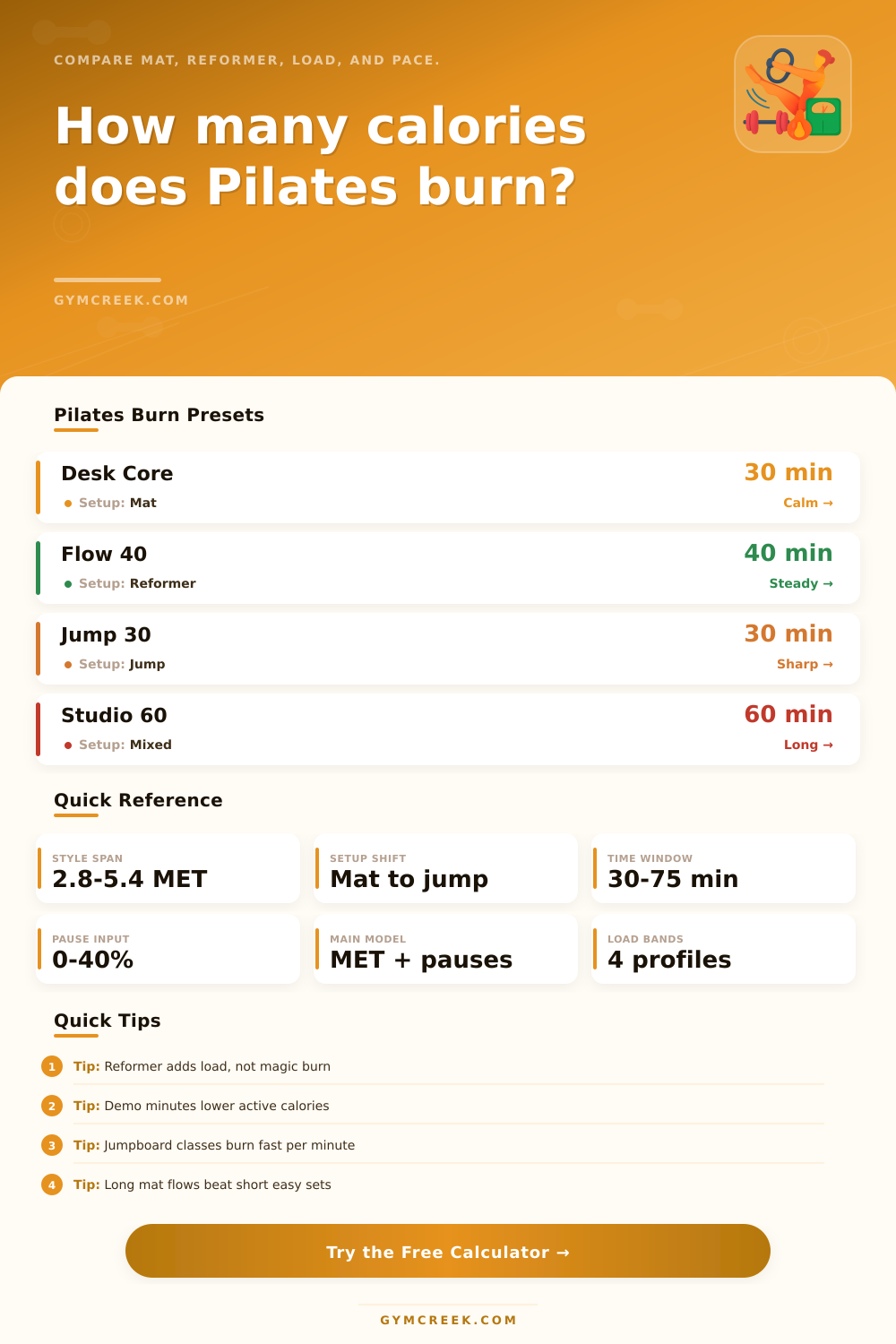
These nine presets compare quiet mat resets, classical sequencing, loaded reformer work, and jumpboard bursts so setup choice and class density can change the calorie estimate for believable reasons.
⚙Pilates Inputs
Pilates calorie snapshot
Enter your class details to estimate active movement calories and the effect of pauses.
📊Pilates Metrics
📑Reference Tables
| Duration | Total kcal | Active kcal | Read |
|---|---|---|---|
| 30 min | --- | --- | Quick |
| 45 min | --- | --- | Base |
| 60 min | --- | --- | Long |
| 75 min | --- | --- | Studio |
| Style | Base MET | Focus | Typical pace |
|---|---|---|---|
| Rehab control | 2.8 | Alignment and breath | Slow and precise |
| Classical mat | 3.4 | Traditional sequence | Steady flow |
| Contemporary flow | 4.0 | Continuous core chain | Fluid studio pace |
| Sculpt Pilates | 4.8 | Hybrid strength bias | Firm blocks |
| Athletic circuit | 5.4 | Cardio-core push | Fast repeat sets |
| Setup | Factor | Motion cue | Best fit |
|---|---|---|---|
| Mat session | 1.00x | Grounded props | Home or studio mat |
| Reformer session | 1.10x | Carriage tension | Spring resistance work |
| Mixed apparatus | 1.08x | Tower or chair swaps | Longer studio blocks |
| Jumpboard reformer | 1.22x | Rebounds and presses | Cardio-biased sessions |
| Lever | Factor | What changes | Best fit |
|---|---|---|---|
| Spacious resets | 0.90x | Longer demos and re-sets | Rehab or new clients |
| Coached flow | 1.00x | Normal studio rhythm | Most group classes |
| Continuous chain | 1.09x | Few full-stop breaks | Intermediate flows |
| Station intervals | 1.18x | Timed work bouts | Athletic circuits |
| Light assist | 0.92x | More support than drive | Mobility sessions |
| Moderate load | 1.00x | Baseline spring tension | General classes |
| Firm tension | 1.08x | Heavier push and pull | Strength-biased work |
| Power drive | 1.15x | Jumpboard or heavy legs | Higher-output blocks |
💡Pilates Tips
Pilates are a form of physical exercise that uses different apparatus and methods to move the body. Due to the nature of Pilates exercises, the calorie estimate given to individuals with fitness trackers may not be accurate after the exercise class. The nature of Pilates include different styles of exercise, different apparatus to use for the exercise, and different amount of rest in the exercise.
Each of these factor can influence the number of calories burned during Pilates. One of the factors that can influence the number of calories burned during Pilates is the type of apparatus used. For example, mat Pilates classes will burn less calories than those using a reformer.
What Affects Calories Burned in Pilates
The reason for this difference in calorie burn is that mat exercises use only the bodys weight to exercise, while reformer exercises use the spring on the exercise apparatus to provide resistance to the individuals movement. Jumping on a jumpboard attached to the reformer will increase the intensity of the exercise, therefore burning more calorie during that exercise than the individual would burn on the reformer alone. Another of the factors that can influence the number of calories burned during Pilates is the density of the exercise.
Density is the amount of time that an individual is performing exercises in comparison to the amount of time that they are on a break from the exercises. Most Pilates exercise classes include long period of rest for the individual. Thus, the less dense the exercise class is, the fewer calorie will be burned.
High density exercises will burn more calories than low density exercises. Individuals must take into account the difference between active movement and downtime during exercise. The third factor that will influence the number of calories burned during Pilates is the body weight of the individual performing the exercise.
An individual that weigh 180 pounds will burn more calories during a Pilates exercise class than an individual that weighs 150 pounds. This factor is applicable to all form of Pilates, including mat, reformer, and jumpboard exercises. Additionally, the amount of time that an individual participate in Pilates will influence the total amount of calories burned during that time.
However, the intensity and density of the exercise will determine whether a short exercise session can be more effective for the individual than a longer session. Pilates comes in different style, each of which can burn a different amount of calories. For instance, restorative Pilates may use fewer calories than athletic Pilates.
Restorative exercises are used to aid in recovery of the bodys muscle, while athletic Pilates increases the intensity of the exercise to improve the strength and flexibility of those muscle. Therefore, using athletic Pilates will burn more calories than restorative Pilates. These exercise styles can be accounted for when individuals plan they exercise routine.
Due to the factors discussed above, individuals should not solely rely on the total amount of calories that is accounted for by their fitness trackers. Most fitness trackers dont account for the nuances of Pilates exercise. For instance, fitness trackers may account for standing or walking for active movement, but standing in a Pilates class isnt an active exercise.
To accurately track the number of calories burned during Pilates exercises, the apparatus, the style of Pilates, and the amount of time spent in active movement should be accounted for. By understanding each of these factors, individuals can choose the type of Pilates exercise that best support their individual goals.