
A one-rep max, also known as a 1RM, are the amount of weight you can lift one time. A one-rep max is an important measurement for fitness because it provides the baseline from which you can create your training program. Using the one-rep max measurement, you can calculate a amount of weight that you should lift during your training program.
By knowing your one-rep max, you can train with purpose and certainty regarding the weights that you should use. In order to find your one-rep max, you must perform a warm-up first. During the warm-up, you will gradually increase a weight that you are lifting.
How to Find and Use Your One-Rep Max
After performing sets with heavy weights, you should allow yourself time to rest so as not to strain your muscles or burn out too quickly. If you feel that attempting to lift a one-rep max would be too risky for your current state of conditioning, you can estimate your one-rep max instead. In order to estimate your one-rep max, you will perform sets with some weight and use the mathematical formula.
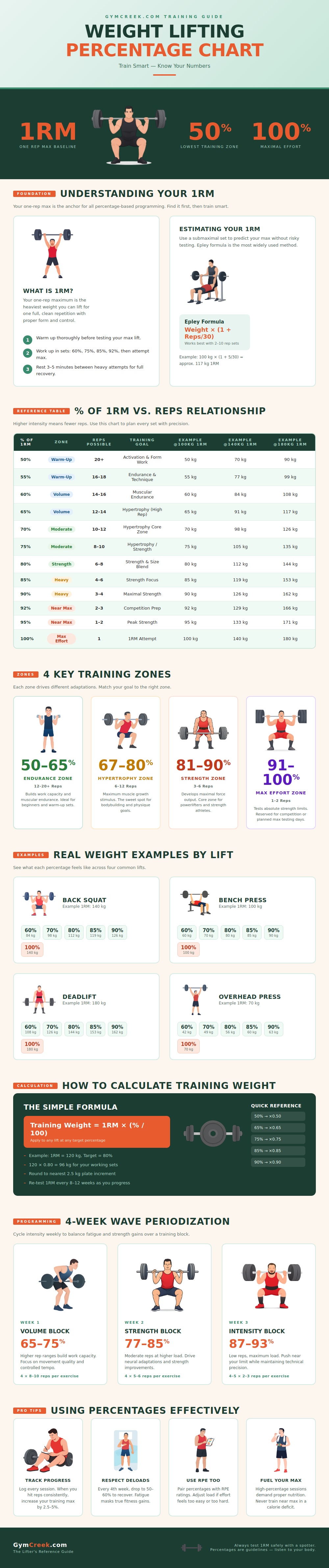
For instance, if you can lift a certain weight for several repetitions, you can multiply that weight by one and add a number of repetitions that you performed. Divide that number by thirty and you will have an estimated one-rep max. If an individual can lift 100 kilograms five repetitions, an individual will have an estimated one-rep max of 117 kilograms. Using this formula allows an individual to begin training without having to risk failing to lift a weight.
Once an individual has established their one-rep max, there is different percentages of that one-rep max that can be used for different purposes. For instance, if an individual trains with approximately fifty percent of their one-rep max, a individual will be able to increase their muscular endurance. If an individual trains with weights that are approximately seventy-five percent of their one-rep max, that individual will be able to increase the size of their muscles through a process known as hypertrophy.
If an individual trains with loads that are close to their one-rep max, they will be able to increase their raw strength. As a percentages of the one-rep max increase, a number of repetitions that an individual can lift with those weights will decline. These percentages of an individuals one-rep max can be used to allow the individual to achieve specific fitness goals.
If an individual uses percentages of their one-rep max for low percentages, the individual will be able to build their capacity to perform muscular work. Beginners in the world of lifting can benefit with this type of training. Using the percentages of a one-rep max in a middle range allows an individual to increase the size of their muscles.
For most individuals, increasing the size of their muscles is their primary fitness goal. If an individual trains with percentages of their one-rep max that are high, they will be increasing their absolute strength. For powerlifters, whose primary goal is to be able to lift massive weights, this type of training is essential.
An individual should train with each of those percentage ranges over time. For instance, beginners may train with low percentages for a while before moving into more intense training for those who have trained for a longer period of time. This same type of percentage calculation can be used for any type of lift that you may perform, such as squats, bench presses, or deadlifts.
If an individual can lift 140 kilograms in squat sets, an individual would lift 84 kilograms for endurance sets (which is fifty percent of one-rep max), and 112 kilograms for strength and size (which is eighty percent of one-rep max). If an individual lifted 126 kilograms (which is ninety percent of one-rep max), they would be performing pure strength sets for their squat exercises. Using percentages of one-rep max ensures that an individual does not lift too much weight or too little weight to achieve there desired goals. In order to calculate a amount of weight that you should lift during your training sessions, multiply your one-rep max by the percentage that you wish to train with.
If you have a one-rep max of 120 kilograms and you want to lift eighty percent of your one-rep max, you will lift 96 kilograms during your training. Under normal circumstances, an individual should re-test their one-rep max every few months because a individual’s strength can change over time. In order to accurately track training programs with percentages of one-rep max, individuals must have up to date information regarding their strength.
In order to create the most effective training program for an individual, an individual should cycle through different types of training for that individual. For instance, an individual can begin a training block with high volume and low percentages of one-rep max. Following this initial period of training, the individual can train with weights of moderate strength. Finally, with a end of the training block, the individual should train with high percentages to develop raw strength.
Including a deload week, which involves lighter training for a period of time, can help an individuals muscles to recover and to avoid injury. An individual should track their training sessions. When an individual can lift a particular weight for several repetitions, they should increase a training max for that lift.
In order to lift heavy weights for an extended period of time, an individual needs to consume sufficient calories each day. When an individual is lifting heavy weights in the gym, they should always use a spotter to increase their safety during these sessions.
