Bicycle Crank Length Calculator
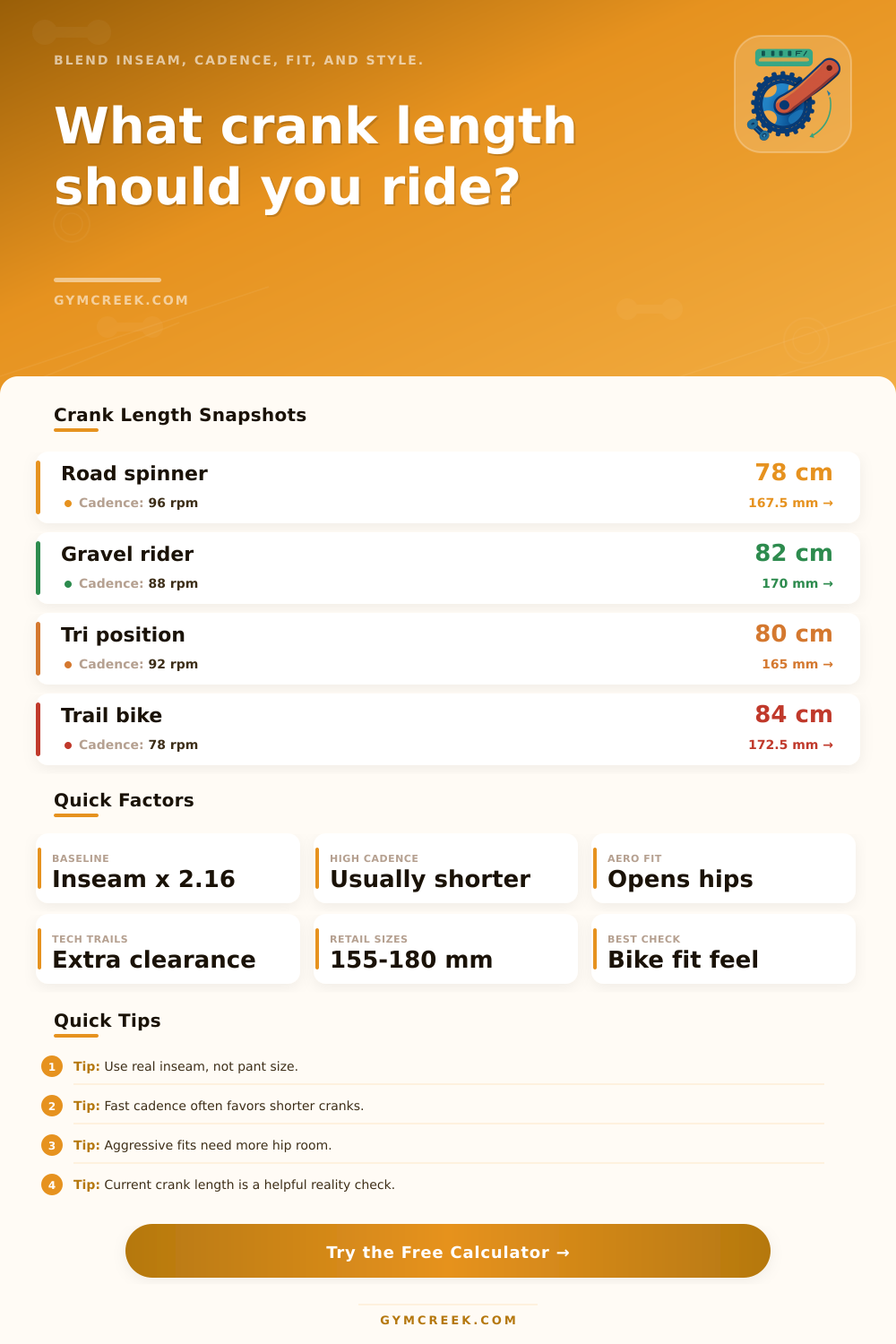
Estimate a sensible crank length from inseam first, then nudge the answer with riding style, cadence, posture, mobility, and comfort so the number feels believable on an actual bike fit.
Rider Presets
Each preset reflects a real riding context so you can contrast road, gravel, tri, trail, touring, and sprint setups without re-entering every field.
Fit Inputs
Crank length recommendation
Enter rider details to estimate a practical crank range.
Crank Metrics
Reference Tables
Inseam baseline before riding-style adjustments
| Inseam | Baseline | Common size | Read |
|---|---|---|---|
| 72-76 cm | 156-164 mm | 160-165 mm | Smaller road or city fit |
| 77-81 cm | 166-175 mm | 167.5-172.5 mm | Middle of the market |
| 82-86 cm | 177-186 mm | 172.5-177.5 mm | Tall rider, still often capped shorter |
| 87-92 cm | 188-199 mm | 175-180 mm | Retail sizes become the real limit |
How riding style pushes the number
| Style | Bias | Why | Typical call |
|---|---|---|---|
| Road endurance | 0 mm | Balanced comfort and speed | Stay near baseline |
| Road race / gravel | -2.5 mm | More leg speed and clearance | Slightly shorter |
| Triathlon / TT | -7.5 mm | Aero posture closes the hip angle | Noticeably shorter |
| Trail / enduro | -5 mm | Pedal clearance matters | Shorter for control |
| Track sprint | +2.5 mm | Torque focus can reward leverage | Slightly longer |
Cadence and fit cues
| Context | Shorter cue | Longer cue | Reason |
|---|---|---|---|
| Cadence | 95+ rpm | Below 80 rpm | Fast turning prefers easier leg travel |
| Posture | Aggressive and low | Upright and relaxed | Hip closure changes top-of-stroke room |
| Mobility | Limited hips | Open hips | Shorter cranks reduce compression |
| Comfort | Knee or hip pressure | No limiter | Complaints usually pull shorter first |
Common retail crank sizes
| Size | Where it appears | Who often likes it | Note |
|---|---|---|---|
| 160 mm | Small road, tri, custom fits | Short inseams and fast spinners | More available now than before |
| 165 mm | Small frames and aero builds | Shorter riders or hip-limited fits | Useful step down from 170 |
| 167.5 mm | Road and gravel OE spec | Many mid-height riders | Easy middle ground |
| 170 mm | Most stock complete bikes | Average adult fit | Most common retail pick |
| 172.5 mm | Larger road and MTB builds | Taller neutral-fit riders | Still easy to source |
| 175 mm | Big frames, MTB, track | Longer legs or lower cadence riders | Less forgiving in tight hip angles |
| 177.5-180 mm | Niche or custom setups | Very tall riders only | Check pedal clearance carefully |
Fit Tips
Crank length is a measurement between the center of the bottom bracket and the center of the pedal spindle. Crank length affect how a person pedals there bicycle, and crank length can also affect in what way a person feel any physical discomfort in they knees or hips. If a person uses a crank length that is incorrect to their body, they may feel pain in their joints.
However, if a person uses a crank length that is appropriate to they body, they may experience more comfort while they ride their bicycles. One of the primary factor that must be considered in determining the appropriate crank length for an individual is their inseam. By calculating the inseam of an individual, that person can determine their baseline crank length.
How to Choose the Right Crank Length for Your Bike
Furthermore, by knowing their inseam, they can also calculate the length of their crank arms. Inseam is one measurement that is used to find the appropriate length of crank arms for each individual, but it isnt the only measurement that is used. For example, another consideration for crank length is the cadence at which an individual pedal.
Individuals that have high cadences may require crank length that are shorter than those with lower cadences. By pedaling at high speeds, individuals with high cadences will experience shorter recovery period between each revolution of their bicycle wheels. In addition to inseam and cadence, another consideration for individuals when determining their crank length is their riding posture.
For instance, individuals that have high levels of hip compression while riding their bicycles may experience less discomfort with shorter crank lengths. Shorter crank lengths will allow for the hips to have a greater angle in relation to the ground, which will reduce the chance of discomfort cause by pinching of the hips. However, individuals that have an upright riding posture may require longer crank lengths to provide the leverage necessary for powerful pedals.
Many bicycles comes with standard crank lengths of 170 mm. Lengths of 170 mm are common for bicycles because this length of crank arms will fit many individuals with average inseam length. However, individuals with shorter inseams may benefit from 160 mm or 165 mm crank lengths.
Additionally, individuals with longer inseams may benefit from crank lengths of 175 mm to provide increased power for climbing mountain or hills. Finally, if any individual changes the length of their bicycle crank arms, they will change the position of each pedal relative to the ground. Additionally, altering the length of their crank arms will also impact the height of the bicycle saddle.
For instance, shorter crank lengths will require the individual to raise the height of the saddle to maintain the same length of extension of their leg. Body proportions are another factor to consider when setting the length of crank arms that are to be installed on a bicycle. For instance, an individual with a long inseam relative to their total body height may have different requirements for crank length different than an individual with a short inseam in relation to their total body height.
An individual with a short inseam relative to their body height may be better with shorter crank lengths to increase their comfort relative to the rest of their body. An individual with a long inseam relative to their total body height may prefer longer crank lengths to increase their leverage with the pedals on their bicycle. To accurately determine inseam length, an individual’s inseam should be measured in millimeters while barefoot and with their feet resting on the floor of their house to their pubic bone.
If the inseam is measured while wearing any pair of pants, the measurement will be incorrect. Riding style is also another consideration in the determination of the length of the crank arms that should be installed on an individual’s bicycle. For instance, individuals that compete in triathlons may have shorter crank lengths on their bicycles to avoid the discomfort in their hips that can develop while maintaining the aerodynamic position require to compete in these races.
Additionally, individuals that sprint on the bicycle track may have longer crank lengths on their bicycles to provide the necessary torque required to sprint quick. Finally, mountain bike riders may desire shorter crank lengths so that their pedals will not repeatedly hit rocks while riding on the path that they take. Finally, in determining the length of the crank arms for an individual, there are many factor that must be considered.
For instance, inseam length, cadence, and posture are three factors that the individual should of consider. Additionally, other factors to consider include the individual’s riding style and mobility of their joints. Finally, the last factor to consider is the ability of the individual to test each potential crank length through test ride on a bicycle.
Testing the bike at all speeds and while performing sprints will allow an individual to determine if a specific length of crank arms is comfort for that individual.